
Some links in this article are affiliate links. If you buy through them, we may earn a commission at no extra cost to you.
Your scooter is in the flat, and the deck feels hot. A scooter battery does not fail without warning — and the first 60 seconds decide whether it is a scare or a fire. This guide is general information, not medical or fire-service advice — but the actions in it are the ones the fire services teach, and the order matters. Read the warning signs now, while nothing is wrong, so the first 60 seconds are a routine you already know.
In this guide
- 💡 The short answer
- 🔬 What swelling actually is
- 🚨 The six warning signs — any ONE of them means stop
- ⏰ The first 60 seconds — in order
- 📍 Where to put it in a flat — and where never to put it
- 🔥 If it is smoking, or it catches fire
- 📦 After it is over — getting rid of the pack
- 🔋 Whose battery — the seven scooters, and their pack sizes
- 🛡 So you never need this article again
- 📚 Related reading
- ✅ The bottom line
💡 The short answer
Any ONE of the six warning signs means stop using it immediately. Unplug the charger if it is safe to do so, and move the WHOLE scooter outside onto concrete or tile, away from anything that can burn. If it is smoking, hissing or burning — get everyone out, close the doors behind you, call 911 from a safe distance, and do not go back for it.
🔬 What swelling actually is
A lithium battery is a stack of thin cells, and swelling is gas building up inside them. The gas comes from the cells breaking down — heat, a manufacturing defect, a hard knock, or a charger that overcharged them — and the sealed pack has nowhere for the gas to go, so the pack bulges. A swollen pack is a pack that has already failed. It may never catch fire. It may catch fire in the next minute. There is no way to tell which one it is, and that is why a swollen pack is treated as an emergency, not a repair.
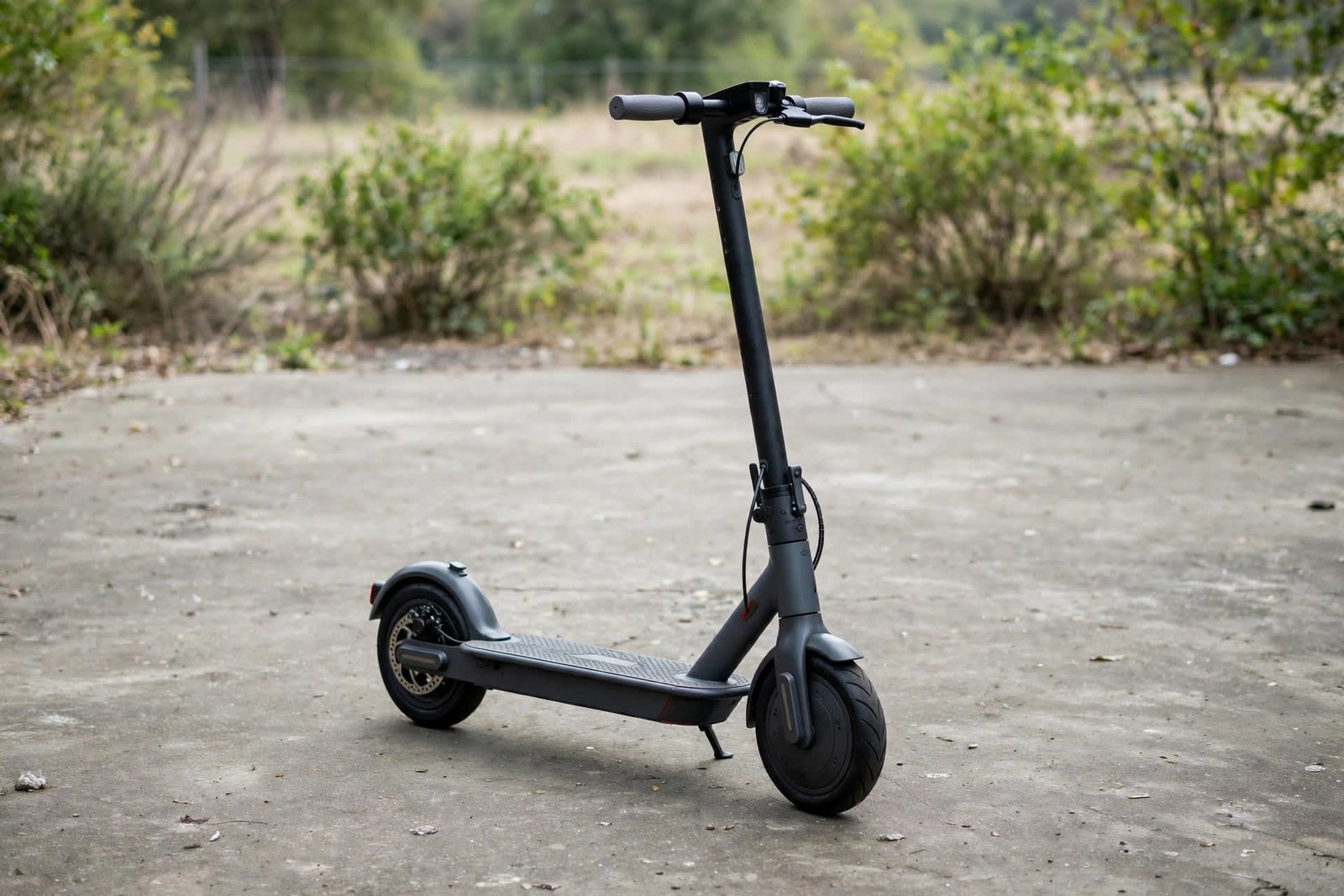
The scooter difference is the deck. An e-bike’s battery slides out of its frame and goes on concrete alone — our e-bike guide, Your E-Bike Battery Is Swelling, Smoking or Hot? What to Do in the First 60 Seconds, is built around that move. A scooter’s battery is bolted under the deck — on the Segway MAX it takes 18 security screws to open the base plate — so it does not come out in an emergency, and it does not come out at all without tools. The whole scooter moves, not the pack. And the whole scooter weighs 30 to 54 lb.
What causes it is usually one of four things. Age: a battery that has done hundreds of charge cycles is closer to the end of its life, and swelling is how the end looks. Heat: a pack left in a hot car, or charged in a room above 105°F, ages faster. Damage: a hard knock or a crash can crack a cell inside the pack, and the damage shows up weeks later as swelling. And overcharging: a wrong charger, or a charger left on long after the battery was full, pushes the cells past their limit. Three of the four are preventable — and the fourth is the reason for the weekly check.
🚨 The six warning signs — any ONE of them means stop
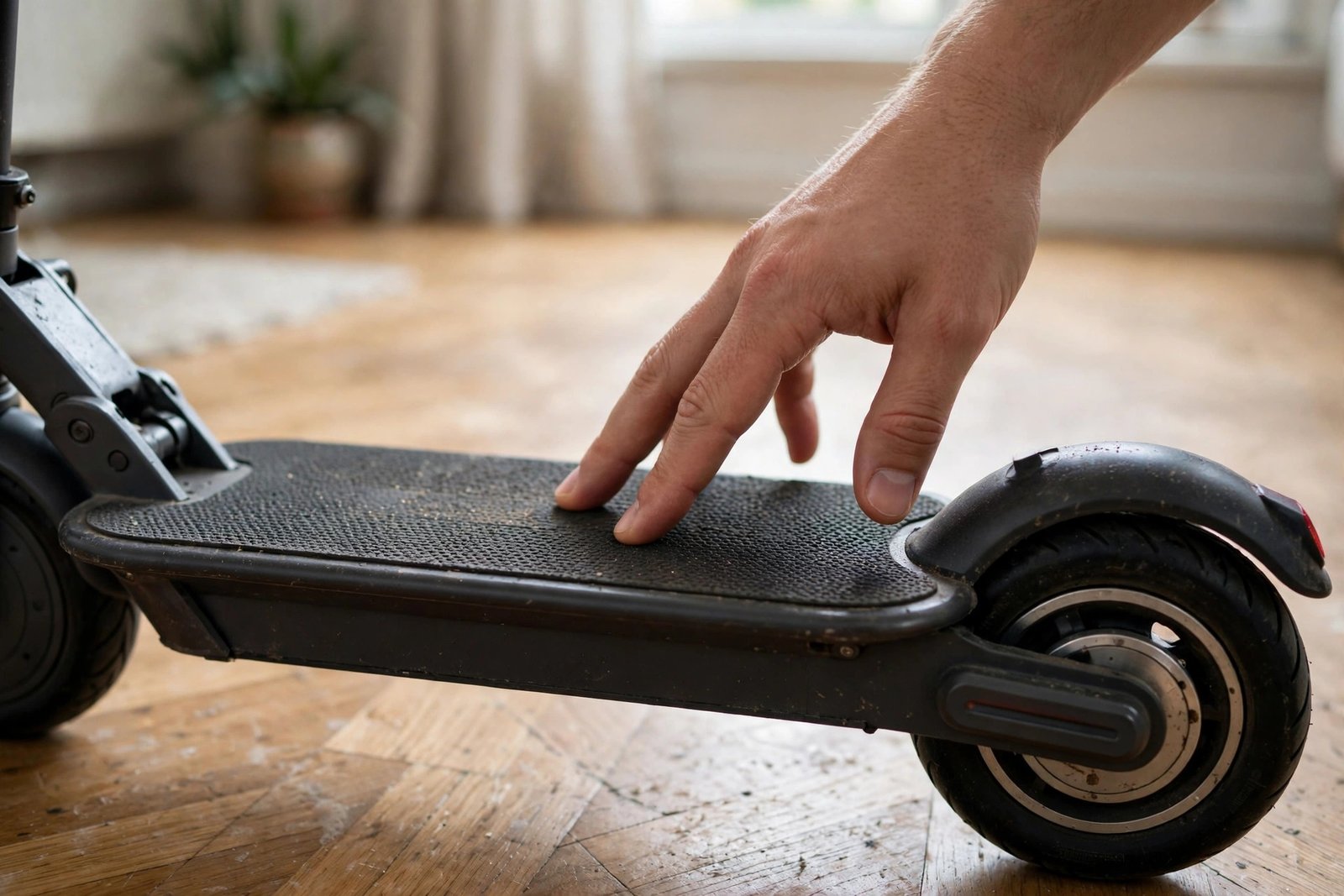
- Hot to the touch. The deck feels warm after a ride — that is normal. The deck feels hot, too hot to keep your hand on it, hours after the ride or while it is sitting still — that is not normal. A battery that is hot when it should be cool is a battery in trouble.
- Swollen or bulging. The deck does not sit flat any more, or the base plate bows out, or the scooter rocks on a flat floor where it used to sit level. A swollen pack pushes the deck out of shape, and the shape is the warning. If the deck looks different from the day you bought it, stop using it.
- A chemical or burning smell. A sharp, sweet, chemical smell, or the smell of burning plastic, coming from the deck — especially while it is charging. A battery has no smell when it is healthy. Any chemical smell is a warning.
- Popping, cracking, or hissing. Small sharp sounds from inside the deck, or a steady hiss like a leaking tyre. A hissing battery is a battery venting gas, and a venting battery is a battery about to fail.
- Leaking or discoloured. Any liquid on or under the deck, or a dark stain spreading across the base plate, or a patch of the deck that has changed colour. A leaking pack is a failed pack, and the liquid is corrosive — do not touch it with bare hands.
- Smoke. Any smoke at all, from the deck or the charging port, in any amount. Smoke is not a warning sign — it is the emergency itself, and the next section is the one that applies.
Check after a crash, too. A hard knock or a drop can crack a cell inside the pack without leaving a mark on the outside, and the damage shows up weeks later as swelling or heat. After any crash — even a small one, even if the scooter looks fine — put your hand on the deck, look at it from the side, and smell it while it charges for the next week. A crash you ignore is a warning sign you missed.
⏰ The first 60 seconds — in order
- Second 0 to 10: stop using it. Turn the scooter off. Do not ride it, do not charge it, do not plug anything into it. A battery that has shown a warning sign does not get one more ride to see if it clears up.
- Second 10 to 20: unplug the charger — if it is safe to do so. If the scooter is charging, pull the charger plug from the wall first, then from the scooter — and only if you can do it without touching the deck or the pack. If the deck is hot, smoking, or hissing, do not touch it at all: skip this step and go straight to the next one.
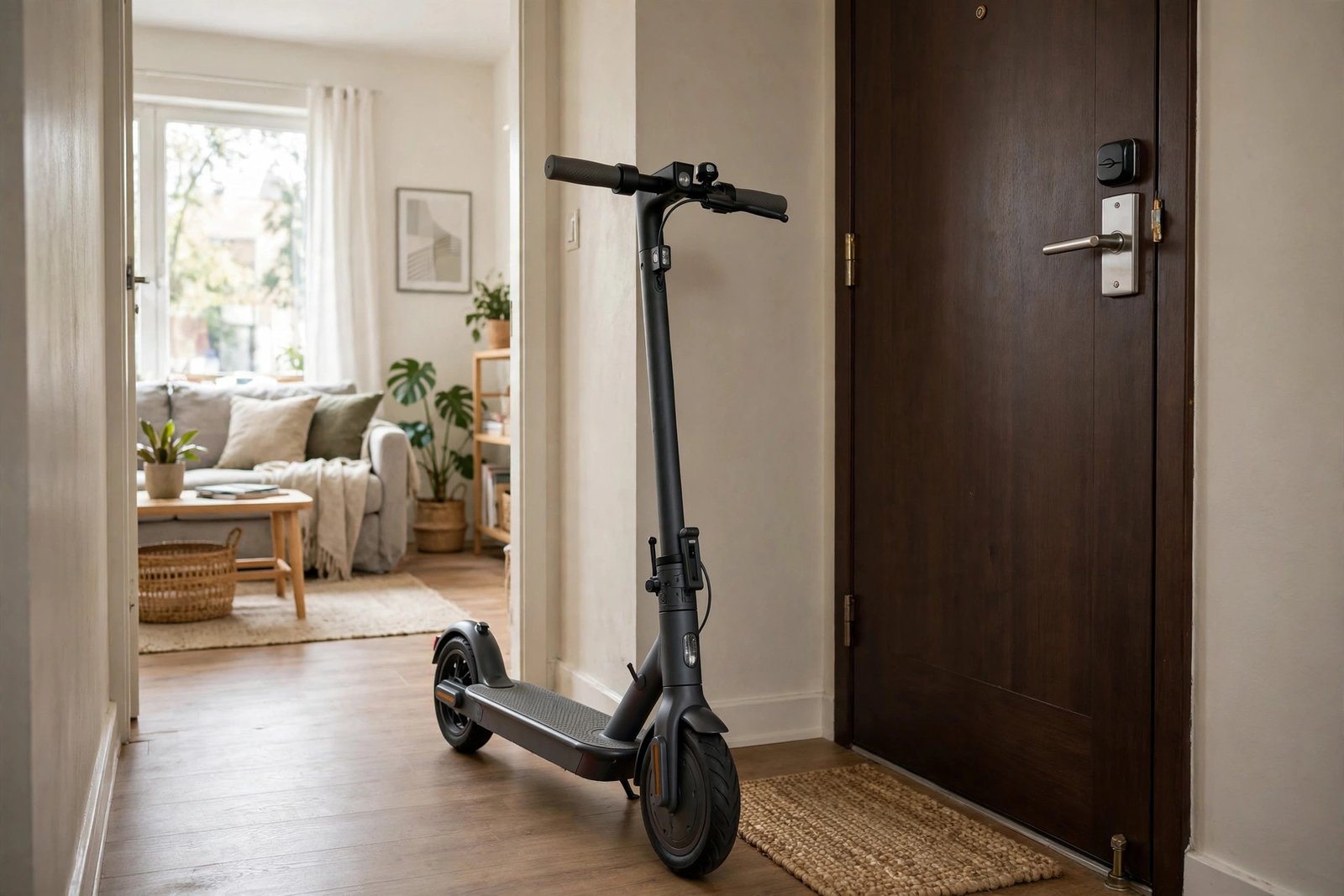
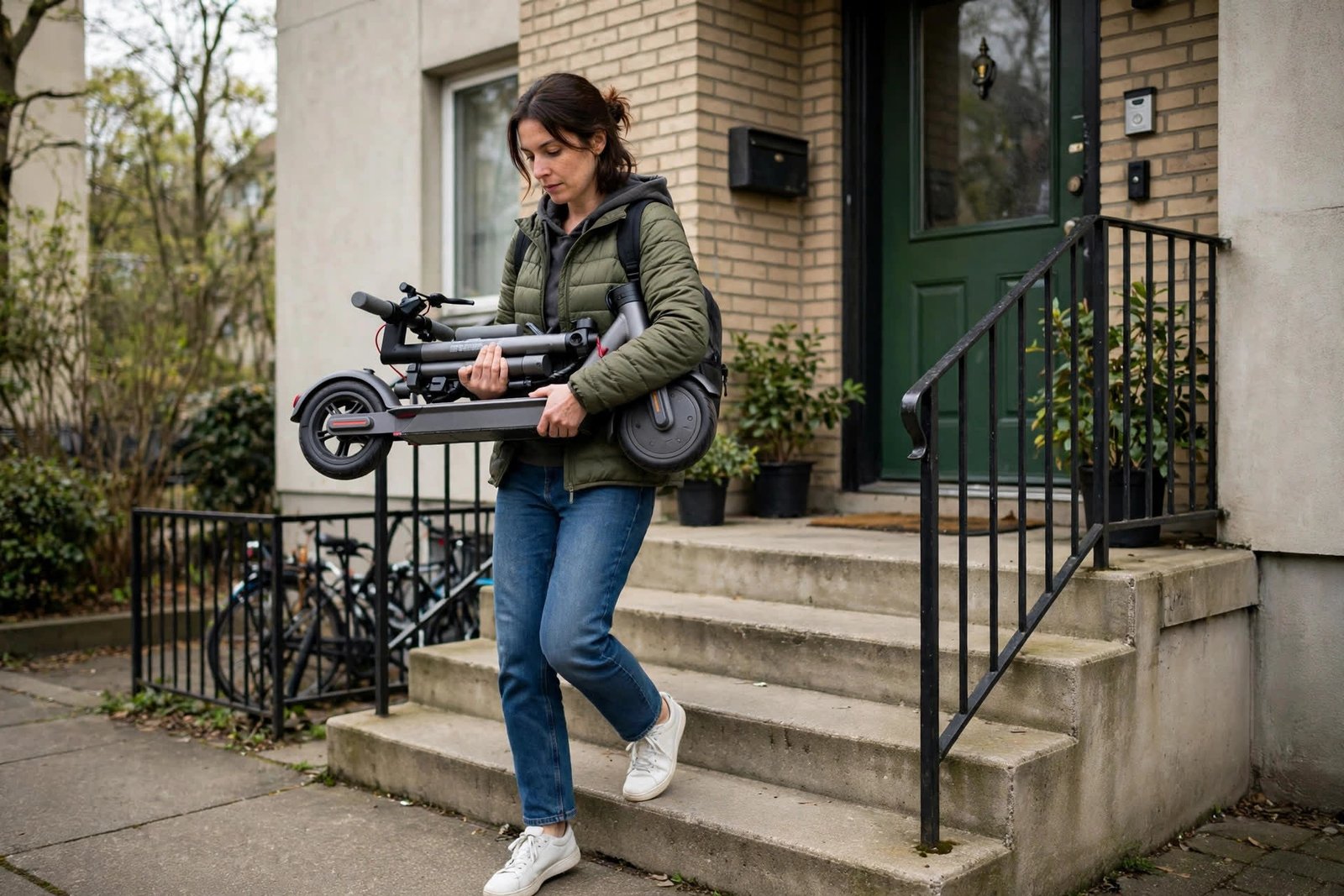
- Second 20 to 60: move the WHOLE scooter outside. Fold it if it folds, pick it up by the stem — never by the deck — and carry it outside onto concrete or tile, away from anything that can burn: away from the building, away from cars, away from dry leaves and bins. Do not put it in the hallway, do not put it on the balcony, and do not put it in the lift. The hallway is your escape route, the balcony is enclosed, and the lift is a metal box — none of them is outside.
📍 Where to put it in a flat — and where never to put it
Outside, on concrete or tile, is the only right answer. A bare concrete patio, a tiled courtyard, the pavement away from the building — somewhere the scooter can sit alone, on a surface that will not burn, with nothing above it and nothing beside it. Leave it there, and leave it alone: do not go back to check on it every few minutes, and do not bring it back inside because it looks calm.
Where never to put it: never in the hallway, because the hallway is the escape route for everyone in the building, and a battery that catches fire in the hallway traps them. Never on the balcony, because a balcony is enclosed on three sides and the fire has nowhere to go but into the flat. Never in a cupboard, a bedroom, or the boot of a car — a swollen pack in an enclosed space is a fire in an enclosed space. And never near an exit: the battery must never charge near an exit, and a failing battery must never sit near one either.
🔥 If it is smoking, or it catches fire
If the scooter is smoking, hissing, or burning, the first 60 seconds are different — and shorter. Do not try to move it. Do not try to unplug it. Do not try to put it out.
Get everyone out. Leave the flat, take everyone with you, and do not stop for anything — not the scooter, not a bag, not a pet you would have to go back for. Close the doors behind you: a closed door slows a fire more than anything else you can do.
Call 911 from a safe distance. Call from outside the building, or from a neighbour’s flat — never from inside the flat with the smoking scooter. Tell the dispatcher it is a lithium battery fire, and tell them where the scooter is.
Do not go back for it. A lithium fire does not behave like a wood fire: it can flare up again after it looks out, and the smoke is toxic. Never try to fight a lithium fire with a household extinguisher — it will not stop thermal runaway, and standing next to a burning battery is the most dangerous place to be. The scooter is replaceable. You are not.
📦 After it is over — getting rid of the pack
A swollen pack is recycled at a certified lithium drop-off, never in the trash, and never back into service. A swollen battery does not heal, and a pack that swelled once will swell again — there is no repair, no reset, and no second chance. Search for a certified lithium battery drop-off near you — your council, your local hardware store, or a battery recycling programme — and take the whole scooter, not just the pack, because the pack does not come out.
The replacement decision is a separate question, and it has its own maths: whether a new pack is worth it depends on the scooter’s age, the pack’s cost, and what the scooter is worth — and our replacement guide works through it with the 40% rule. A swollen pack on a scooter worth less than the pack is a new scooter, not a new pack. But that decision comes later, when the scooter is safe outside and the emergency is over — not in the first 60 seconds.
Tell the maker, too. If the scooter is still under warranty, a swollen pack is a warranty claim — report it to the seller or the manufacturer, with photos, before you dispose of the pack. A swollen pack on a new scooter is a defect, not wear and tear, and the maker needs to know about it. Keep the photos and the receipt: if the pack ever caused damage, they are the record.
🔋 Whose battery — the seven scooters, and their pack sizes
| Scooter | Battery | Weight | Price |
|---|---|---|---|
| Segway Ninebot MAX G3 | 597Wh | 54.2 lb | Check latest price |
| Segway Ninebot MAX G2 | 551Wh | 53.5 lb | Check latest price |
| Hiboy S2 MAX | 557Wh | 40 lb | Check latest price |
| Hiboy S2 Pro | 418Wh | 37.4 lb | Check latest price |
| HopCycle Electric Scooter | 281Wh | 31.5 lb | Check latest price |
| Segway Ninebot E2 Pro | 275Wh | ~41 lb | Check latest price |
| Segway Ninebot E2 Plus | 220Wh | ~31.7 lb | Check latest price |
A bigger battery is a bigger emergency, not a different one. The MAX G3’s 597Wh pack holds nearly three times the energy of the E2 Plus’s 220Wh pack, and a fire in a bigger pack burns longer — but the response is the same for every scooter in this table: stop, unplug if safe, move the whole scooter outside, and if it is smoking, get out and call 911. The pack size changes the stakes. It does not change the first 60 seconds.
🛡 So you never need this article again
Check the deck every week. Put your hand on it after a ride and after a charge: warm is normal, hot is not. Look at it from the side once a month: if the deck does not sit flat, stop using it. Smell it while it charges: a healthy battery has no smell.
Charge it the way the fire services say. With the charger that came with the scooter, straight into a wall outlet, on a hard surface, where you can see it — never overnight, never near an exit, never below 32°F or above 105°F, and never a battery that is swollen, hot, or damaged. Our apartment charging guide, Can You Charge an E-Bike Battery Inside Your Apartment? The Honest Safety Answer, explains the rules in full — they apply to a scooter’s battery exactly as they apply to an e-bike’s.
Use only the charger that came with the scooter. A wrong charger — a different voltage, a different plug, a cheap replacement — is the most common cause of overcharging, and overcharging is one of the four causes of swelling. If the charger is lost or damaged, buy the maker’s own replacement, not the cheapest one that fits.
And never buy a used scooter without checking the battery first. A used scooter’s pack has a history you cannot see, and the battery test — charge to 100%, ride to 50%, compare — is the check that catches a dying pack before you pay for it. A cheap scooter with a swollen battery is not a bargain. It is an emergency you bought.
📚 Related reading
- Your E-Bike Battery Is Swelling, Smoking or Hot? What to Do in the First 60 Seconds
- Can You Charge an E-Bike Battery Inside Your Apartment? The Honest Safety Answer
- Buying a Used Electric Scooter Checklist Before You Pay
- Electric Scooter Battery Replacement: When It’s Worth It
✅ The bottom line
A scooter battery does not fail without warning — and the first 60 seconds decide whether it is a scare or a fire. Any one of the six signs means stop using it immediately. Move the whole scooter outside onto concrete. And if it is smoking or burning, get everyone out, close the doors, call 911, and do not go back for it. The scooter is replaceable. You are not.
Previous: Article #94 “How to Ride an Electric Scooter in Summer Heat (Battery, Tyres, and the 105°F Rule)”
Next: Article #96 “How to Ride an Electric Scooter at Night (Lights, Visibility, and the Legal Minimum)