
Some links in this article are affiliate links. If you buy through them, we may earn a commission at no extra cost to you.
Heat is the battery’s other enemy — and on a scooter the battery is under the deck, so the whole scooter comes inside. An e-bike’s battery slides out of its frame and cools on its own; a scooter’s battery is bolted under the deck, and it does not come out. That one difference changes the whole summer routine: the scooter comes inside to cool, the deck decides when it charges, and the tyres get checked before the ride, because heat raises pressure.
In this guide
- 💡 The short answer
- 🔥 What heat does to the battery
- 🔢 The three numbers that decide it
- 📉 How much range you lose in the heat
- ✋ The deck rule — the touch-test
- 🏠 The apartment routine — the whole scooter comes inside
- 🛞 Tyres in the heat — pressure rises, so check before the ride
- 📊 The worked examples — seven scooters, and their water ratings
- 🚴 Riding in the heat — yourself, not just the scooter
- 📚 Related reading
- ✅ The bottom line
💡 The short answer
Never charge above 105°F, and never charge a hot battery. Let the scooter rest 30 to 45 minutes in a cool indoor space first, and touch-test the deck — if it is not close to room temperature, it does not charge yet. Charge in the cool evening, not the hot afternoon, and never leave the scooter in a hot car.
🔥 What heat does to the battery
Heat does two things to a lithium battery, and they are not the same thing. The first is the day’s range: heat raises the internal resistance inside the cells, so the battery delivers less usable power per charge — the scooter goes fewer miles on the same charge, and the dashboard drops faster than it should. The second is the battery’s life: heat speeds up the chemical reactions that wear the cells out, the electrolyte breaks down, and a layer grows on the anode that slowly takes capacity away for good. The first is a hot day. The second is a hot summer — and a battery that spent every summer baking in the sun is a battery that holds noticeably less charge by the second year.
🔢 The three numbers that decide it
105°F — the charging ceiling. Never charge a battery above 105°F (40°C), and never charge a battery that is hot to the touch. Charging a hot battery is the fastest way to damage it: the cells are already stressed by the heat, and charging adds more heat on top. This is the same rule our e-bike charging guide gives, from the fire services — and it applies to a scooter’s battery exactly as it applies to an e-bike’s.
50–77°F — the battery’s happy range. A lithium battery works best between about 50°F and 77°F (10–25°C), and it is happiest in that band. Above it, the battery ages faster: the heat speeds up the chemical reactions inside the cells, the electrolyte breaks down, and the internal resistance rises — which is why the range drops and the battery’s life shortens. The damage is permanent, and it adds up: a battery stored hot all summer is a battery that holds less charge next summer.
120°F — what a parked car reaches. A parked car’s interior can reach 120°F in minutes and approach 150°F in an hour, even on a day when it is only in the 70s outside — that is the National Weather Service’s figure. On a 95°F day, researchers measured 116°F inside a car within an hour. A scooter left in a hot car is a battery baking at twice its charging ceiling, in a metal box with no air. The scooter never lives in a hot car — not in the cabin, not in the boot, not for an hour.
📉 How much range you lose in the heat
On a hot day, expect 10 to 20% less range — and up to 30% in scorching sun. The guides disagree on the exact number, and the honest answer is a range, not a figure: one guide says 5 to 10% above 90–95°F, another says 10 to 20%, another says 20 to 30% in peak summer, and one model measured a 30% drop above 32°C. The hotter it is, the more you lose — and the loss is not just the day’s range, it is the battery’s life, because every hot day takes a little off the pack’s capacity for good. Plan the ride around the lower number: if the scooter does 20 miles in spring, plan for 16 in a heatwave, and turn around at half battery.
Ride in the morning or the evening, not at midday. The battery is coolest in the morning, after a night indoors, and the road is coolest before the sun is high — so the morning ride is the ride where the scooter goes furthest. If you must ride at midday, ride slower, stop in the shade, and let the deck cool before you charge: a midday ride is two hot rides in one, the ride out and the charge after it.
✋ The deck rule — the touch-test
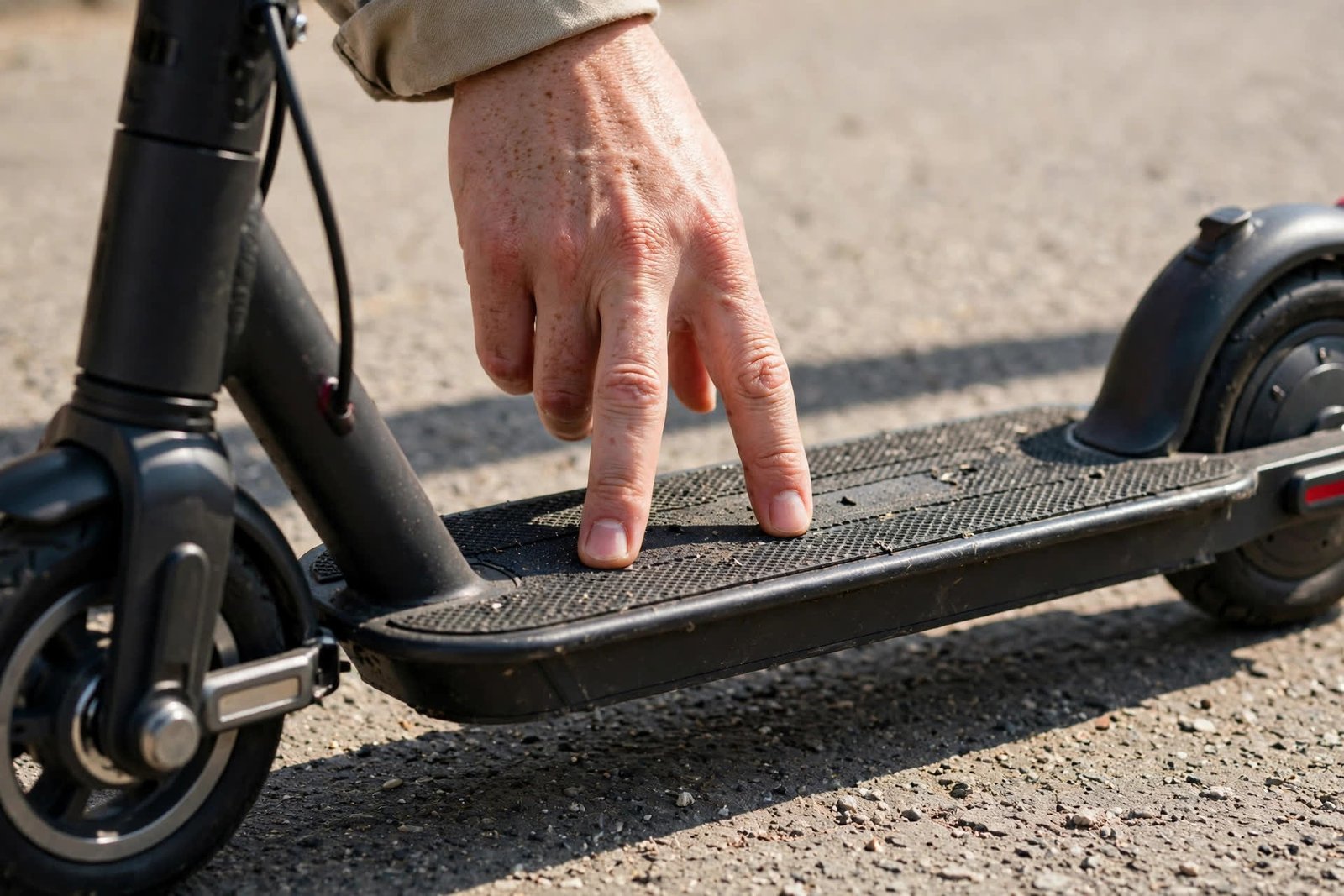
Touch the deck before you charge. Put your hand flat on the deck after a ride: warm is normal, hot is not. If the deck is not close to room temperature, it does not charge yet — bring the scooter inside, let it rest 30 to 45 minutes in a cool indoor space, and touch it again. The deck is the battery’s skin: it is the only part of the pack you can touch, and it tells you what the pack feels like. A deck that is hot to the touch is a battery that is too hot to charge, and charging it anyway is the one mistake that costs a battery.
Check the charging port before you plug in. A hot, dusty port is a bad connection, and a bad connection is a hot connection — so look at the port, wipe it clean with a dry cloth, and make sure it is dry before the charger goes in. If the port is wet, do not plug in: dry it first, and charge only when it is dry.
🏠 The apartment routine — the whole scooter comes inside
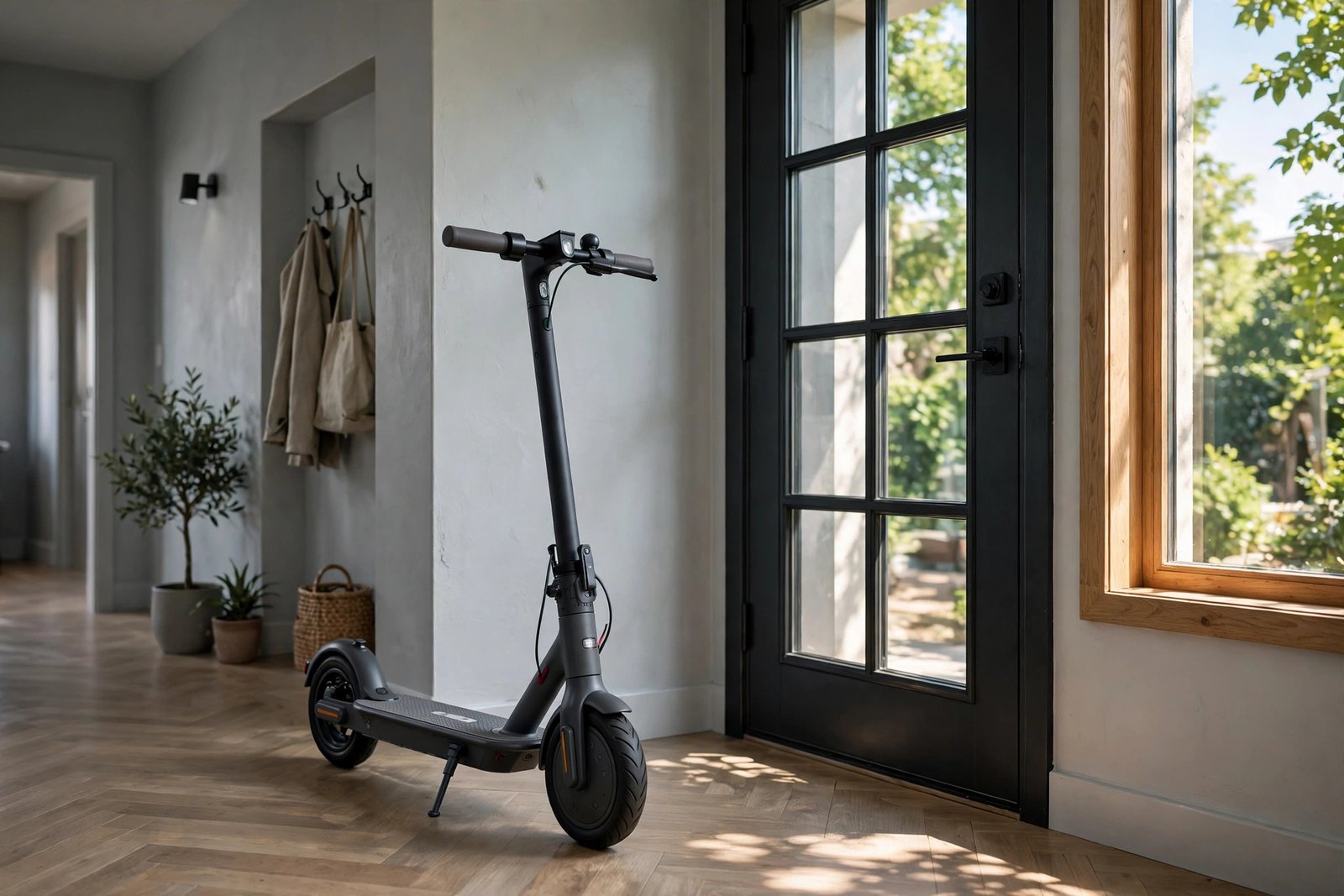
The scooter lives in the flat, and the flat is where it cools. Bring it inside after the ride, park it in the hallway — the coolest place it will be all day — and leave it there until the deck is cool. Do not leave it on the balcony: a balcony in the sun is hotter than the street, and a scooter left there is a battery baking in a glass box. Do not leave it by a sunny window, either — the sun through the glass heats the deck just as fast as the sun outside.
Charge in the cool evening, not the hot afternoon. The flat is coolest in the evening, the battery is coolest in the evening, and the charger is coolest in the evening — so the charge happens when everything is cool, with the charger that came with the scooter, straight into a wall outlet, on a hard surface, where you can see it. Never charge overnight in the heat, never charge near an exit, and never charge a battery that is swollen, hot, or damaged.
If the scooter sits unused for over a week, store it at 50 to 60%. A full battery stored hot ages faster than a half-full one, and an empty battery stored hot can drop too low to recover. Charge it to about half, put it in the coolest corner of the flat, and check it once a month — top it back to half if it has dropped below 40%.
The balcony is the trap. A balcony in the sun is hotter than the street: the glass traps the heat, there is no air moving, and the sun hits it all day — so a scooter left on the balcony is a battery baking in a glass box. If you must leave the scooter outside, park it in the shade, cover it with a light cloth, and bring it in as soon as you can: shade and a cover are better than nothing, but they are not a substitute for the hallway.
🛞 Tyres in the heat — pressure rises, so check before the ride
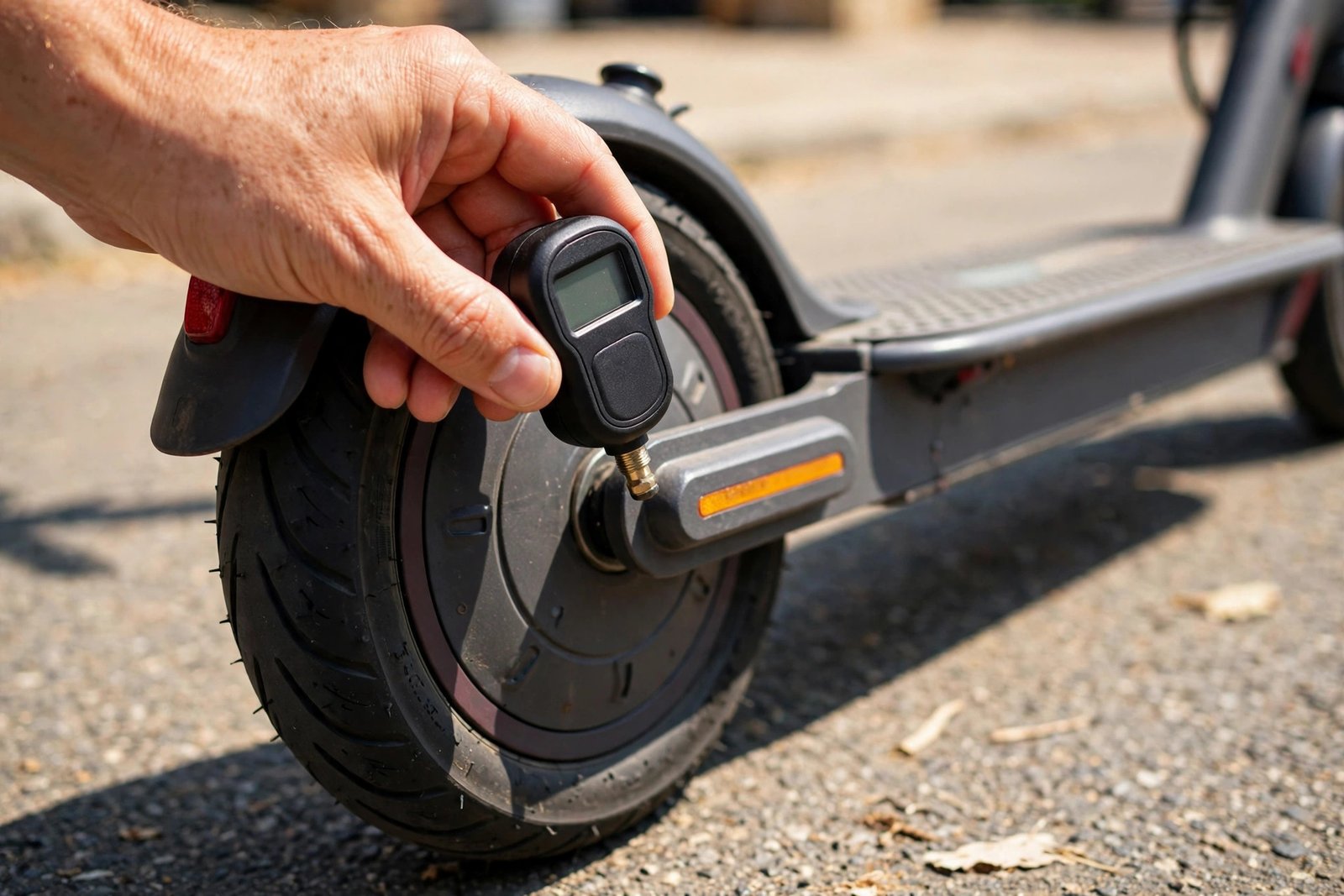
Heat raises tyre pressure, and a scooter’s tyres are small, so the pressure check matters more. A tyre pumped to 45 PSI in a cool morning can read several PSI higher by the afternoon — and an over-inflated tyre is a hard, skittish tyre on a hot road. Check the pressure before the ride, not after it: a hot tyre reads high, and letting air out of a hot tyre leaves it under-inflated when it cools.
Our Tire Pressure Calculator gives the right pressure for your scooter and your weight — run it in the cool morning, before the sun heats the tyres. The pressures from our scooter guides: the MAX G3’s 11-inch tyres take 42–48 PSI, the MAX G2’s 10-inch tyres take 42–48 PSI, and the E2 Pro’s 10-inch tyres take 45 PSI. The solid tyres — the S2 Pro’s honeycomb and the E2 Plus’s inner hollow — do not hold air, so they do not gain pressure in the heat, but they do get harder and harsher on a hot road, so slow down on them.
Check the tyres for heat damage, not just pressure. A tyre left in the sun can reach 150°F or more on the surface, and the heat ages the rubber — so look at the sidewalls in summer, and look for cracks, bulges, or a tyre that has gone shiny and hard. A tyre with a bulge in the sidewall is a tyre that is about to fail, and a tyre that fails at 20 mph is a fall.
📊 The worked examples — seven scooters, and their water ratings
| Scooter | Body rating | Battery rating | Price |
|---|---|---|---|
| Segway Ninebot MAX G3 | IPX6 | IPX7 | Check latest price |
| Segway Ninebot MAX G2 | IPX5 | IPX7 | Check latest price |
| Segway Ninebot E2 Pro | IPX4 | IPX6 | Check latest price |
| Segway Ninebot E2 Plus | IPX4 | IPX6 | Check latest price |
| HopCycle Electric Scooter | IPX4 | — | Check latest price |
| Hiboy S2 Pro | IPX4 | — | Check latest price |
| Hiboy S2 MAX | IPX4 | — | Check latest price |
Say both ratings for the Segways, never the battery rating alone. The MAX G3’s body is IPX6 and its battery is IPX7 — the battery is better protected than the body, and quoting IPX7 alone makes the scooter sound more waterproof than it is. The same for the MAX G2, the E2 Pro and the E2 Plus: the battery rating is the higher one, and the body rating is the one that decides what the scooter survives.
And never hose the scooter to cool it. The IP rating is a splash rating, not a wash permit: it means the scooter survives rain, not a hose. Hosing a hot deck shocks the seals, drives water into the battery compartment, and does nothing the hallway does not do better — bring it inside, let it cool, and wipe it with a damp cloth.
Wash it the way our cleaning guide says: wipe it with a damp cloth, never a hose. A damp cloth takes the dust off without driving water into the seals, and the scooter dries in the shade in minutes. A hose drives water into the battery compartment, the motor, and the display — and a scooter that was washed with a hose in the summer is a scooter that stops working in the autumn.
🚴 Riding in the heat — yourself, not just the scooter
The rider overheats before the battery does. Drink water before the ride, not during it — by the time you are thirsty, you are already behind. Wear light colours, wear a helmet with vents, and ride in the shade where you can: a tree-lined street is 10 degrees cooler than an open road, and the scooter’s battery notices the difference too.
Slow down in the heat, for the same reason you slow down at night: you cannot see as far, and you cannot stop as fast. A hot road is a soft road, and a soft road grips less — so the braking distance grows, and the potholes hide under the heat shimmer. And if you feel dizzy, or the scooter feels wrong, stop: the ride home is not worth a fall in the sun.
And on the hottest days, consider not riding at all. Above 100°F, the battery is stressed, the tyres are stressed, and you are stressed — and the ride home in the hottest part of the day is the ride where all three fail together. The bus, a walk in the shade, or waiting for the evening is not giving up: it is the day the scooter rests, and the day you arrive in one piece.
📚 Related reading
- Riding an Electric Scooter in Winter (Ice, Salt, and Range Loss)
- How to Ride an E-Bike in Summer Heat
- How to Ride an E-Bike in Winter
- Can You Ride an Electric Scooter in the Rain?
✅ The bottom line
Heat is the battery’s other enemy — and on a scooter the battery is under the deck, so the whole scooter comes inside. Never charge above 105°F, touch-test the deck before you charge, charge in the cool evening, and check the tyres before the ride. The scooter that cools inside and charges in the evening is the scooter that still holds its range next summer.
Previous: Article #93 “Can I Charge My Electric Scooter at Work? (The Commuter’s Guide — Ask First, Then Plug In)“
Next: Article #95 “Your Electric Scooter Battery Is Swelling, Smoking or Hot? What to Do in the First 60 Seconds“