

You notice it while the bike is leaning against the wall. The battery — the big black pack that slides out of the frame — no longer sits flat. One side of the case has bowed outward, as if something inside it is pushing to get out. Or the pack is far hotter than it should be after a ride. Your battery is telling you it is failing — now, not next week, not after one more charge.
Almost every guide on this question assumes you live in a house. “Move it outdoors onto concrete, fifteen feet from any wall.” You live in a flat on the third floor. There is no driveway — a hallway, a balcony if you are lucky, and a stairwell that is your only way out. This is the flat version of a battery emergency: the first sixty seconds, where to put the pack, and who takes it away.
What swelling actually is
A lithium-ion battery is a sealed box of calm chemistry. When a cell inside it fails, the liquid electrolyte breaks down and gives off gas. The gas has nowhere to go, so the sealed case swells — the bulge is pressure you can see. Swelling is never cosmetic.
Four things cause it: overcharging, often from the wrong charger; physical damage, a drop or crash; a bad cell from the factory; and heat and age, a pack left in a hot car or past its life. Whatever caused yours, a swollen pack is a failing pack, and it does not get better.
A damaged lithium-ion battery does not need to be charging to fail. The Fire Department of New York says so — a pack can fail on a shelf, unplugged, hours after it was damaged. The failure has a name, thermal runaway: one cell heats itself faster than it can shed the heat, vents flammable gas, and passes that heat to the cell beside it. That is why the first minute matters more than the first hour.
The warning signs that come before the swelling
Swelling is the loudest warning, but it is rarely the first. Most failing packs give you smaller warnings first.
Heat when it should not be hot. A battery gets warm working hard and warm while charging. A battery that is hot while sitting still is not normal. If you cannot hold it, stop using it.
A smell, or a noise. A healthy pack smells of nothing. A failing pack can give off a sweet, chemical smell. A hiss, a crackle or a faint popping is gas escaping or a cell venting.
Leaking, discolouration or a cracked case. Any liquid, stain or warp on the pack. A cracked case after a drop is a damaged battery, even if the bike still rides fine.
Range that suddenly halves, or charging that never finishes. A pack that gave you twenty miles and now gives ten has lost cells.
A drop or a crash. The damage can be inside where you cannot see it. A dropped pack should not go back on the charger until you have checked it against this list.
The first 60 seconds
If your battery is swelling, smoking or hot, do these things in this order, and do not improvise.
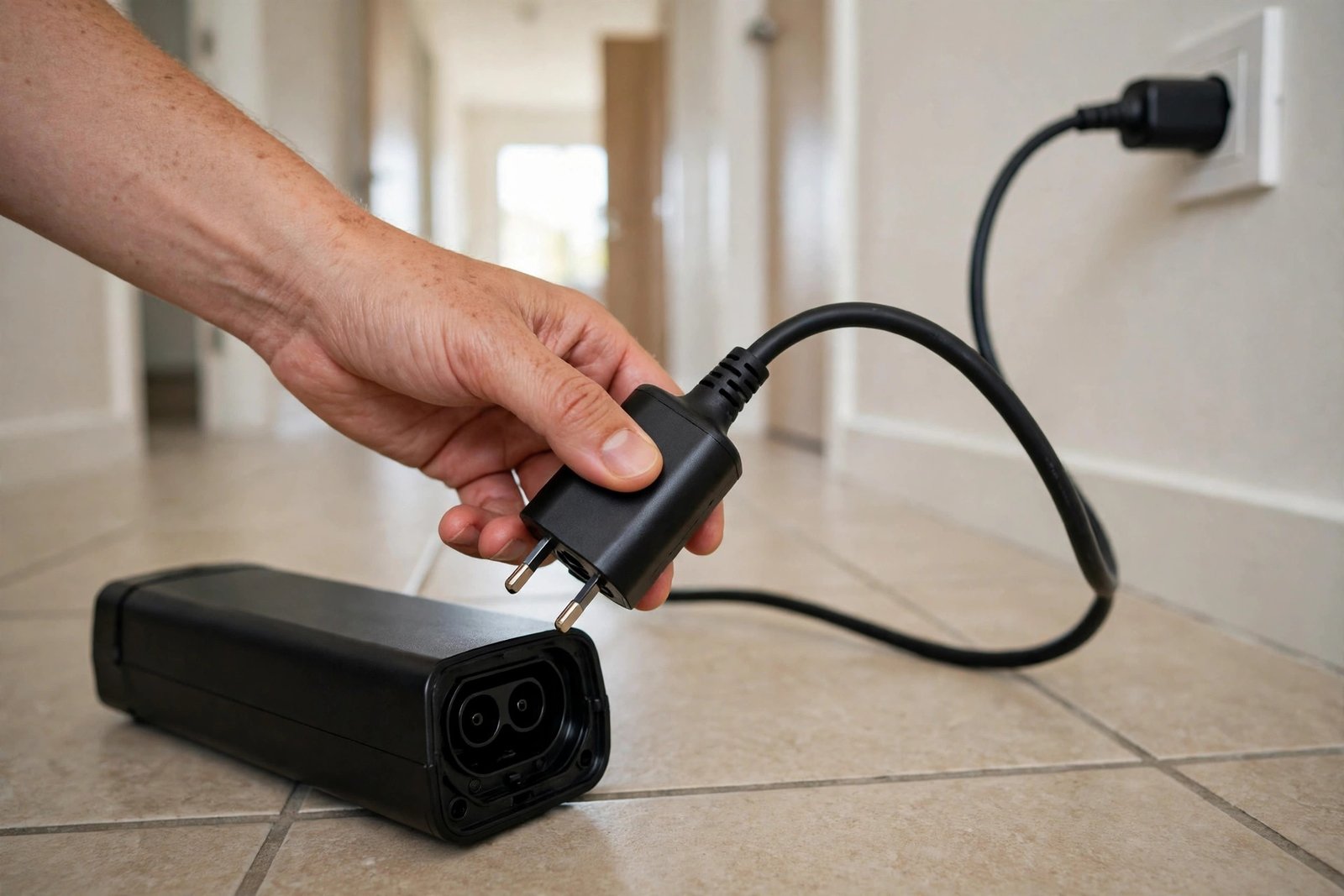
- Stop charging it. If the pack is on the charger, unplug it at the wall socket.
- Stop using it. Power the bike off. Do not plug the pack back in “to see if it is all right” — a swollen battery is never all right, and charging it again is the fastest way to make it worse.
- Do not open it, do not puncture it, do not press it flat. This is the most dangerous temptation. The bulge is pressurised gas inside a sealed case, and puncturing it can set the pack on fire on the spot. There is no home repair for a swollen pack.
- Do not put water on it. A jug of water will not stop a failing battery. Water is what fire crews use to cool a burning pack — in thousands of litres, with breathing apparatus. Your job is the door.
- Do not move it if it is smoking, hissing or getting hotter by the second. If the pack is actively failing, leave it where it is and get out.
- If it is cool and stable, move it — and only then. A cool, stable pack can be moved to the safe spot in the next section. Handle it gently.
“The battery is not a gadget you can wait out. Once it starts failing, the clock is the thing that matters — sixty seconds of the right moves, and then it is someone else’s problem.”
Where to put it in a flat
This is the part the house guides never answer. In a flat, the safe spot has four rules: hard, clear, visible, and never on your way out.
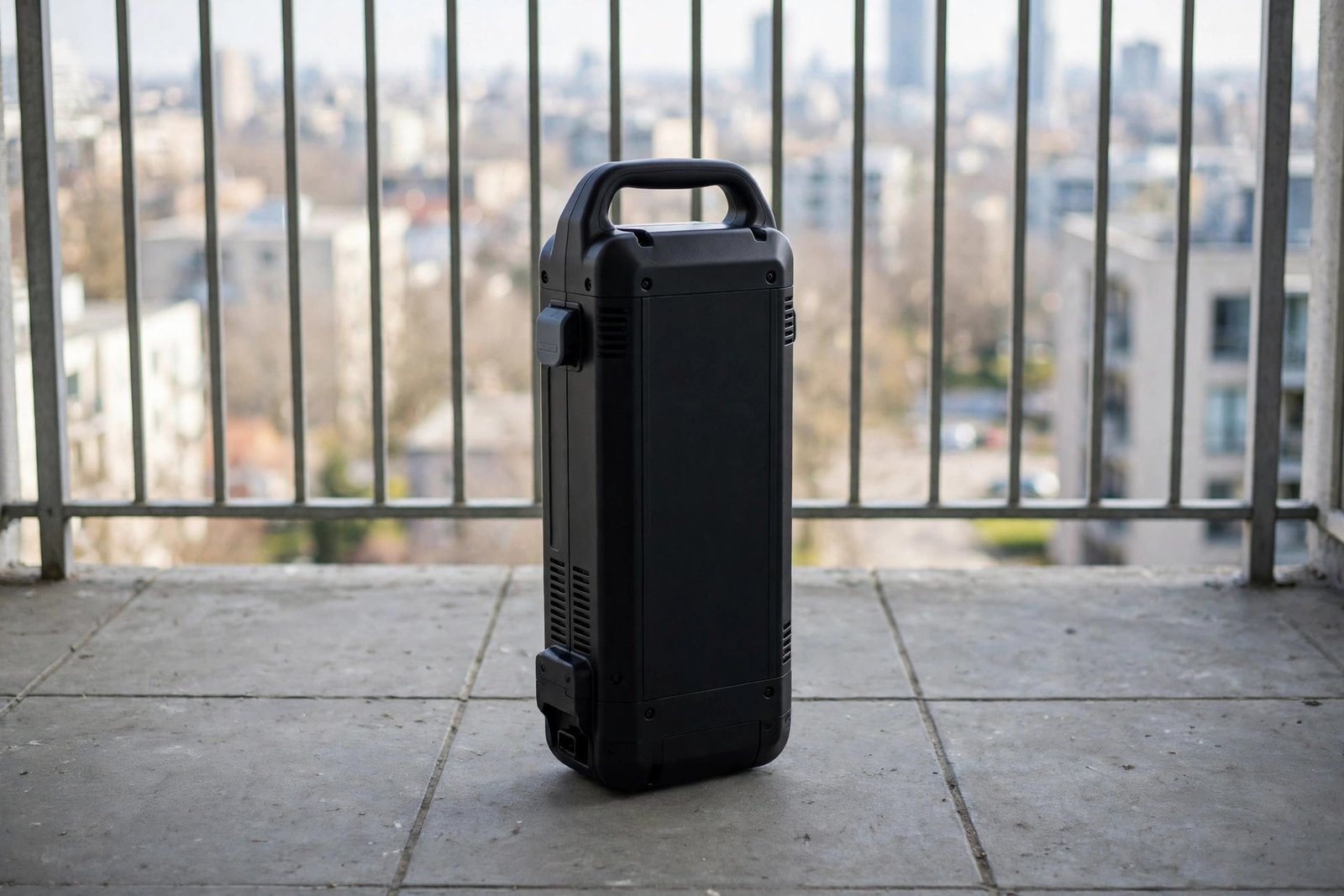
The balcony, if you have one, is the best place in the flat. Set the pack on the bare concrete or tile. Leave it where you can see it, and where children and pets cannot reach it. Do not cover it, and do not put it in a box or a bag.
If there is no balcony, use the hardest, clearest surface you have — the middle of a tiled floor. Close the door to that room, so a problem stays in one room.
The rule that matters most in a flat: never put the battery in the stairwell, and never put it by the front door. The stairwell is your escape route and your neighbours’. The London Fire Brigade is blunt about this: never charge or store a battery in a hallway, on a landing or anywhere on your escape route. Never charge a suspect pack, and never leave it on a bed or a sofa.
“A battery failing by the front door can cut off your only way out. In a flat, where the pack sits is a safety decision, not a storage decision.”
If it is smoking, or it catches fire
Everything above is for a pack that is swollen, hot or strange — but still. Once it is smoking, hissing hard, venting gas or on fire, the plan changes completely, and it has only three steps.
Get out. Close the doors behind you. Call 911 — or 999 if you are in the UK — from outside, and stay out. Tell the operator a lithium-ion battery is involved. Do not go back inside for the bike, the charger or anything else.
Do not try to put the fire out yourself. A battery in thermal runaway makes its own oxygen and vents toxic gases, and can throw burning material out of the pack. The smoke is toxic, and the gases can look like ordinary steam.
Now the water question, honestly. Some public fire-service guidance for residents says do not try to extinguish a battery fire with water. The technical guidance fire services work from says water is the preferred agent for lithium-ion fires — because it cools. Both are true — water cools, but cooling a pack takes a sustained, large volume. An ordinary ABC extinguisher will knock the flames down and then the pack will reignite, because the extinguisher cools nothing. There is, as of late 2026, no portable fire extinguisher sold in the United States with a UL rating for lithium-ion battery fires. A Class D extinguisher, for burning metal, is the wrong tool. A resident with a jug or an extinguisher cannot stop a battery fire. The people who can are one phone call away.
In 2023, the Fire Department of New York attended 268 lithium-ion battery fires — 150 people injured, 18 killed. In London, the fire brigade attended a record 206 e-bike and e-scooter fires in 2025, and five people have died in London since 2023. The UK’s product safety regulator was notified of 211 e-bike and e-scooter fires in 2024, and 45 percent involved bikes converted with aftermarket kits.
After it is over — getting rid of the pack
A cooled-down pack is still dangerous — and this is where most people make their second mistake. Do not put it back on the bike or the charger, and do not leave it in the flat for a week while you decide. And above all, do not put it in the household bin, and do not put it in the general recycling.
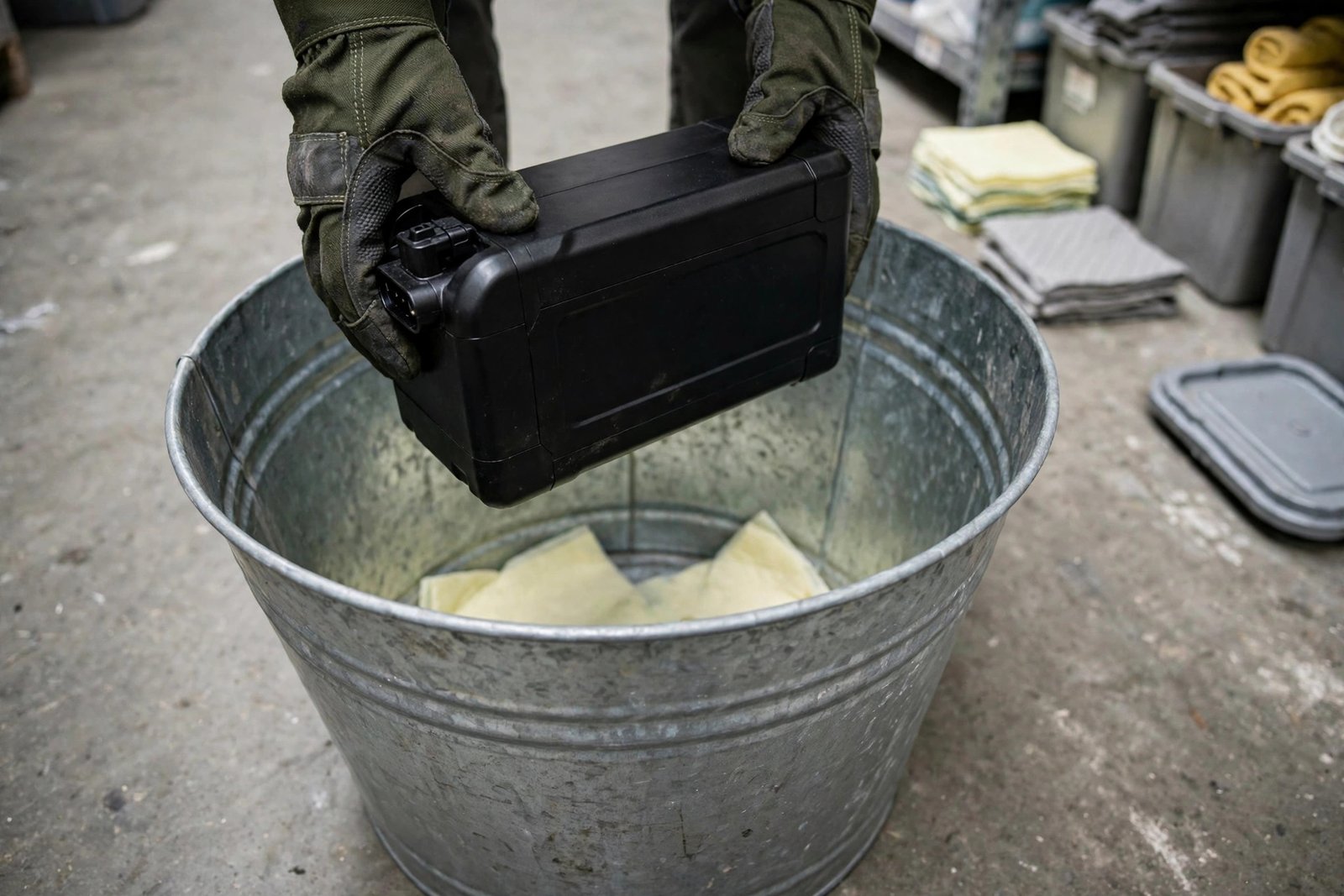
A lithium-ion battery in the bin is a fire waiting for a bin lorry. Packs get crushed in compactors and punctured by other waste — which is why putting one in household waste is illegal in New York City. The right route is one of three. First, the dealer or the maker of your bike. Second, your local household hazardous waste collection. Third, a certified electronics recycler. Whichever route you take, call ahead first: a damaged or swollen pack needs a separate route, and not every drop-off point accepts one.
Tape the terminals if they are exposed, keep the pack upright, and carry it in a metal bucket if you have one. Never post it without the carrier’s dangerous-goods instructions. A pack that is still warm, hissing or smelling after it has cooled is not a disposal job — it is an emergency again.
Report the failure. In the United States, file with the Consumer Product Safety Commission at SaferProducts.gov. In the UK, report it to Trading Standards. Check whether your pack or bike is already under a recall before you buy a replacement.
“A swollen battery in the bin is a fire in someone else’s lorry. The pack leaves your flat through hazardous waste, or through the dealer — never through the rubbish.”
So you never need this article again
A battery emergency is rare, and almost all of them are preventable. The habits that stop a fire are the same habits that make a battery last longer.
Buy a certified pack, from a brand you can trace. Look for UL 2849, which certifies the whole e-bike electrical system, and UL 2271, which certifies the battery pack itself. New York City has barred the sale of uncertified e-bikes and batteries since September 2023.
Use only the charger that came with your bike. A mismatched charger is one of the commonest causes of overheating. Charge while you are awake and at home, on a hard surface, away from the exit — and unplug the pack when it is full. Never charge overnight or on a bed or a sofa, and never charge a dropped pack until you have checked it against the warning signs above.
Know your normal charging time — a change in it is a warning sign. A 48V 15Ah pack on a 2A charger takes about seven hours from twenty percent to full — run your own pack through our Charging Time Calculator and write the number down. If it suddenly takes nine hours, or never shows full, you have caught a failing cell early.
When a pack does need replacing, do the maths before you spend the money. A replacement pack is the most expensive single part of an e-bike. Run the numbers in our Cost-to-Own Calculator first — if the pack costs more than the bike will ever save you, the honest answer is a new bike, not a new pack.
Questions, answered honestly
Can I still ride it if the battery is swollen but the bike still works?
No. A swollen pack is a failing pack even if the bike still rides. It can fail without further warning. Stop using it.
Can I puncture the bulge to let the gas out?
Never. Puncturing a swollen lithium-ion battery can set it on fire immediately. The gas is the symptom, not the problem.
My battery is warm after a ride — is that normal?
Warm, yes. Hot enough that you cannot hold it comfortably, no. A pack that is hot while sitting still is a warning sign.
It swelled a little and then stopped — is it safe now?
No. Swelling does not reverse, and a pack that swelled once has already failed. Treat it as a dead pack and dispose of it through hazardous waste.
Disclosure
We have not tested any product in this article, and there are no product links in it — this is a safety article, not a shopping article. Every fact comes from a fire service or the maker’s own manual. Other pages on this site do carry affiliate links: if you buy through a link on BoltWander, we may earn a small commission at no extra cost to you.
Keep reading
- Can You Charge an E-Bike Battery Inside Your Apartment? The Honest Safety Answer
- E-Bike Battery Safety — What UL 2849 Means
- How Long Does an E-Bike Battery Last? (and How to Make Yours Last Longer)
Previous: Solid vs Pneumatic Scooter Tires: Which One for Commuting? (Flats vs Comfort)
Next: Throttle vs Pedal Assist on an E-Bike: When to Use Each (and What It Does to Your Range)
