
Some links in this article are affiliate links. If you buy through them, we may earn a commission at no extra cost to you.
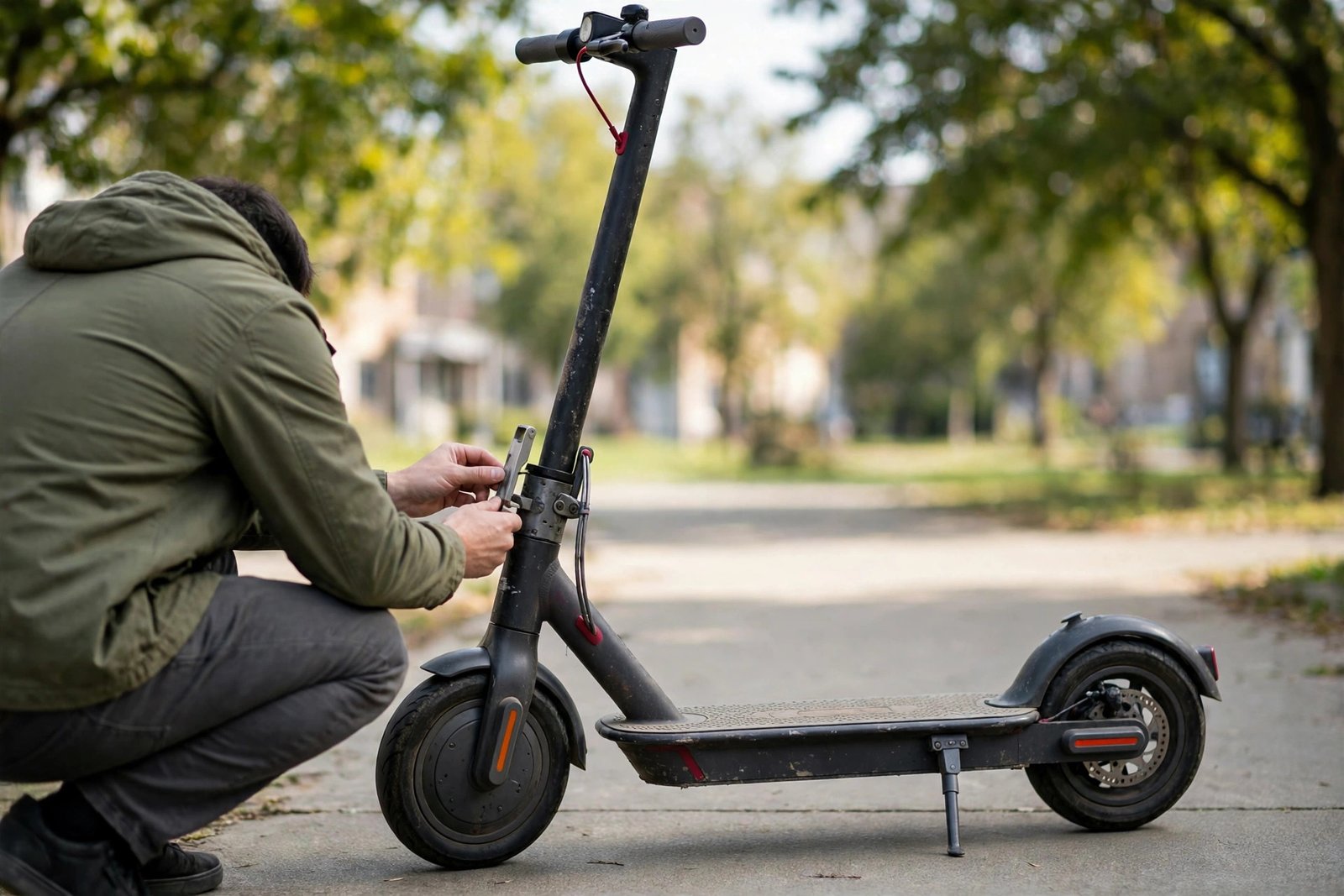
You want to buy a used scooter. The listing looks good, the photos look clean, and the price is half of new. Before you hand over cash: what is it actually worth, and how do I check it before I pay?
In this guide
- The short answer
- Check 1 — the battery test: charge it, ride it, compare it
- Check 2 — the new-price comp: what would it cost new today?
- Check 3 — the latch: fold it, unfold it, and walk away if it rattles
- The tyres — solid wear and pneumatic wear are different problems
- The rest of the inspection — frame, brakes, display, charger
- The meeting — public, daylight, cash only, and a test ride
- The decision — used or new?
- Related reading
- The bottom line
The answer is three checks, and the battery comes first. The battery is the price — everything else is negotiation. A used scooter with a dead battery is not a bargain, it is a repair bill with wheels. One with a healthy battery, a solid latch and honest tyres is a commute for half the money.
The short answer
Check the battery, compare the price with new, and test the folding latch. Charge it to 100 percent, ride it to 50 percent, and compare the distance with what the scooter is rated for. Look up what the same scooter costs new today — and price a replacement battery into the deal before you decide. Then fold and unfold it several times. If the latch rattles loose or will not fully lock, walk away, whatever the price.
Check 1 — the battery test: charge it, ride it, compare it
The battery is the single biggest value factor in a used scooter, and the part you cannot see. A scooter pack lasts 300 to 500 full cycles, and every cycle takes a little range away. The seller will tell you the battery is fine. Prove it yourself.
The test needs no dealer diagnostic, no app, and no special tool. Charge the scooter to 100 percent, ride it until the display reads 50 percent, and compare the distance with the scooter’s rated range. If it is rated for 25 miles and you rode 8 miles to reach half charge, the pack holds roughly two-thirds of what it should — 16 miles on a full charge against a 25-mile rating. A pack that dies at under 60 to 70 percent of its rated distance has lost about a third of its capacity, and a third of the capacity is a third of the scooter’s value gone.
Do the maths on the spot. Rated range, halved, is the distance you should cover by 50 percent. If the scooter falls well short of half its rated range at half charge, the battery is tired. The seller may blame the cold, the tyres, or the hills — and a cold day does cost a little range. But a little is a few percent, not a third. A battery that loses a third of its range has lost it for good, and no amount of charging brings it back.
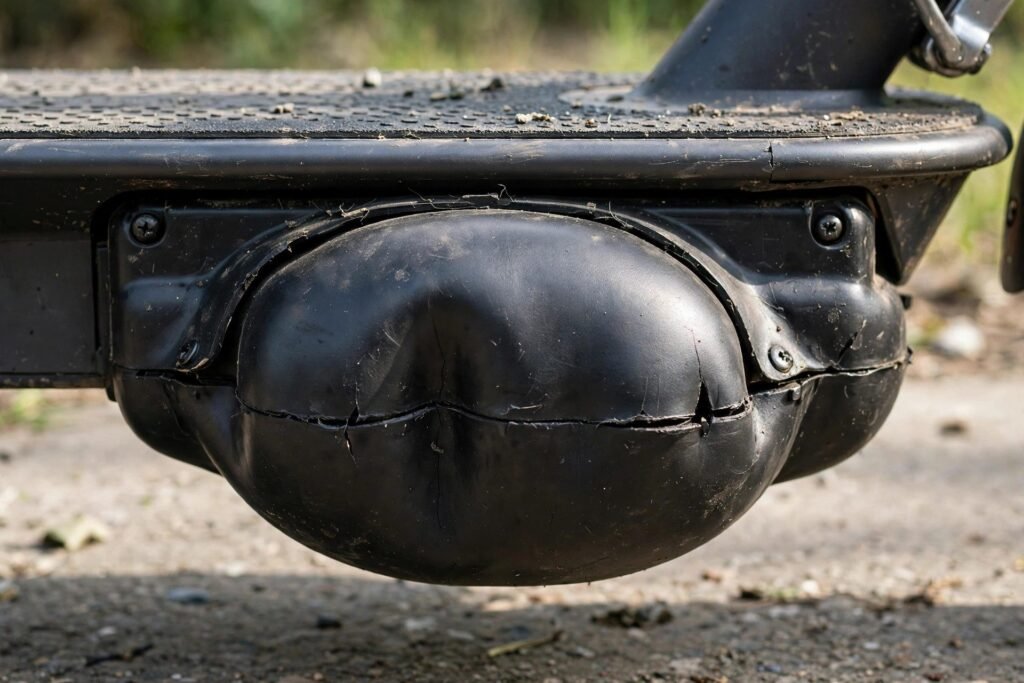
One more battery check, and it takes ten seconds. Look at the battery case — and if it is swollen, bulging, or the deck no longer sits flat, do not buy the scooter. A swollen case means the cells inside have failed, and a failed pack is a fire risk, not a repair job. Never buy a scooter with a swollen battery case, at any price. The same goes for one that smells of chemicals, or one the seller tells you not to charge indoors. Walk away.
Check 2 — the new-price comp: what would it cost new today?
A used price means nothing without the new price beside it. The new-price comp is what the same scooter costs new today, and whether the used price is actually a saving once a replacement battery is priced in.
The table below is the whole comparison: the nine scooters in our catalogue, at what a buyer would pay new. The point is not to sell you a new scooter — it is to show you what the used one has to beat.
| Scooter | What it costs new |
|---|---|
| Phantomgogo Electric Scooter | Check latest price |
| WERHY 500W Adult Scooter | Check latest price |
| HopCycle Electric Scooter | Check latest price |
| Segway Ninebot E2 Plus | Check latest price |
| Segway Ninebot E2 Pro | Check latest price |
| Hiboy S2 Pro | Check latest price |
| Hiboy S2 MAX | Check latest price |
| Segway Ninebot MAX G2 | Check latest price |
| Segway Ninebot MAX G3 | Check latest price |
Now the depreciation maths, from Levy Electric via scootergearlab’s used-scooter guide: a scooter keeps 70 to 85 percent of its retail price in the first six months, and 30 to 50 percent within the first year. Those are general figures, not prices for any one scooter — but they show the shape of the deal. A six-month-old scooter at half price is a good deal. A two-year-old scooter at half price is not, unless the battery proves itself.
Work it through with a round number. A scooter that cost $400 new should sell for roughly $280 to $340 at six months, and $120 to $200 within a year — the Levy Electric range applied straight. If the asking price is above that range, the seller is pricing the scooter as if it were newer than it is. If it is below, ask why — and check the battery twice.
Then price the battery into the deal. A replacement battery costs roughly $150 to $500 or more, per scootergearlab’s guide — and on a cheap scooter, the battery can cost more than the scooter. A used scooter is only a saving if the price plus a possible battery is still less than new. Run that sum before you pay: the asking price, plus a battery at the top of the range, against the new price with a full warranty. Sometimes new wins. A new E2 Plus (check latest price), with a full warranty and a fresh battery, beats a used mid-range scooter with a tired pack — and the warranty is worth real money on a machine with no dealer to take it back to.
Check 3 — the latch: fold it, unfold it, and walk away if it rattles
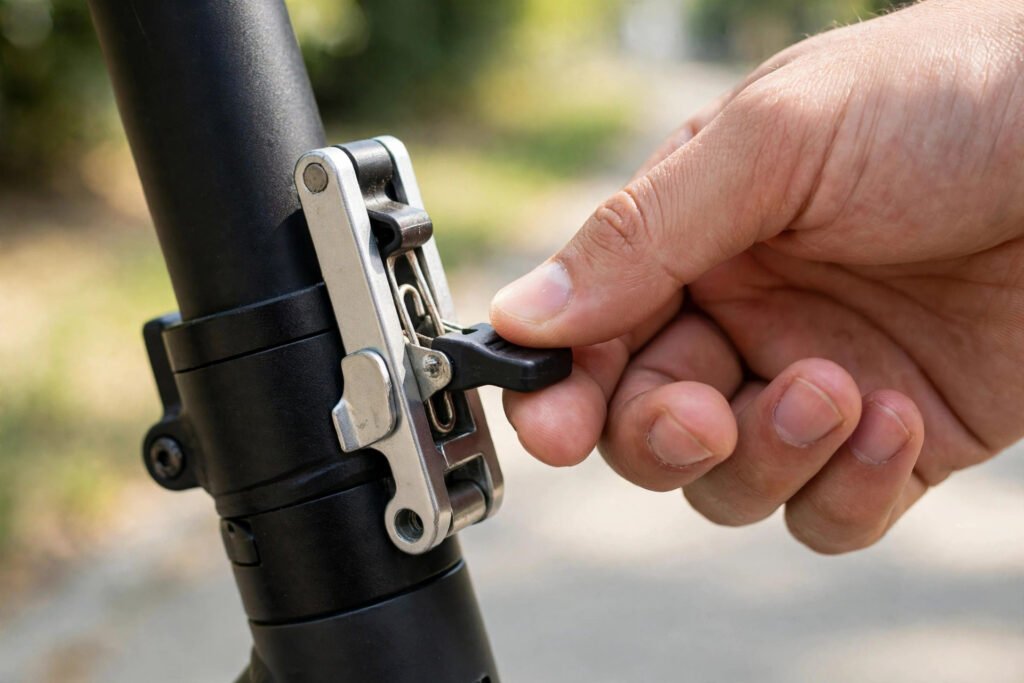
The folding latch is the single most dangerous failure point on a folding scooter, and it is the check most buyers skip. Fold and unfold the scooter several times, and if the locking latch rattles loose or will not fully lock, walk away.
Here is why it matters more than a scratch or a worn tyre. The latch is the only thing holding the stem upright while you ride. A latch that rattles loose on the pavement is a stem that folds under you at speed — and there is no warning, no second chance, and no repair that makes a worn latch trustworthy again. Our scooter safety guide covers the same latch as the first thing to check before every ride. A loose latch is not a negotiation point. It is a walk-away.
The test is simple. Fold the stem down and lock it, then unfold it and lock it upright. Do it three or four times. The latch should click into place firmly, with no play and no wobble, every single time. Push the stem forward and back while it is locked — there should be no movement at all. If the stem rocks, if the latch needs a second push to catch, or if it pops loose when you shake it, the scooter is not safe to ride. A scooter that will not lock upright is a scooter you do not buy.
The tyres — solid wear and pneumatic wear are different problems
Tyres are the next thing to read, and the wear tells a different story depending on the type. A solid tyre with no tread left is a different problem from a pneumatic tyre with a slow leak — and both tell you how the scooter was treated.
On a solid tyre, look at the tread. A solid tyre that is smooth in the middle has been ridden hard and has no grip left in the wet — and it cannot be patched or pumped, only replaced. Check the sidewalls too: cracking or chunking means the rubber is old, and an old solid tyre is a hard, slippery ride.
On a pneumatic tyre, look for the same tread wear — then check the pressure and the valve. A pneumatic tyre that is soft at the meeting has either a slow leak or a seller who never checked it, and a slow leak means a puncture, a bad valve, or a rim that no longer seals. Pump it up if you can, and watch whether it holds. Our tyre guide works through the solid-versus-pneumatic choice in full — the point here is that either tyre can be worn out, and the wear is visible if you look.
The rest of the inspection — frame, brakes, display, charger
The battery, the latch and the tyres are the three big checks. The rest of the scooter takes five minutes and catches the expensive surprises.
Start with the frame and the stem. Look for cracks at the folding joint, at the base of the stem, and where the deck meets the frame — those are the places a crash bends metal. Scratches on the deck are cosmetic. A crack at the joint is structural, and a structural crack is a walk-away.
Then the brakes. Squeeze both brake levers and roll the scooter forward — the wheels should stop dead, with no grinding and no lever that pulls to the handlebar. A lever that pulls all the way to the bar means worn pads or air in the line — both fixable, but money off the price, not a reason to pay full asking.
Then the display and the throttle. Turn the scooter on and watch the display come up clean, with no dead lines and no flicker. Twist the throttle and listen for the motor engaging smoothly, with no grinding and no delay. A display with dead lines will die completely, and a throttle that hesitates is a controller problem.
Then the charger. Ask for the charger that came with the scooter, and check that it is the maker’s charger, not a look-alike. A scooter sold without its charger is one you cannot charge at the meeting — which means you cannot run the battery test at all. No charger, no battery test, no sale. A wrong charger is worse: the wrong voltage can damage a pack that was fine when you bought it.
The meeting — public, daylight, cash only, and a test ride
The last check is not the scooter. It is the meeting. Meet in a public place, in daylight, and test-ride the scooter before you pay.
A public place with people around it — a car park, a plaza, outside a café — is the safe meeting. Daylight lets you see the battery case, the latch, and the tyre tread properly; a scooter inspected under a street light is inspected half-blind. Cash only, and only after the test ride — never pay before you have ridden it, and never pay by a method you cannot take back.
The test ride ties the rest together. Ride it for ten minutes, not thirty seconds. Accelerate, brake hard, turn both ways, and ride over a rough patch. The battery test told you the range; the test ride tells you the rest. A motor that whines under load, a brake that pulls to one side, a stem that flexes, a deck that rattles — all of it shows up in ten minutes, and none of it shows up standing still.
And if anything in this guide fails at the meeting, use it. A tired battery, a loose latch, a soft tyre — each one is a reason to lower the price or walk away. A seller who will not let you charge it, ride it, or fold it knows what you would find. A seller who says no to the test is telling you the answer.

The decision — used or new?
Put the three checks together and the decision is arithmetic. The asking price, plus a possible battery, against the new price with a warranty. Our free Cost-to-Own Calculator runs the same maths for the whole first year — put in the price, the battery, and the miles, and it tells you what the scooter really costs to own. Run your numbers before you pay, not after.
The used scooter wins when the battery is healthy, the latch is solid, and the price is well under new. A six-month-old scooter at half price, with a battery that proves itself on the ride test, is the cheapest commute there is. New wins when the battery is tired, the latch is loose, or the used price is close to new — because new comes with a warranty, a fresh battery, and a charger that matches. Sometimes new wins, and knowing when is the whole point of the checklist.
This is the flip side of our guide to buying a used e-bike, and the same rule runs through both: the battery is the price, and everything else is negotiation. The e-bike version works through the same battery test on a bigger pack, and the selling guide works the same maths from the seller’s side. Read both before you buy — and before you sell.
Related reading
- Buying a Used E-Bike? The Checklist Before You Pay (Battery First)
- Solid vs Pneumatic Scooter Tires: Which One for Commuting? (Flats vs Comfort)
- Article #56 “How to Sell Your Used E-Bike”.
- Article #51 “Electric Scooter Maintenance”.
The bottom line
The battery is the price — everything else is negotiation. Charge it to 100 percent, ride it to 50, and compare the distance. Compare the asking price with new, and price a battery into the deal. Fold it and unfold it, and walk away if the latch rattles. Meet in public, in daylight, pay cash only after a ten-minute test ride, and never buy a scooter with a swollen battery case. Do those checks, and the cheapest commute on the market is yours — skip them, and the bargain is a repair bill with wheels.
Previous: How to Charge an E-Bike When You Have No Outlet (No Garage, Street Parking, No Problem)
Next: Best E-Bike for Camping (Off-Grid, Campground Roads): Range, Cargo, and Charging Without an Outlet