

Some links in this article are affiliate links. If you buy through them, we may earn a commission at no extra cost to you.
You just spent hundreds of dollars on an e-bike. Now you need the thing that decides whether it is still there in the morning. The lock is not an accessory. It is the cheapest insurance on the most expensive thing you own that has no engine and no alarm. The rule for what to spend is simple: 5 to 10% of the bike’s price goes on the lock. Spend less and you are protecting a five-hundred-dollar bike with a ten-dollar lock, which is the same as not protecting it at all.
You do not need to spend a fortune, and you do not need to carry a boat anchor. One competitor guide names our lead pick its best overall lock, and it costs Check latest price. What you need is the right type, the right size, and the right rating — in that order. Type first, size second, rating third. Get the type wrong and the strongest lock in the world does not help you, because a lock that does not fit your frame is a lock you leave at home.
The three numbers that decide it
Every lock worth buying is decided by three numbers. Learn them once and you can read any lock listing in a minute.
Number one: the shackle thickness, in millimetres. This is the steel that stands between the thief’s bolt cutters and your bike. A 13mm hardened steel shackle is the commuter sweet spot: thick enough to resist the bolt cutters that defeat cables and thin U-locks, light enough to carry every day. A 12mm shackle is the budget floor. Below 12mm you are in cable territory, and cables are not locks. Thickness is the first number because it is the one the thief has to beat.
Number two: the independent rating. This is the grade an outside testing body gives the lock after attacking it — not the maker’s own score. The two that matter are Sold Secure (the UK testing body — grades run Bronze, Silver, Gold, Diamond) and ART (the Dutch body, 1 to 5 stars). Sold Secure Gold is the commuter standard — the grade insurers ask for, earned by surviving a sustained attack. Diamond is the top grade, for valuable bikes left in cities; Silver is basic protection for low-risk stops. Kryptonite also gives every lock its own in-house score out of 10 — the Mini-7 scores 7/10 — but a maker’s own score is a marketing scale, and the independent grade is the one to trust. A listing with no independent grade is not necessarily a bad lock, but it is unproven, and you should know that before you pay.
Number three: the fit — the inside size of the U, in inches. This is the number most buyers skip, and it is the one that decides whether the lock gets used. A U-lock’s inside is published as width by length — the Mini-7 is 3.25 by 7 inches — and that opening has to close around your frame, your wheel, AND the anchor at the same time. A lock that does not fit is a lock you leave at home, and a lock left at home protects nothing.
The lock types, ranked honestly
Four types exist, and they are not equal. Here is the honest ranking, worst first.
Cable locks: skip them as your only lock. Braided cable is cut with hand shears, and the armoured-looking sleeve is cosmetic. A prepared thief carries bolt cutters and works fast in daylight, and a cable dies instantly. As your only lock, a cable is not a lock. It has one legitimate job: as a secondary, through the front wheel, while a real lock holds the frame — the job the cable in the Mini-7’s box is made for.
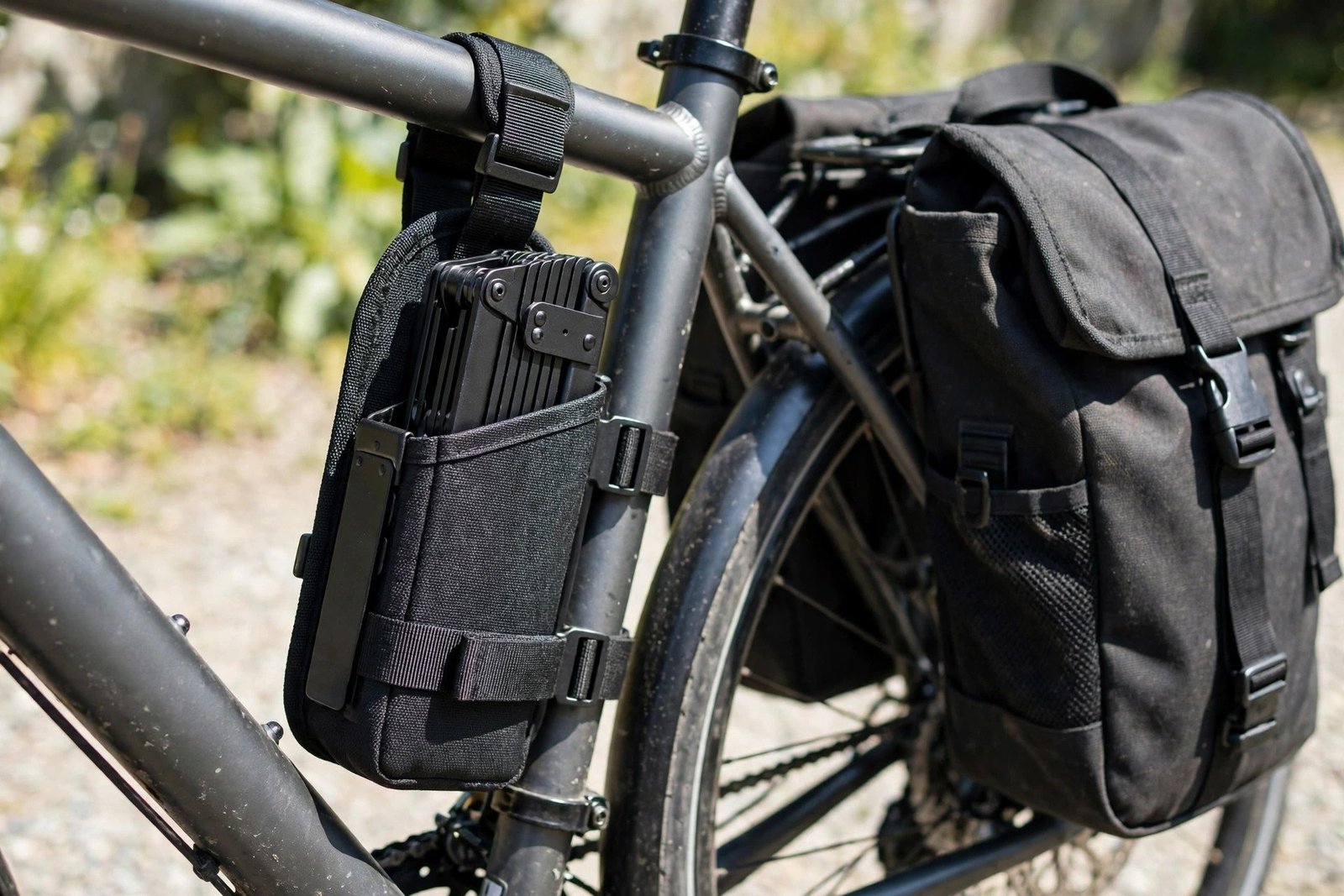
Folding locks: the best fit for a pannier or a bag. Hardened steel plates riveted together, folding flat into a holster on the frame, opening into a loop long enough to reach around a frame and a post. They carry better than any U-lock — flat against the frame — and they reach around shapes a rigid U cannot. The honest weakness is the rivets: on a cheap folding lock the joints can be drilled out, so buy a named maker, not the cheapest listing. We now carry one: the ABUS Bordo 6000C at Check latest price — 5 mm hardened steel bars in a 90 cm combination lock (no key to lose), rated ABUS Security Level 10/15 on ABUS’s own scale, and a top pick in multiple 2026 guides. When you shop for one, look for hardened steel links and a length around 85–90 cm.
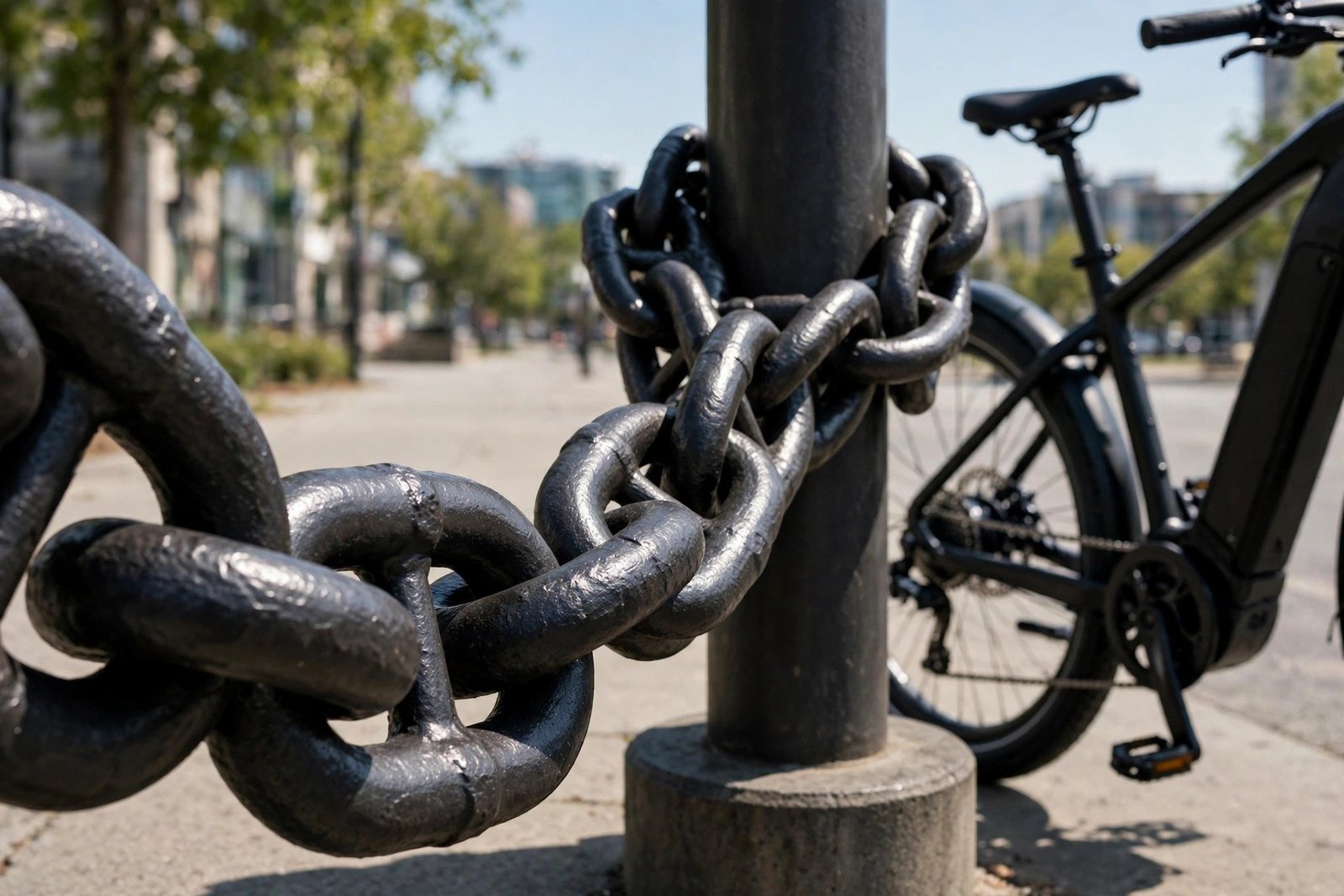
Chain locks: flexible, heavy, and best left at the office. A chain wraps around thick posts and trees that a rigid U-lock cannot grip. That flexibility is the whole point — and the whole problem. A chain strong enough to matter weighs several pounds, and nobody carries several pounds of chain on a daily commute. The honest use for a chain is the second lock you leave at the office — locked to the rack you use every day, waiting for you when you arrive. We now carry one: the Kryptonite Keeper 712 at Check latest price — 7 mm hardened manganese-steel links, Sold Secure Bronze, 4 ft long, and 1K+ bought in the past month. When you shop for one, look for hardened links 7mm or thicker and a length that reaches your frame and the anchor.
U-locks: the strongest per pound, if they fit. A rigid shackle of hardened steel, a double deadbolt that locks on both sides, and a small inside that leaves a thief no room to get a tool in. That small inside is the whole design argument for a mini U-lock: the less air inside the lock, the less room a thief has to get a jack or a bar in. The weakness is the fit — a rigid U cannot bend, so if your frame and rack do not fit inside it, it does not work.

The fit test: measure before you buy, not after
Here is the test, and it takes two minutes with a tape measure. Measure your frame tube where the shackle will close, measure the rack post you lock to, and add them together. The inside width has to clear the frame tube beside the rack post, and the inside length has to reach around both. Buy the shortest shackle that closes around both — too small and it cannot close at all; too large and the slack inside gives a thief room to insert a jack or a bar.
For a normal commuter e-bike, the Mini-7’s 3.25 by 7 inch opening is enough: through the rear triangle, around the rear wheel, around a standard rack post, done. But e-bikes change the geometry. The frame tubes are thicker — the down tube houses the battery. The tyres are wider — a fat tyre starts at 4 inches, and the shackle has to clear the tyre as well as the frame. And the rack posts are thicker, because modern racks are built for heavier bikes.
On a fat-tire folder, the Mini-7 often does not fit. The 3.25 inch width cannot close around a fat-tyre frame tube beside a thick rack post, and the 7 inch length cannot reach around both. That is not a defect in the lock — it is the wrong size for that bike. The fix is not a weaker lock; it is a longer one. The Evolution Mini-9 is the same 13mm shackle in a longer 3.25 by 9.5 inch body — the same security, more reach — and it is the size to look for if the Mini-7 will not close around your frame and your rack. We do not carry the Mini-9, so this guide does not link it. Measure your frame and your rack before you order, not after.
The other fit trap is the step-through frame, whose main triangle is small. On a step-through, lock through the rear wheel and the seat tube — the closed section of the frame beside the rear wheel — and let a second lock take the front wheel.
The two U-locks
Here are the two U-locks we carry. Every price is Approx — Amazon prices move, so check the latest price before you buy.
| Lock | Shackle | Inside | Rating | Approx price | Best for |
|---|---|---|---|---|---|
| Kryptonite Evolution Mini-7 | 13mm hardened steel | 3.25″ x 7″ | Sold Secure Gold | Check latest price | Daily commuting, city parking |
| Kryptonite Keeper Mini-6 | 12mm hardened steel | 3.25″ x 6″ | Sold Secure Silver | Check latest price | Budget, low-risk stops |
Kryptonite Evolution Mini-7 — Check latest price
The lead pick, and the lock most commuters should actually buy. A 13mm hardened Max-Performance shackle with a double deadbolt, Sold Secure Gold certified, and Kryptonite’s own 7/10 high-security rating. It weighs 3.55 lb with the cable and bracket in the box, and it comes with a 4 ft 10mm KryptoFlex cable for the front wheel and a frame bracket. One competitor guide names it its best overall lock: the thickest shackle in its size class, an independent Gold grade, and a small inside that leaves a thief no leverage room. The honest limit is the fit — the 3.25 by 7 inch opening is tight around thick posts and fat-tire frames. If it closes around your frame and your rack, buy it. If it does not, do not buy a weaker lock to make the fit work — buy the longer body.
Kryptonite Keeper Mini-6 — Check latest price
The budget pick, and the cheapest lock in this guide that is still a lock. A 12mm hardened steel shackle, a 3.25 by 6 inch inside, Sold Secure Silver rated, and 1.65 lb — less than half the weight of the Mini-7, at half the price. It comes with a bracket and two keys. The trade is honest: one millimetre thinner, one inch shorter, and Silver instead of Gold. For short stops in low-risk places — the café, the lecture hall, the shop — it is enough. For a bike left all day in a busy city, or overnight, it is not. Buy it for quick stops — not as a substitute for the Mini-7 on a bike you leave out all day.
The two-lock method: the layered approach
One lock, however good, protects one point. The layered method uses two locks, and it is the professional standard. The primary lock — your U-lock — goes through the frame and the rear wheel, to the anchor; the secondary goes through the front wheel. A thief who defeats one lock still has a second to beat, and most thieves move on to the easier bike next to yours. The short version is that the second lock does not need to be as strong as the first. The cable in the Mini-7’s box is exactly this: a 4 ft cable through the front wheel, while the U-lock holds the frame. The cable is a secondary, never a primary — through a wheel on its own it is cut in seconds; beside a U-lock it is what makes the thief walk past your bike.
The other half of the method is the anchor. A lock is only as good as what it is locked to. A solid, cemented-in steel rack or a heavy post is an anchor; a signpost a thief can lift the bike over is not. And keep the lock off the ground: a lock resting on the ground gives a thief leverage with a sledgehammer or bolt cutters, so position it high on the frame, keyhole facing down.
What to do before you buy
Do these four checks before you spend a dollar.
First, measure the fit. Frame tube plus rack post, against the lock’s inside size. The Mini-7 needs 3.25 inches of width and 7 inches of length around your frame, wheel and anchor together. If the numbers do not add up, size up the body, not down the security.
Second, check the rating. Look for an independent grade on the listing — Sold Secure Gold is the commuter standard, Silver and Bronze are honest budget grades, and ART 3 stars or better. Some makers grade on their own scale instead (ABUS rates its locks 1–15) — that is the maker’s word, not an independent test, so weigh it accordingly. If the listing publishes no grade at all, the lock is unproven — you are trusting the maker’s word, and the maker’s word is the one thing a thief does not have to beat.
Third, match the lock to the parking. An hour at the café needs the Keeper Mini-6. All day in a busy city needs the Mini-7. Overnight needs more than either — a heavier lock, or a chain left at the rack. The lock follows the risk, not the bike.
Fourth, buy the second lock. A cable for the front wheel, or a second U-lock if the bike is valuable. It costs a little more and takes thirty seconds longer to lock up, and it is the difference between a bike that gets stolen and a bike a thief walks past.
If your bike is already stolen, our guide to what to do in the first 30 minutes covers the police report, the serial number, and where a stolen e-bike actually turns up. If you ride a scooter instead, our guide to locking an electric scooter covers the same locks and thieves, with different locking points. And the method itself is in our guide to how to lock and protect your e-bike.
The bottom line
Spend 5 to 10% of the bike’s price on the lock, and spend it on the right type. For most commuters that is the Kryptonite Evolution Mini-7 at Check latest price — 13mm of hardened steel, Sold Secure Gold, and a small inside that leaves a thief no room. For short stops in low-risk places, the Kryptonite Keeper Mini-6 at Check latest price is the honest budget pick — 12mm, Silver, and half the weight. If the Mini-7 will not close around your frame and your rack, do not buy a weaker lock — buy the longer body, and measure before you order. Add a second lock for the front wheel, lock to something solid, and keep the lock off the ground. The lock is the cheapest insurance on the most expensive thing you own that has no alarm. Buy the right one, and use it every time.
Previous: Electric Scooter Laws: Where Can You Actually Ride? (State by State, 2026)
Next: Best Fat-Tire E-Bikes for Sand & Beach Riding (Under $1,100)