
Some links in this article are affiliate links. If you buy through them, we may earn a commission at no extra cost to you.
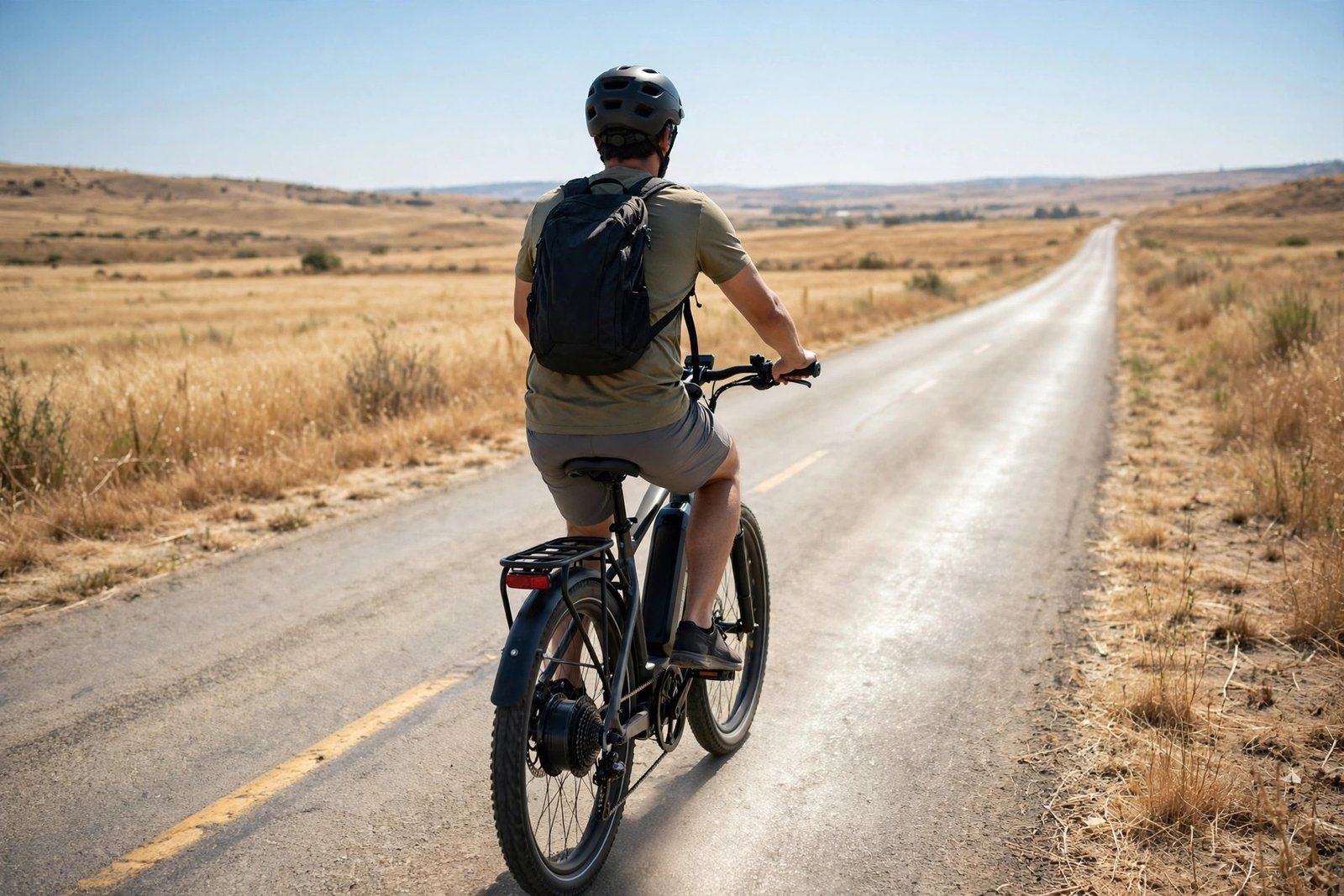
It is 100°F, the sun is straight overhead, and you still have to commute. Heat is the battery’s other enemy — and the rule is the same as the cold one, in reverse. In winter the battery loses range and hates the cold; in summer it loses range and hates the heat, and the heat is the more dangerous of the two, because a cold battery just goes flat and a hot battery can fail. Three numbers decide the ride, and this guide is built around them.
In this guide
- The short answer
- The three numbers that decide it
- The battery in the heat
- The charge rule — never charge a hot battery
- The ride — early, late, and in the shade
- The tyres — heat raises the pressure
- The apartment routine — battery inside, charge in the evening
- The hot car — never, not even for an hour
- Related reading
- The bottom line
The short answer
Never charge a hot battery, never leave the bike in a hot car, and ride early or late. Bring the battery inside to cool before it charges, charge in the cool evening, and check the tyre pressure before the ride — heat raises it. Do those three things and the summer commute is a normal ride, not a risk.
The three numbers that decide it
First, 105°F — never charge above it, and never charge a hot battery. 105°F is 40°C, and it is the ceiling for charging a lithium battery. A battery that comes off a ride in 100°F heat is already hot, so it rests for 30 to 45 minutes in a cool indoor space before it goes on the charger. Charging a hot battery is the one mistake that turns a summer ride into a fire risk.
Second, 50 to 77°F — the battery’s happy range. Between 10 and 25°C the battery is at its best, and that is the range to keep it in when you can. In scorching sun, summer range drops by up to 30 percent, so a battery that does 40 miles in spring does 28 in a heatwave — plan the ride on the smaller number, not the bigger one.
Third, 120°F — what a car interior reaches in an hour at 95°F outside. Schwinn’s own warm-weather guide gives that number, and it is the reason the bike and the battery never live in a hot car. A car parked in the sun is an oven, and a battery is not made to withstand it.
The battery in the heat
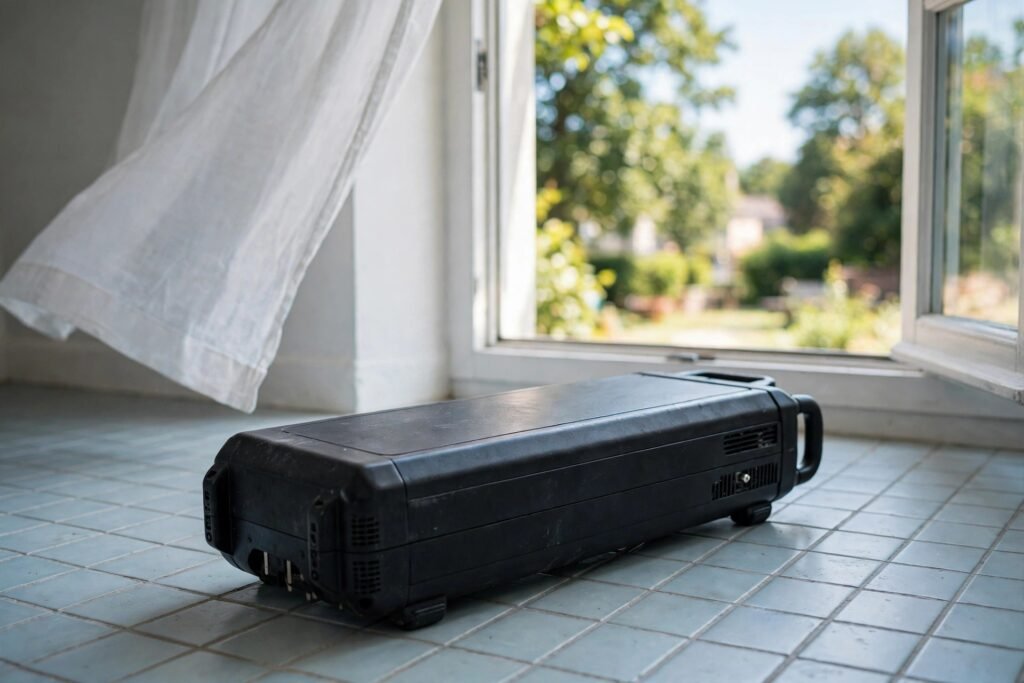
A lithium battery makes its own heat while it works, and the summer sun adds more on top. Riding in 100°F heat is riding with a battery that is already warm before it does any work, and the heat builds through the ride. That is why the range drops — the battery is working harder in worse conditions — and why the battery must cool down after the ride before anything else happens to it.
The fix depends on what kind of battery your bike has, and our three bikes show the two cases. If the battery comes out, take it inside to cool. If it does not, the whole bike comes inside.
The Lectric XP Lite 2.0 (Check latest price) is the removable case: a 48V 7.8Ah battery, 374Wh, that slides out of the frame with a key. Ride home, slide the battery out, and put it on a table indoors to cool — the bike can stay in the hallway while the battery cools where it is cool. At 49 lb the bike itself is light enough to carry in, too, but the battery is the part that needs the cool air.
The AYOLNY Foldable Electric Bike, 14″ Wheels (Check latest price) is the fixed case: a 36V 7.8Ah battery, 280.8Wh, that is non-removable — the maker’s own copy says so. There is no battery to take out, so the whole bike must come inside to cool, and it must cool before it charges. The bike folds, so it fits in the hallway, but it cannot stay out in the heat while you wait.
The Heybike Mars 3.0 is the in-between case: its 624Wh battery is removable, but the frame must be folded first to slide it out, and the key sits inside the fold area. Fold the frame, slide the battery out, and let it cool indoors — it is one more step than the Lectric, and the step is worth taking. The battery is UL 2271 certified, which is the battery standard, not the whole-bike UL 2849 standard — and the heat rules apply to it just the same.
Whichever bike you have, the rule is the same: the battery cools indoors, in the shade, before it charges. Never leave it on a sunny balcony to cool, and never put it in the fridge — a cool room is enough, and a cold shock is its own problem.
Heat does its damage slowly, not just on the day. A battery stored hot loses capacity faster than a battery stored cool, even when it is not being used — heat ages the cells whether you ride or not. That is why the summer storage rule matters as much as the charging rule: a battery that spends July at 100°F in a garage comes back in September with less range than it had in June. The cool indoor spot is not just for the charge, it is for the whole summer.
The charge rule — never charge a hot battery
Never charge a hot battery, and never charge above 105°F. The charge is when a lithium battery is at its most stressed, and heat on top of charging is the combination that fails. Ride home, let the battery rest for 30 to 45 minutes in a cool indoor space, and only then plug it in.
Charge in the cool evening, not in the hot afternoon. The evening air is cooler, the battery is cooler, and the charge is safer — the slow one goes on after dinner, not at midday. And the rest of the charging spine holds in summer exactly as it holds in winter: never charge overnight, never charge near an exit, plug straight into a wall outlet with no power strips and no extension cords, and use the charger that came with the bike. Never charge below 32°F or above 105°F, and never charge a battery that is hot to the touch — if you cannot hold it comfortably, it is too hot to charge.
A battery that has been in the heat needs the rest even if the ride was short. A ten-minute ride in 100°F heat still leaves a warm battery, and a warm battery still waits 30 minutes. The rest costs nothing and it is the cheapest safety rule in this guide.
The ride — early, late, and in the shade
Ride early in the morning or in the evening, and avoid 12 to 4 PM. The middle of the day is the hottest part of the ride and the hardest part on the battery, and it is the part of the day the sun is strongest on the rider too. A commute shifted an hour earlier or an hour later is a cooler ride and a cooler battery.
Shade the route where you can. A tree-lined street is cooler than an open road, and a shaded parking spot is cooler than a sunny one — park the bike in the shade at the far end, not in the sun by the door. The battery cools faster in the shade, and the saddle does not burn your hands when you get back on.
Hydrate like the ride is a workout, because in 100°F heat it is one. Carry water, drink before you are thirsty, and stop in the shade if you feel dizzy, nauseous or unusually tired — those are heat symptoms, and the ride can wait. A helmet is still non-negotiable in the heat, and a light-coloured one is cooler than a dark one.
Use the assist less and the gears more on the hottest days. High assist in high heat is the battery working hardest when it is already hottest, so drop a level and pedal a little more — the ride is slower and the battery is cooler. The range stretches too, which is the same trick as the cold-weather one, in reverse.
If the bike cuts the assist or the display shows a temperature warning, stop and let it cool. A cut-out in the heat is the bike protecting its battery, not a fault — park it in the shade, wait, and ride on when the assist comes back. Forcing a hot bike to keep going is how a warm battery becomes a failed one.
The tyres — heat raises the pressure
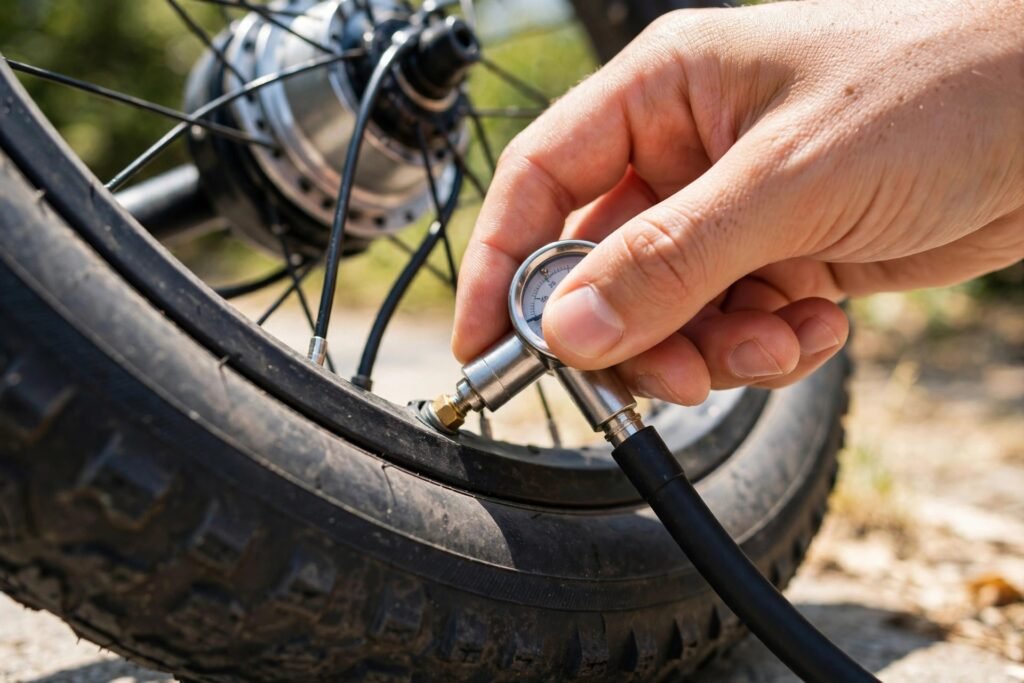
Heat raises tyre pressure, so check it before the ride, not after it. A tyre pumped to full pressure in a cool morning is over pressure by the afternoon, and an over-pressure tyre is a harder, harsher ride with less grip. Check the pressure in the shade, before the ride, and let a little out if it is above the number on the sidewall.
Our free Tire Pressure Calculator takes your weight, your tyre size and your riding style and gives you the pressure to run. Put in the summer numbers, not the winter ones — the same tyre needs less pressure in the heat than in the cold.
Check the tyres themselves, not just the pressure. Hot tarmac softens rubber, and a tyre that is already worn or cracked is the one that fails in the heat. Look for cracks in the sidewall and wear on the tread before the summer riding starts, and replace a tyre that is showing its age — a blowout in 100°F heat is a long walk home.
The apartment routine — battery inside, charge in the evening
The battery comes inside to cool, and it charges in the cool evening. That is the whole apartment routine in one sentence, and it is the same routine as the winter one, with the direction reversed: in winter the battery comes inside to warm up, in summer it comes inside to cool down. The flat is the coolest place the battery will be all day, so use it.
If the battery is removable, it lives on a table indoors between rides — not on a sunny balcony, not in a hot hallway by the front door, and never in a car. If the battery is fixed, the whole bike lives indoors between rides, folded in the hallway, out of the sun. The Mars 3.0 folds to bring its battery in; the AYOLNY folds to bring the whole bike in; the Lectric’s battery slides out on its own.
The charger comes inside too, and it charges in the shade, not on a sunny windowsill. A charger makes its own heat while it works, and a charger in the sun is a charger working in the heat — put it on the floor in a cool room, with air around it. Never cover it with a cloth while it charges, and never charge on a bed or a sofa.
Store at 50 to 60 percent if the bike is unused for over a week. A battery left full in the heat ages faster, and a battery left empty in the heat is worse — half full is the resting state, and it is the state the battery keeps best in. Check the charge once a week, top it back to half if it has drifted, and charge it fully only the evening before the next ride.

The hot car — never, not even for an hour
The bike and the battery never live in a hot car. A car interior hits about 120°F in an hour at 95°F outside, per Schwinn, and a battery is not made to withstand that. An hour in a hot car is hotter than any ride, and the battery has no airflow in there to cool it down.
This is the rule that catches people on summer trips. The bike goes on the rack or in the boot for the drive, and it comes out at the other end — it does not sit in the car while you have lunch, and it does not sit in the car overnight. If the car is the only transport, park it in the shade, crack the windows, and get the bike out as soon as you arrive. A battery that has been in a hot car rests indoors for 45 minutes before it charges, just like a battery that has been ridden hard.
Related reading
- Can You Ride an E-Bike in the Rain? IP Ratings Explained in Plain English
- How Long Does an E-Bike Battery Last? (and How to Make Yours Last Longer)
- Can You Charge an E-Bike Battery Inside Your Apartment? The Honest Safety Answer
- How to Store Your E-Bike for Winter (Battery, Tires, Chain — the Flat-Dweller’s Checklist)
The bottom line
Heat is the battery’s other enemy, and the rule is the same as the cold one, in reverse. Never charge a hot battery, never charge above 105°F, and never leave the bike in a hot car. Bring the battery inside to cool, charge it in the cool evening, check the tyres before the ride, and ride early or late. Do those things and the summer commute is a normal ride — hot, but safe.
Previous: How to Clean an Electric Scooter in an Apartment (No Hose, No Balcony): The Bucket Method
Next: What Wattage E-Bike Do I Need? (250W vs 500W vs 750W vs 1000W)