
Some links in this article are affiliate links. If you buy through them, we may earn a commission at no extra cost to you.
Your commute is ten miles each way, and the ride home is the part you worry about. Yes, you can charge your scooter at work — in most workplaces, if you ask first. A full charge costs your employer about four to ten cents, and eight of our nine scooters are full inside an eight-hour workday. The hard part is not the electricity. It is asking, and doing it in a way nobody minds.
In this guide
- 💡 The short answer
- 🔌 1. The ask — one outlet, one scooter, one workday
- 💰 2. What does a charge actually cost your employer?
- 📊 3. The nine scooters — the charge-time table, and the workday test
- 🔋 4. The two scooters that NEED the work charge
- 🧱 5. The setup — the brick under the desk, the scooter by the wall
- 🛡 6. The safety spine — the charger that came with the scooter, and nothing else
- ❓ 7. What if the answer is no?
- 📚 Related reading
- ✅ The bottom line
💡 The short answer
Ask first, plug in at your desk or by the wall, and the scooter is full by home time. Your workday is longer than your scooter’s charge time — the slowest published charge in our range is seven and a half hours, and the fastest is three and a half. For two of our scooters, the work charge is not a convenience — it is the commute itself.
🔌 1. The ask — one outlet, one scooter, one workday
Workplace charging is a permission, not a right — and the ask is specific. You are plugging a personal device into a shared building, and the first time someone notices a scooter by the wall, they will ask whose it is. If you asked first, that conversation is already over.
Ask the facilities or office manager — the person who controls the sockets, not HR and not your boss. Ask for a socket, not for permission to “charge a vehicle”. The words matter: “vehicle” sounds like a car in the car park; a socket sounds like a phone charger, which is what it is. Here is the script, word for word:
“I ride an electric scooter to work. Could I plug it in at my desk during the day? A full charge costs about ten cents of electricity, and I bring my own charger.”
That is the whole ask. Most employers say yes because it costs them almost nothing — and your scooter frees up a car space. Some will point you at a specific socket, or a bike room instead of your desk. Take the socket they offer — the one they chose is the one nobody will complain about.
If the facilities manager sends you to HR, go — and take the same script. The ask does not change because the person does: one socket, one scooter, ten cents a charge, your own charger. And in the first week, charge only on the socket you were given. Do not quietly expand to a second socket, or a second scooter, without asking again — the permission was for one scooter, and the trust it builds is worth more than the extra outlet.
💰 2. What does a charge actually cost your employer?
About four to ten cents for a full charge — and that is the number that makes the ask easy. Electricity in the US costs about 17.23 cents per kilowatt-hour on average (EIA, 2025 final data); a battery’s size is printed on it in watt-hours. Divide by a thousand, multiply by the price.
| Battery | Size | Full charge costs about |
|---|---|---|
| Segway Ninebot E2 Plus | 220Wh | 4 cents |
| Segway Ninebot E2 Pro | 275Wh | 5 cents |
| HopCycle | 281Wh | 5 cents |
| Hiboy S2 Pro | 418Wh | 7 cents |
| Segway Ninebot MAX G2 | 551Wh | 10 cents |
| Hiboy S2 MAX | 557Wh | 10 cents |
| Segway Ninebot MAX G3 | 597Wh | 10 cents |
A working year of weekday charges costs about $10 to $27, depending on the scooter — less than a single tank of petrol. Offer to pay it if the ask feels easier that way; most employers will wave it off. The offer is the point: it shows you have done the maths, and the maths is trivial.
Run the year, not the day. A working year is about 260 weekday charges: the cheapest scooter in this guide costs about $10 a year, the dearest about $27, and the average about $18. That is less than a single tank of petrol, and less than a week of bus fares in most cities. The number is small enough that most employers will not bother with it — and that is exactly why the offer to pay it works: it shows you have done the maths, and the maths is trivial.
📊 3. The nine scooters — the charge-time table, and the workday test
Every one of our scooters with a published charge time fully charges inside an eight-hour workday. The table proves it — the times are the makers’ stated times, from our charge-times guide.
| Scooter | Battery | Charger | Full charge | Plan on (80%) | Price |
|---|---|---|---|---|---|
| Segway Ninebot MAX G3 | 597Wh | 209W built-in | About 3.5 hours | About 2.5 hours | Check latest price |
| Segway Ninebot MAX G2 | 551Wh | 121.8W built-in | About 5 hours | About 4 hours | Check latest price |
| Hiboy S2 MAX | 557Wh | 109W | 6 to 7 hours | About 4.5 hours | Check latest price |
| Hiboy S2 Pro | 418Wh | 84W | 4 to 6 hours | About 4 to 4.5 hours | Check latest price |
| Segway Ninebot E2 Pro | 275Wh | 70W | About 5.5 hours | About 3.5 to 4 hours | Check latest price |
| HopCycle Electric Scooter | 281Wh | 42V charger (amps not stated) | About 5 hours | About 3.5 hours | Check latest price |
| Phantomgogo Electric Scooter | Check the label | Check the label | About 5.5 hours | About 4 hours | Check latest price |
| Segway Ninebot E2 Plus | 220Wh | 36.3W | About 7.5 hours | About 5.5 hours | Check latest price |
| WERHY 500W Adult Scooter | Check the label | Check the label | Check the label | Check the label | Check latest price |
The MAX G3 is the fastest charge in our range and the biggest battery in it — 597 watt-hours filled in about three and a half hours, because the built-in charger pushes 209 watts, more than twice any other here. The E2 Plus is the slowest charge and the smallest battery — 220 watt-hours on a 36-watt charger takes about seven and a half hours. And seven and a half hours still fits inside an eight-hour workday: plug it in at nine, and it is full at half past four. But it only just fits — if your workday is shorter than eight hours, the E2 Plus is the one scooter that needs the full day.
The 80% rule is what makes the workday comfortable. Plug the MAX G3 in at nine and it is at 80% before lunch; plug the E2 Plus in at nine and it is at 80% by mid-afternoon, full by home time. If you arrive with a nearly empty battery, the 80% time is the one that matters — you do not need a full battery to get home, you need enough, and enough comes hours sooner than full.
The 80% column is the number to plan on. A lithium battery charges fast while it is empty and slows down as it fills — the last fifth is a slow finish, taking about half as long again as the bulk charge. Plan on 80%, not 100%, and the scooter is ready hours sooner. Our Charging Time Calculator takes your battery in watt-hours and your charger in amps and gives you the time from any starting charge — run it once for your scooter, and the workday maths is settled.
🔋 4. The two scooters that NEED the work charge
For two of our scooters, the work charge is not a convenience — it is the commute. The Hiboy S2 Pro and the Segway Ninebot E2 Pro cannot do a ten-mile-each-way round trip on one charge — our long-commutes guide proved it. Without a work charge, neither of them does a ten-mile commute. With one, both of them do.
That changes the ask. If you ride one of these two, do not ask for a socket as a favour — ask for it as the condition of the commute. The script is the same, but the stakes are different: if the answer is no, the scooter cannot do your commute, and you need a different scooter or a different route. Ask before you buy, not after: a work charge that is not certain is a commute that is not certain. The MAX G2 and the MAX G3 do the same ten-mile round trip without a work charge at all — if the answer might be no, that is the scooter to buy.
The range maths is why. A scooter’s claimed range is a best case — on a real commute, plan on 60 to 70% of the claim, and a ten-mile-each-way round trip needs twenty real miles. The S2 Pro and the E2 Pro cannot promise twenty real miles on one charge, so the work charge closes the gap. The MAX G2 and the MAX G3 can promise it — which is why they are the scooters to buy if the answer might be no.
🧱 5. The setup — the brick under the desk, the scooter by the wall
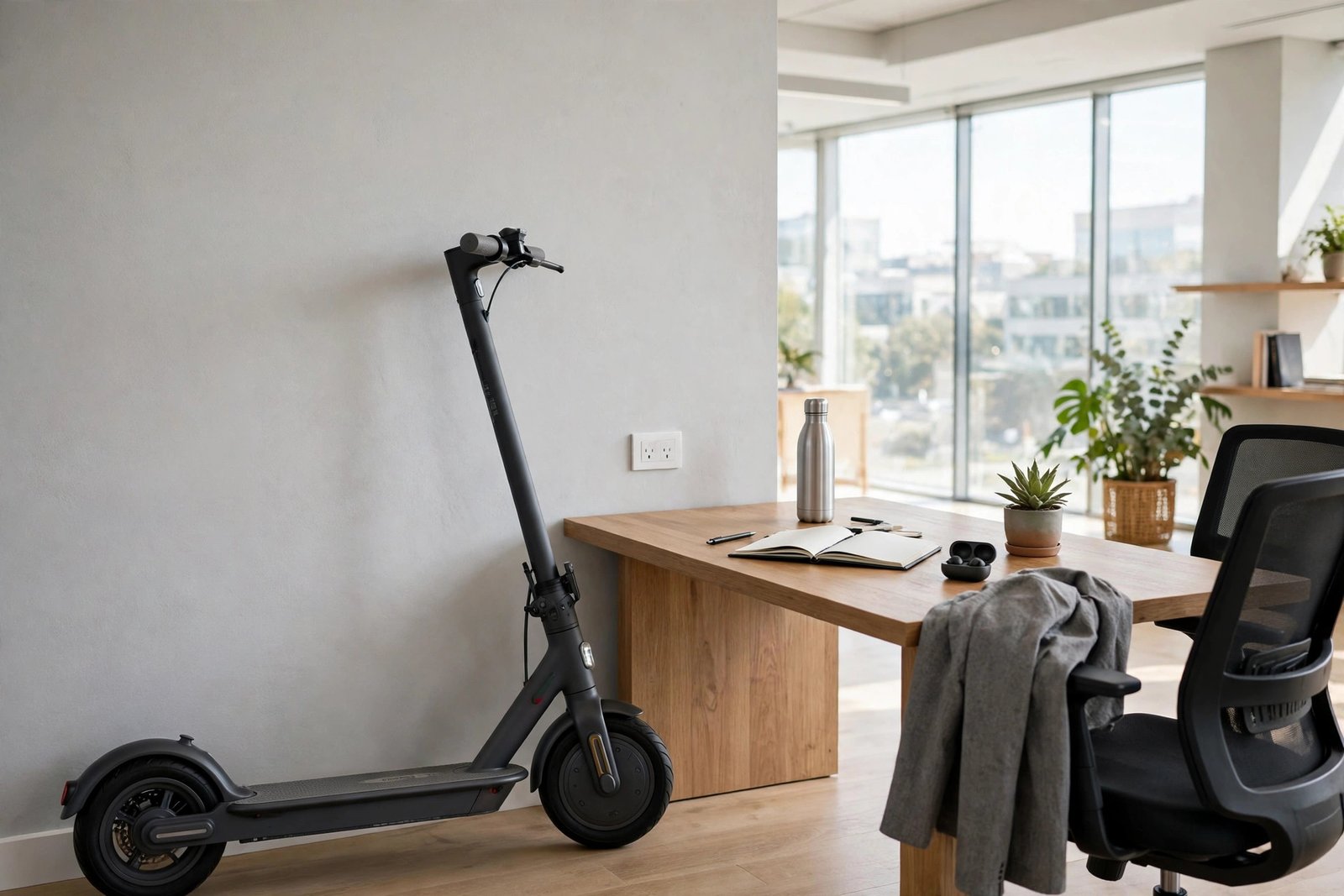
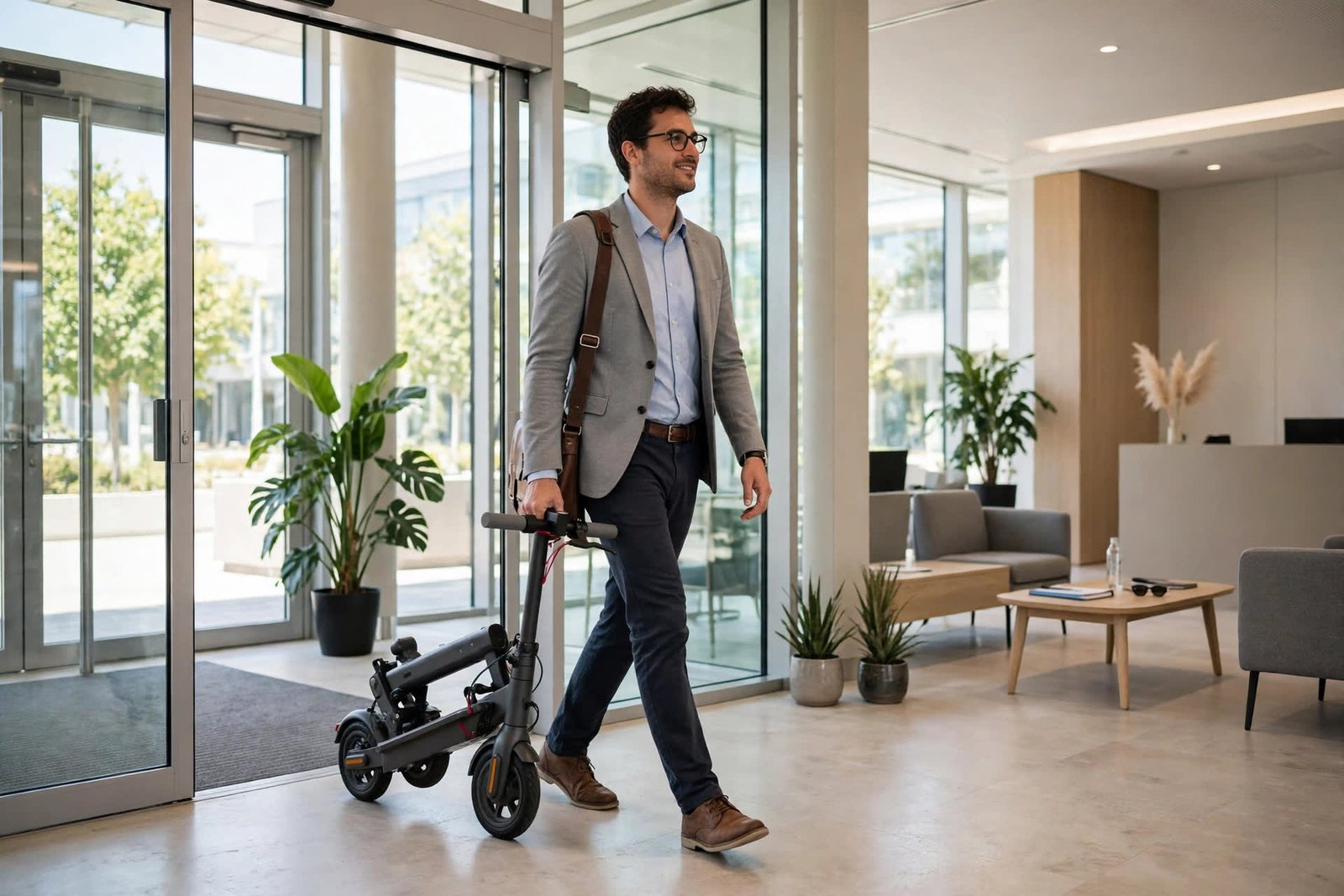
The scooter version has one difference from the e-bike version, and it matters: the whole scooter comes inside. None of our scooters has a removable battery, so there is no battery to carry in and no bike to leave outside — the scooter comes through the door, folds flat, and stands by the wall. That is the deal you are offering your employer: a folded scooter against the wall, not a vehicle in the car park.
The charger is a small external brick that sits under the desk — except the MAX G2 and the MAX G3, whose chargers are built in and charge with just a cord, no brick at all. Plug the charger straight into a wall outlet, never into a power strip, and put the brick on the floor where it can breathe, not buried under papers. Run the cable along the wall, not across the walkway — a cable across the floor is a trip hazard, and a trip hazard is the fastest way to lose the socket.
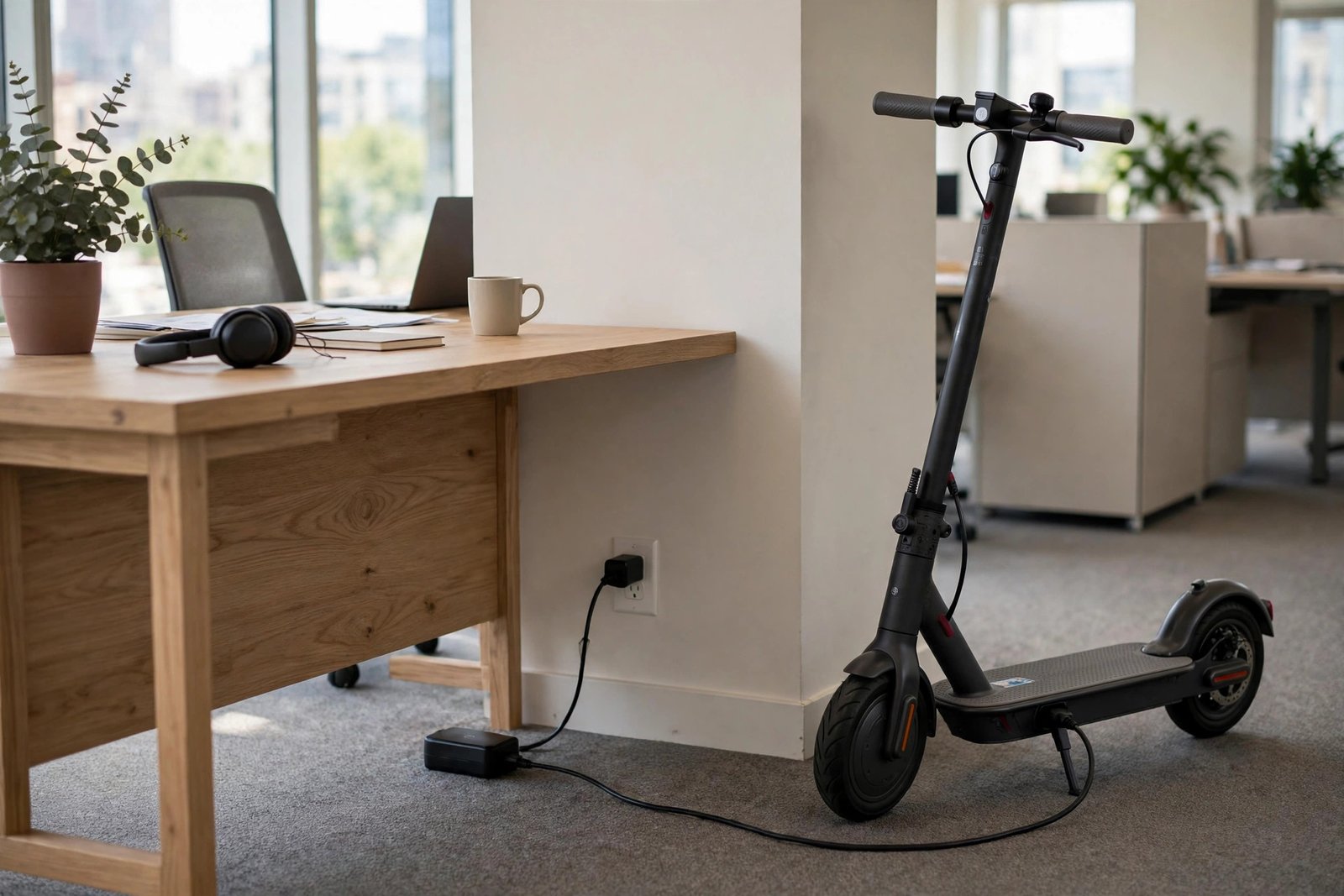
Park the scooter by the wall, never blocking an exit, never in a corridor, never in front of a fire door. The scooter is 30 to 54 lb of lithium battery, and the fire services’ rule is the same at work as at home: never charge near an exit, because the exit is the way out if the battery ever fails. A scooter by the wall, out of the way, charging quietly — that is the setup nobody objects to.
🛡 6. The safety spine — the charger that came with the scooter, and nothing else
Charge it the way the fire services say: with the charger that came with the scooter, straight into a wall outlet, where you can see it. Never charge overnight at work — the office is empty at night, and nobody is there to notice a problem. Never charge a battery that is swollen, hot, or damaged — if the deck feels hot, or the scooter smells of chemicals, do not plug it in, and tell your manager. Never charge below 32°F or above 105°F, and never charge a frozen battery.
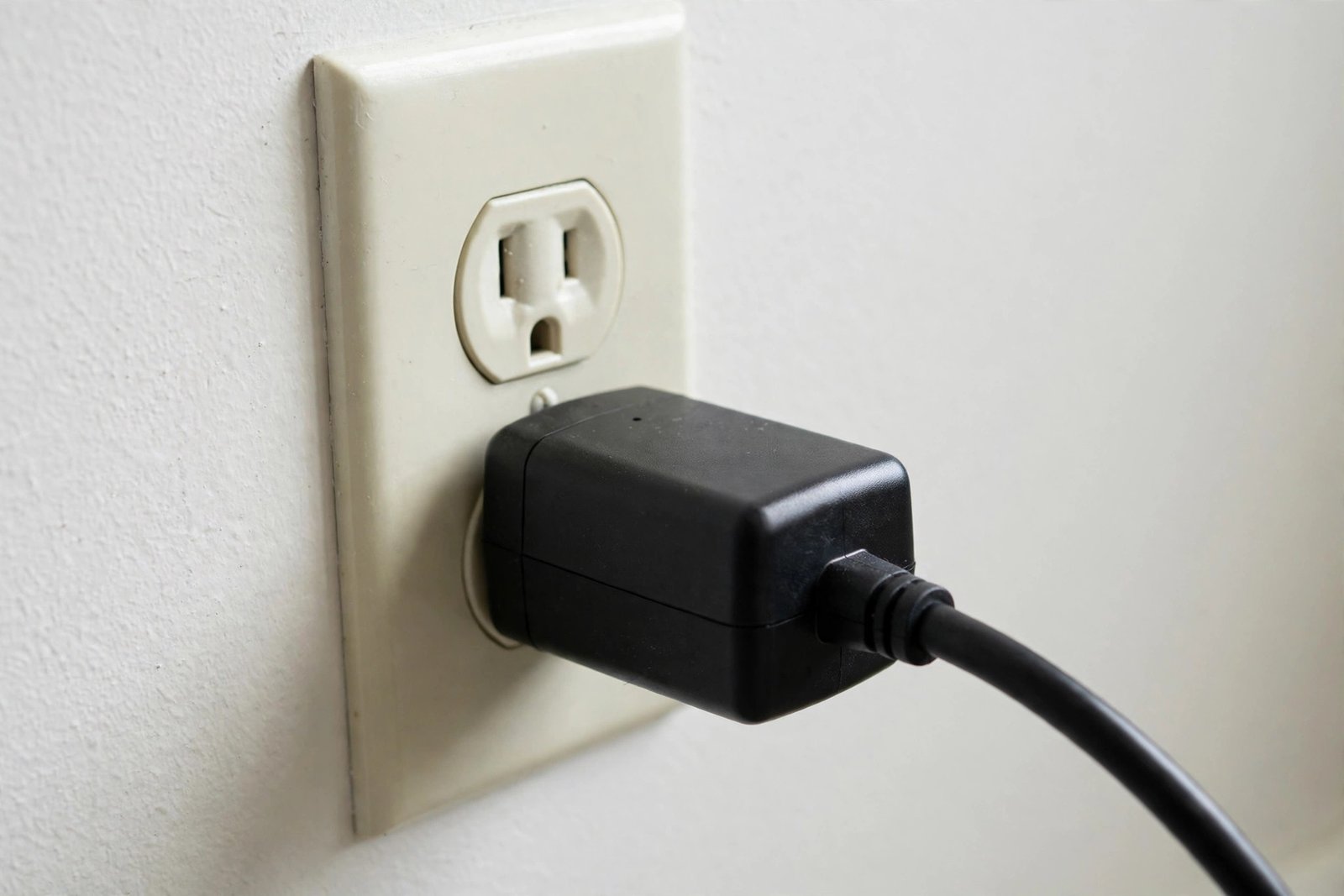
Unplug when it is full. A scooter left on charge all day after it finished is a scooter nobody is watching, and the habit of leaving it plugged in is the habit that causes the problems. Plug it in at nine, unplug it at home time, and the routine is the safety.
❓ 7. What if the answer is no?
If the answer is no, do not argue — ask what would make it yes. Some employers will say yes to a bike room instead of a desk, or to a specific socket by the entrance, or to charging two days a week instead of five. Take the yes they offer, even if it is smaller than the one you asked for. A socket in the bike room is still a full charge by home time.
And if the answer is a flat no, the commute still has options: charge at home the night before and ride a scooter that does the round trip on one charge — the MAX G2 or the MAX G3 — or split the commute with the train, and charge at home. The work charge is the easiest answer, not the only one.
📚 Related reading
- Can I Charge My E-Bike at Work? (The Commuter’s Guide — Ask First, Then Plug In)
- Best Electric Scooter for Long Commutes (10+ Miles): Real Range, Not the Box Claim
- How to Charge an E-Bike When You Have No Outlet
- How Long Does It Take to Charge an Electric Scooter
✅ The bottom line
Your workday is longer than your scooter’s charge time — and for two of our scooters, the work charge IS the commute. Ask the facilities manager for a socket, not for permission to charge a vehicle. A full charge costs about four to ten cents. Plug it in at nine, unplug it at home time, and the scooter is full for the ride home — every day, for about a dollar or two a month.
Previous: Article #92 “Best Electric Scooter for Rough Roads and Potholes (Suspension That Actually Smooths the Ride)“
Next: Article #94 “How to Ride an Electric Scooter in Summer Heat (Battery, Tyres, and the 105°F Rule)“