

Some links in this article are affiliate links. If you buy through them, we may earn a commission at no extra cost to you.
Your e-bike battery is the most expensive part of the bike — usually the single most expensive thing you will ever replace on it. And unlike a tire or a brake pad, you cannot see it wearing out. It just quietly holds a little less charge each year, until one day your 40-mile range is 30 miles, then 25, and the commute you bought the bike for starts to feel tight.
The good news is that most of that wear is not fate. It is habit. How you charge, where you store the battery, and how deeply you drain it decide whether you get three years out of a pack or five — and the habits that help cost nothing. This article explains what a charge cycle actually is, the simple charging rule that adds years, how to store a battery properly, and the warning signs that say it is time to replace it.
The short answer: 3–5 years, or 500–1,000 charge cycles
A quality lithium-ion e-bike battery typically lasts between 500 and 1,000 full charge cycles, which works out to roughly 3 to 5 years of regular riding (per eBikeRepairCo, BikeBesties and eBicycles.ai, all checked November 2026). A daily commuter who runs the pack down every other day will hit 500 cycles in under three years; a weekend-only rider can stretch the same battery past five, and sometimes past seven.
Two things that surprise most owners:
- “End of life” does not mean the battery dies. It means its usable capacity has fallen to roughly 70–80% of its original rating — the point the battery industry defines as the end of useful life. The bike still rides. It just goes less far on a charge, and the range keeps sliding from there.
- The range is wide because the habits are wide. A commuter hammering full assist through hilly terrain every day might watch the range shrink in two years; a rider who charges gently and stores the battery well can get five. The battery you get is partly the battery you buy — and mostly the battery you look after.
What is a charge cycle, really?
A charge cycle is one full use of the battery’s capacity — 100% down to 0% — but it does not have to happen in one go. If you use 50% of the battery today and recharge, then use another 50% tomorrow and recharge, that adds up to one cycle, not two. Two rides that each drain 50%, followed by top-ups, equal a single cycle (per eBikeRepairCo and eBicycles.ai).
That matters for two reasons:
- Batteries are rated by cycles, not by years. The number on the spec sheet is a count of full discharges, not a calendar date. A rider who uses 25% of the battery on a daily 10-mile round trip and plugs in nightly consumes roughly one cycle every four days — about 90 cycles a year — and will take years to reach 500 (per eBicycles.ai).
- Partial top-ups are fine — and actually gentler than full cycles. You do not need to drain the battery before charging it, and you should not. Shallow discharges and partial charges count as fractions of a cycle, and they wear the cells less than running the pack flat every time.
Should you charge to 100% every time?
No — not for daily use. The single most effective habit for battery life is also the simplest: keep the battery between roughly 20% and 80% for daily riding (per eBikeRepairCo, BikeBesties and CyberBikes). Charging to 80% for daily use, rather than 100% every time, reduces the voltage stress on the cells — and operating mostly inside that 20–80% window can stretch a quality pack to as many as 1,500 partial cycles before noticeable degradation (per eBikeRepairCo).
The rules, in plain language:
- Daily riding: charge to about 80%. Unplug when it reaches 80% — or use the timer on your charger if it has one. You lose a little range on paper, and you gain years of battery life in practice.
- Long ride coming up: charge to 100%, and ride soon after. A full charge is fine when you actually need the range. What wears the battery is sitting at 100% for days, not reaching 100% itself.
- Do not drain it to 0% regularly. Deep discharges below 10% shorten the battery life (per Ufine Battery). If the battery is nearly empty, charge it — do not ride it flat to empty it out. There is no memory effect to manage on a lithium battery; that idea belongs to older battery types.
- Do not leave it on the charger for days. Once the battery is full, unplug it. A battery left plugged in at 100% for days is a battery being held at its most stressful state for no reason.
What charge level should you store the battery at?
If you will not ride for more than a few days, do not store the battery full and do not store it empty. The guidance from the sources that test this agrees closely (per Himiway, BikeBesties and eBicycles.ai):
- Store at 30–60% charge — Himiway guidance is 30–60% for storage of more than a few days; BikeBesties and eBicycles.ai put it at 40–60%. Anywhere in the 40–60% middle is the safe answer, and the exact number matters less than avoiding the two extremes.
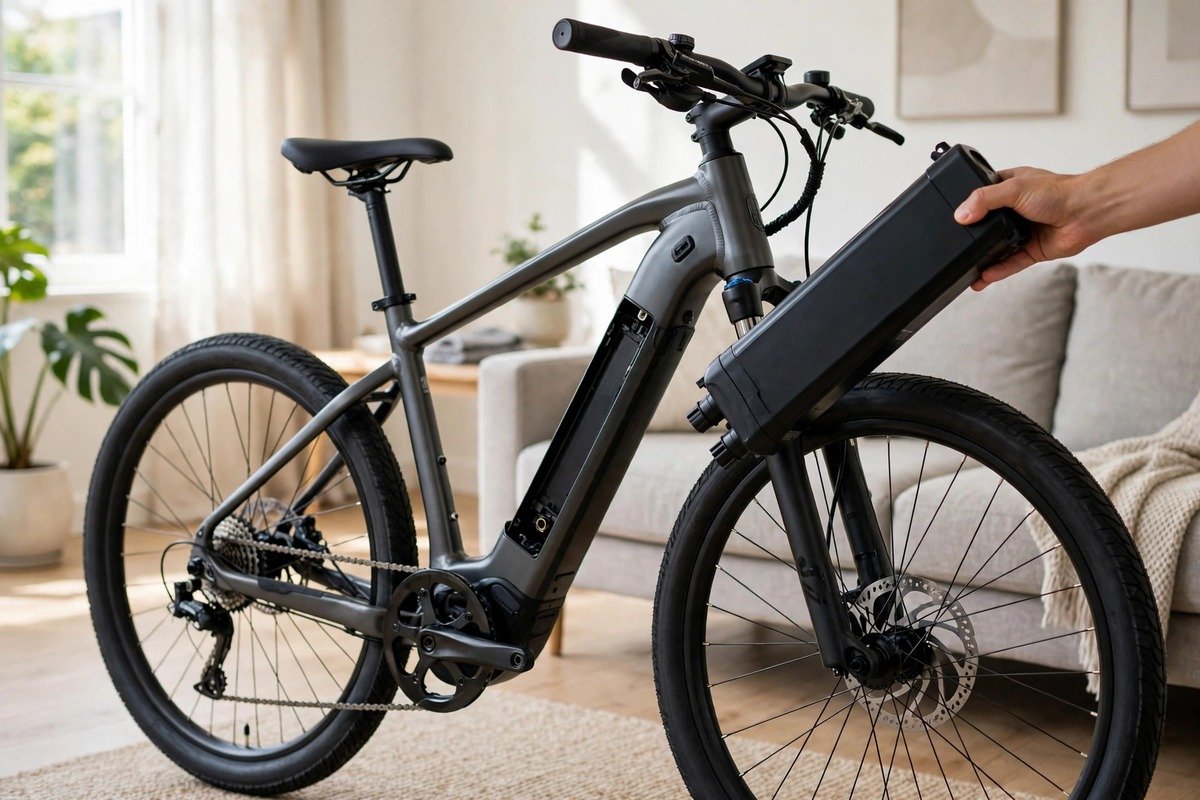
- Store it indoors, at room temperature. A cool, dry spot, roughly 50–70°F (10–21°C), away from radiators, sunlight and damp. A removable battery makes this easy — it comes inside while the bike stays in the garage or bike room.
- Top it up every six to eight weeks. A stored battery slowly loses charge on its own. Check it every six to eight weeks during long storage and bring it back to around 50% if it has drifted down (per eBicycles.ai). A battery left for months at 0% may not come back at all.
- Winter storage is the same rule, not a different one. Store at 40–60% in a cool, dry spot indoors — and never charge a frozen battery (see below).

Heat and cold: the two things that actually kill batteries
The four biggest battery killers, named by the guides that track this, are sustained heat, regularly draining to 0%, storing the pack at 100% charge, and charging below freezing (per eBicycles.ai). Two of them are about temperature, and they are worth understanding properly:
- Heat is the slow killer. Sustained heat accelerates the chemical reactions that wear cells out. Do not leave the battery in a hot car, in direct sun, or next to a radiator. If the battery feels hot after a ride, let it cool to room temperature before you charge it.
- Never charge a frozen battery. The rule is absolute and every source agrees on it: never charge a lithium battery below 32°F (0°C) (per PNW eBike 32°F rule, cited in our research). Bring the battery indoors and let it warm to room temperature first. Charging a cold battery can cause permanent damage — and it is a fire risk.
- Cold riding is fine; cold charging is not. Riding in the cold costs you range — the battery gives less while it is cold — but that loss is mostly temporary, and the range comes back when the battery warms up. What does permanent damage is charging while the battery is still cold, and storing it for months in a freezing shed.
What shortens battery life fastest?
In order, the habits that cost you the most:
- Storing the battery at 100% for weeks. The single worst storage habit — a full battery held at full charge is under maximum voltage stress the whole time.
- Regularly draining it to 0%. Deep discharges wear cells far more than shallow ones. If you ride until the motor cuts out, you are spending battery life faster than you need to.
- Charging below freezing. Permanent damage, not just lost range — and a fire risk. Never do it.
- Sustained heat. Hot cars, direct sun, radiators. Heat is the slow killer that adds up over years.
- Always riding on maximum assist. A commuter hammering full assist through hilly terrain every day will see the range shrink in two years where a gentler rider gets five (per BikeBesties). Full assist is not free — it spends cycles faster.
None of these is a reason to worry. They are a reason to charge to 80%, store at 50%, and bring the battery inside. Three habits, no cost, years of difference.
When is a battery too old to keep using?
A battery does not announce its retirement. It fades, and the signs are gradual — until one of them is not:
- Range has dropped noticeably. Your 40-mile battery now manages 30, then 28, and each season the slide steepens (per eBicycles.ai). When the range no longer covers your commute with a buffer, the battery is at the end of its useful life — even if it still works.
- Voltage sag on hills. The bike feels weaker on climbs than it used to, or the motor cuts out briefly under load. This is the sign of cells that can no longer hold voltage under demand.
- Rapid cutouts or sudden drops. The battery shows charge, then drops to empty without warning, or the bike shuts off mid-ride. At this point the battery is unreliable, not just old — and an unreliable battery on a commute is a stranded rider.
- Swelling, heat or smell. Stop using it immediately. Do not charge it, do not store it in the house, and move it somewhere safe outdoors if you can do so without risk. A swollen or hot battery is a fire risk, and no amount of remaining range is worth it. This is also the rule from our charging-safety article: if the battery gets hot, swells or smells, stop — and never use a cheap universal charger. The CPSC has warned against universal chargers after 156 fire and overheating reports (per Bridgehill, cited in our research).

Replacement: when the time comes, buy only the manufacturer’s own battery for your bike — never a cheap no-name replacement. A replacement battery is expensive, which is exactly why the habits in this article are worth following: every year you add to the pack is a year you do not pay for a new one. The industry norm for warranty is 2 years or 500 cycles, whichever comes first, covering defects and abnormal capacity loss — not normal fade (per eBicycles.ai).
You may also like: The batteries in our range that make good storage practice easy are the removable ones — the Heybike Mars 3.0, with the biggest removable pack we cover at 624 Wh, and the Heybike Mars 2.0. The battery comes inside; the bike stays put.
Best product for battery longevity
Heybike Mars 3.0 — the bike in our range that makes the habits in this article easy, because its 624 Wh battery is removable: it comes inside to charge at room temperature, it stores at partial charge in a cool dry room, and it never has to sit in a freezing garage or charge while cold. 750W nominal motor (1400W peak), 624 Wh removable battery, 20″ × 4.0″ fat tires, full suspension. Check latest price on Amazon
What we will not pretend otherwise: we have not verified a UL 2271 or UL 2849 certification for the Mars 3.0 on the live listing, and we do not claim one here — the battery advantage in this article is that it is removable, not that it carries a particular certification. What we can say is that it is the biggest removable pack in our range (per Chain & Charge, citing Heybike), and that a removable battery is what turns the storage and charging rules in this article from good advice into something you can actually do.

Frequently asked questions
How long does an e-bike battery last?
A quality lithium-ion e-bike battery lasts 500–1,000 full charge cycles, or about 3–5 years of regular riding, before its capacity drops to roughly 70–80% of new. A daily commuter may reach that in under three years; a weekend rider can stretch the same battery past five.
Should I charge my e-bike battery to 100% every time?
No — not for daily use. Charge to about 80% for daily riding; the 20–80% window reduces voltage stress and can stretch a quality pack to 1,500 partial cycles. Charge to 100% only when you actually need the range for a long ride, and ride soon after.
What charge level should I store my battery at?
Between 30% and 60% — the middle of that range, around 40–60%, is the safe answer. Store it indoors at room temperature, in a cool dry spot, and top it back to about 50% every six to eight weeks during long storage.
Does leaving the battery on the charger damage it?
Yes, if you leave it plugged in at 100% for days. Once the battery is full, unplug it. What wears the battery is sitting at 100% for long periods, not reaching 100% itself.
Can an e-bike battery catch fire when it is not charging?
Yes — batteries can ignite even at rest, which is why storage location matters as much as charging. Store and charge away from exits, on a hard surface, and never use a cheap universal charger. If a battery swells, gets hot or smells, stop using it immediately.
When is a battery too old to keep using?
When its range no longer covers your commute with a buffer, when it sags or cuts out on hills, or when it drops charge suddenly. The industry defines end of life as capacity falling to about 70–80% of new. Swelling, heat or smell means stop immediately — that is a safety problem, not an age problem.
Browse by category: Folding E-Bikes · Commuter E-Bikes · Electric Scooters · E-Bike Accessories
As an Amazon Associate, BoltWander earns from qualifying purchases.
Keep reading
Related articles:
- Can You Charge an E-Bike Battery Inside Your Apartment? The Honest Safety Answer — the charging routine, in full
- E-Bike Battery Safety — What UL 2849 Means — the certifications behind the battery, explained
- E-Bikes in Winter: How Much Range You Lose in the Cold (and How to Get It Back) — cold-weather range and the freezing rule, in detail
Previous: Can You Carry a Folding E-Bike Up the Stairs? The Honest Weight Answer
Next: Can My Landlord Ban My E-Bike? What Apartment Renters Need to Know
Photo credits: the photographs in the middle of this article — the charging photograph, Pedelec-Lader-Gepida Akku-Li-Ion Foto-quer — are from Wikimedia Commons, licensed CC BY-SA 3.0, and the handlebar-display photograph, Himiway E-Bike Speedometer on Handlebar by Erik Mclean, is from Pexels. Each image was cropped to 1200×800.
