
Some links in this article are affiliate links. If you buy through them, we may earn a commission at no extra cost to you.
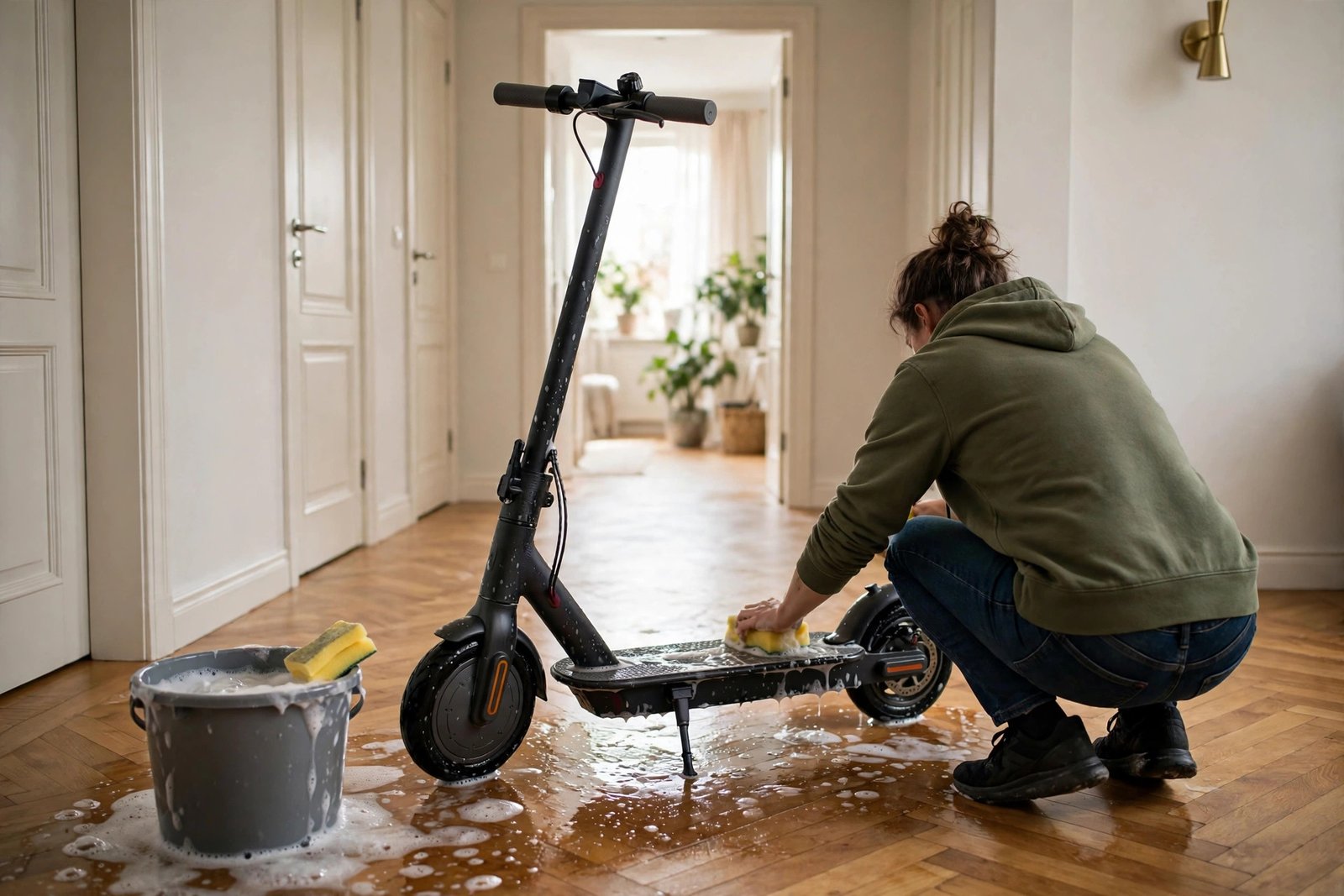
Your scooter is covered in road grime. The deck is black, the wheels are grey, and the stem has a stripe of mud up one side — and you have no hose, no balcony and no garage. The question is how to clean it in your flat without flooding the hallway or killing the electrics. The answer is a bucket, a sponge and twenty minutes, in the hallway, with the scooter standing on cardboard. This guide gives you the five rules that keep the water out of the electrics, the kit that fits in a cupboard, and the wash step by step.
In this guide
- The short answer
- A scooter is not an e-bike in the wash
- Rule 1 — system off and unplugged before any water
- Rule 2 — no hose and no pressure washer, ever
- Rule 3 — the charging port shut, the display wiped dry
- Rule 4 — cleaners stay off the brakes
- Rule 5 — dry it before it goes back
- The kit — bucket, sponge, two brushes, cardboard
- The wash, step by step
- How wet can yours get? — the seven scooters
- How often
- Related reading
- The bottom line
The short answer
System off and unplugged, a bucket and a damp cloth, and nothing sprayed at the electrics. A scooter is washed with a wrung-out sponge, not a hose, and the parts that stay dry are the charging port, the display and the deck seam. Dry it before it goes back in the hallway, and the whole job takes twenty minutes.
A scooter is not an e-bike in the wash
Our #74 is the e-bike version of this guide, and the method looks the same — a bucket, a sponge, cardboard under the wheels. But a scooter is not an e-bike in the wash, because the battery is under the deck, and the deck is where the water goes. An e-bike pack slides out of the frame with a key, so the first step is taking the battery out. A scooter pack is bolted inside the deck, so there is no battery-out step — the battery stays in, and the water stays out.
That changes the wet points. On an e-bike the wet points are the battery mount and the display. On a scooter the wet points are the charging port, the display and the deck seam — the three places water can reach the battery and the controller. Everything in this guide is built around those three points: the port cover stays shut, the display gets wiped, never sprayed, and the seam gets a damp cloth, never a running tap.
Rule 1 — system off and unplugged before any water
Nothing wet touches the scooter until the system is off and the charger is unplugged. Power the scooter off, unplug it from the wall, and leave it unplugged for the whole wash. A scooter that is charging while it is washed is a scooter with live current and wet hands, and that is the one combination this guide never allows.
Wait a moment after switching off — if the display is still lit, the system is still on. Then the wash begins, and the scooter stays off until it is dry again.
Rule 2 — no hose and no pressure washer, ever
No hose and no pressure washer, ever — a bucket and a damp cloth is the wash. A pressure washer drives water past seals that rain cannot get past, and it drives grit into bearings and brake pads. The water rating on your scooter is a rain rating, not a jet-washer rating, and a pressure washer voids it in practice even if it does not void it on paper.
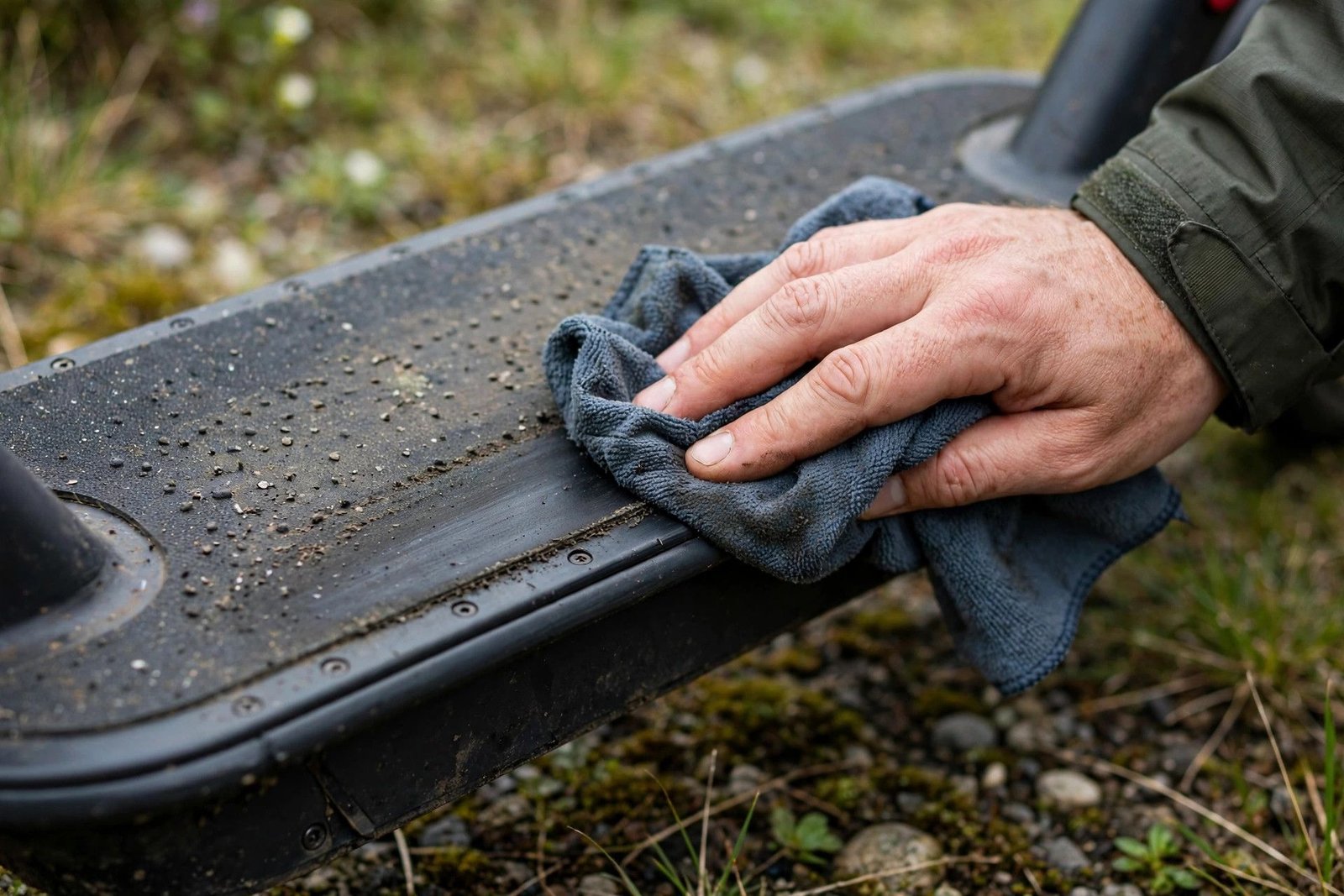
The wash is a bucket of warm water with a drop of mild soap, a sponge, and a second bucket of clean water for rinsing the sponge. Wring the sponge out before it touches the scooter — the cloth should be damp, not dripping. A damp cloth lifts road grime; a dripping one sends it running down the stem and into the deck seam. If water is running off the scooter, you are using too much of it.
Rinse the same way, with a clean cloth, wrung out. A squeezed bottle is the only running water this wash allows, and only for the wheels and the mudguards.
Rule 3 — the charging port shut, the display wiped dry
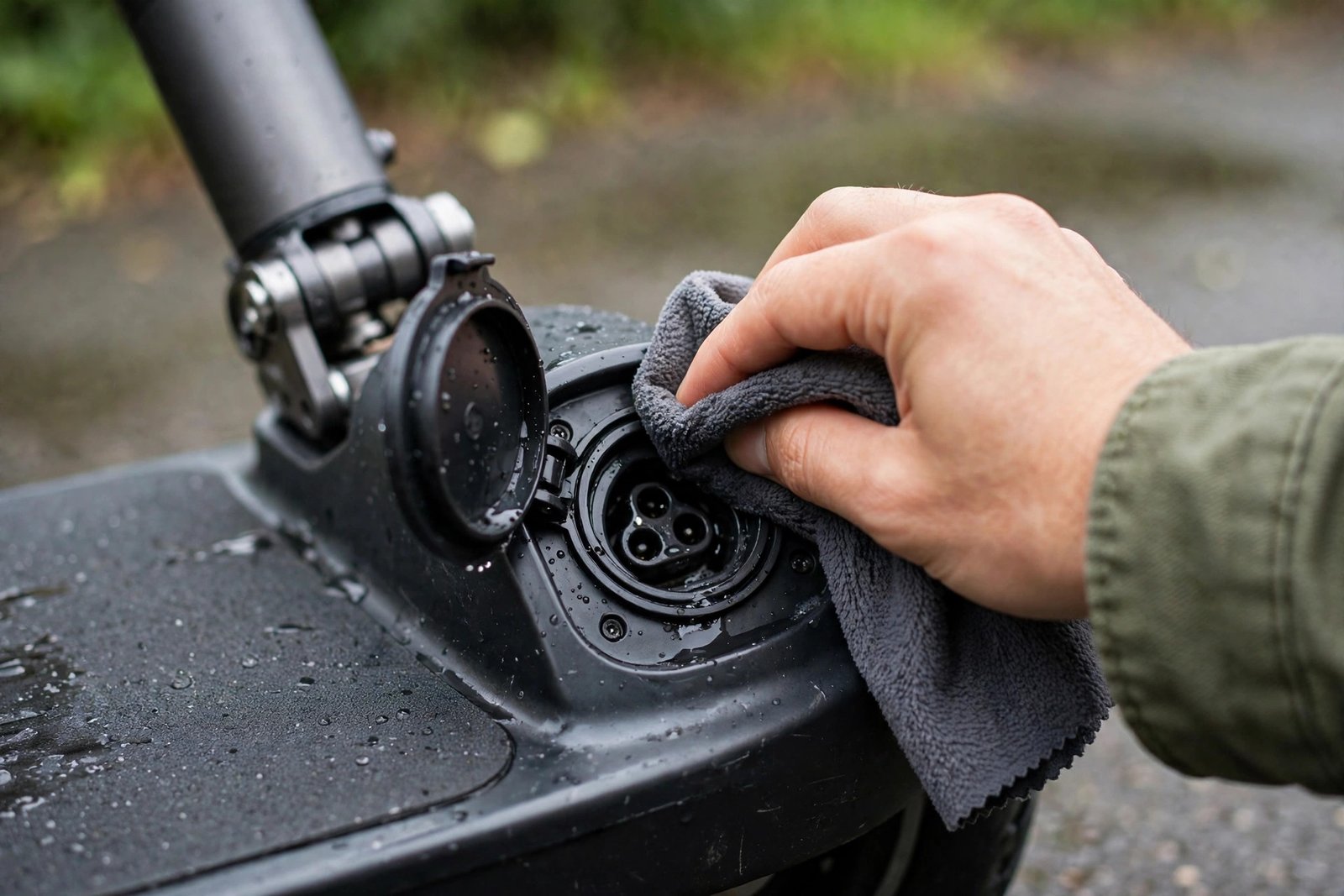
The charging port cover stays shut for the whole wash, and the display gets wiped dry, never sprayed. These are the two wet points a sponge can actually reach, and they are the two that matter most.
Check the port cover before you start. If it is open, cracked or missing, tape it shut for the wash and order a replacement — an open port is a hole straight to the battery. Wipe around the cover, never into it. If water gets in, leave the scooter to dry for a full day before you charge it.
The display is the same rule. Wipe it with a barely damp cloth, then a dry one, and never spray cleaner onto it — cleaner runs down the stem and into the seam behind it. If the display fogs after the wash, it dries for a day — a fogged display is water inside, and water inside is a repair.
Rule 4 — cleaners stay off the brakes
Degreaser and cleaners stay off the disc brakes and the pads. This is the rule that costs the most when it is broken, because a contaminated brake does not squeak a warning — it simply stops working when you need it.
Wash the wheels and the mudguards with soap and water, and the brake disc with water only. If degreaser touches a disc or a pad, the pad is ruined — no amount of wiping brings the braking back. Keep the degreaser for the deck and the stem, and away from anything that stops the scooter.
Check the brakes after the wash, before the next ride. Squeeze both levers and roll the scooter forward — if a brake feels soft or grabs late, it got wet or contaminated, and it needs drying or a new pad. The wash is not finished until the brakes feel the way they did before it.
Rule 5 — dry it before it goes back
Dry the scooter before it goes back in the hallway, and dry the deck seam and the charging port to the touch first. A scooter put away wet rusts quietly in the dark, and a charging port put away damp is a charging port that corrodes.
Dry in this order: the display first, then the charging port, then the deck seam, then everything else. Wipe the seam along its whole length with a dry cloth, pressing it in where the deck meets the body. If the cloth comes away damp, wipe it again — the seam is dry when the cloth comes away dry.
Leave the scooter standing on the cardboard for half an hour after the wash, in the hallway with the door open if you can. Air does the last part of the drying. Only then does it go back against the wall, and only then does it go back on charge. Never charge a wet scooter — Segway’s own manual says “Do not charge the product when it is wet or in a moist environment,” and the rule holds for every scooter here.
The kit — bucket, sponge, two brushes, cardboard
The whole kit fits in a cupboard, and it costs less than a takeaway. A bucket, a sponge, a soft brush for the deck and the tyres, a small stiff brush for the mudguards and the wheel hubs, a spray bottle of clean water for the wheels only, a bottle of mild soap, two cloths — one damp, one dry — and a flattened cardboard box for the floor.
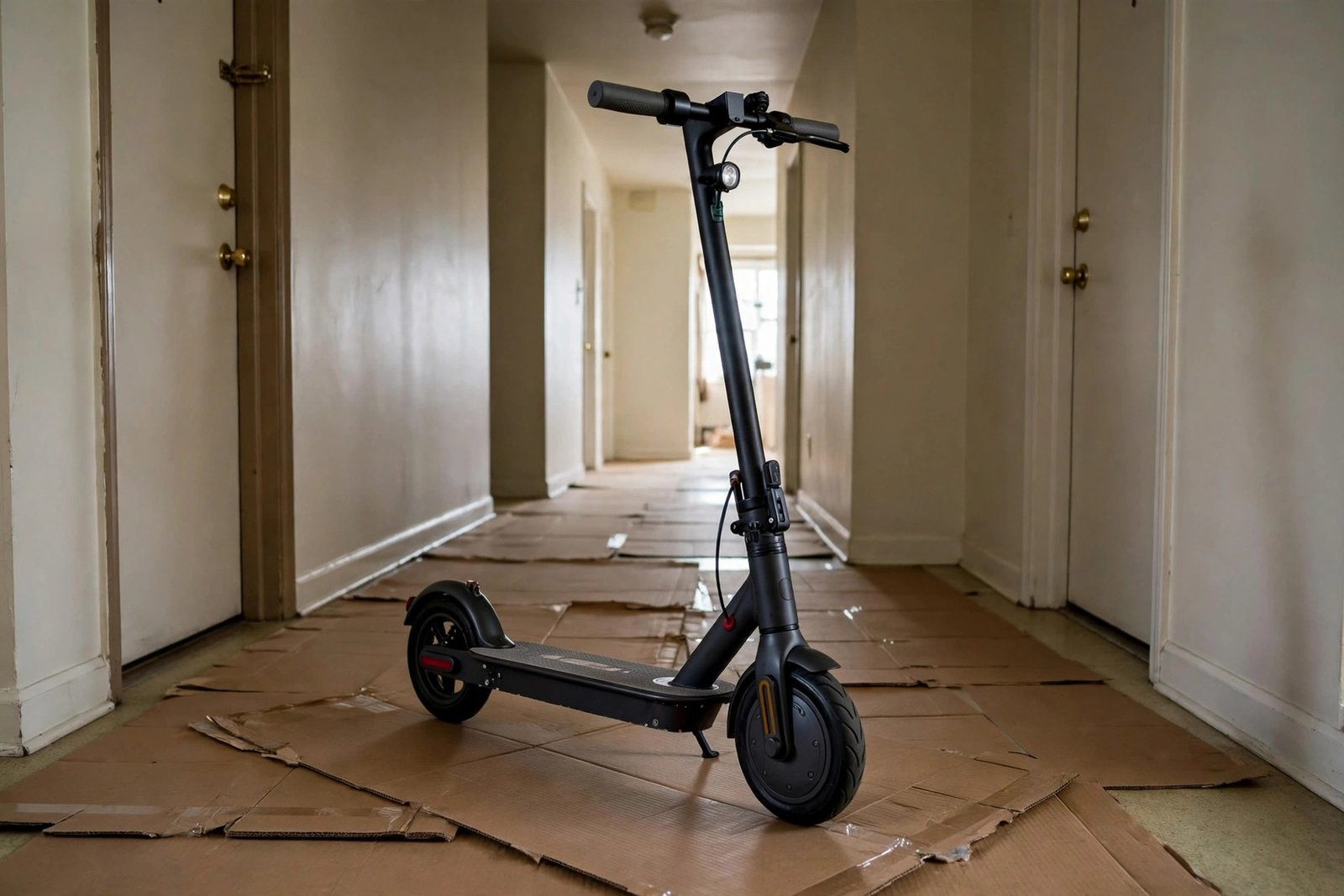
The cardboard is the wash bay. Lay it flat in the hallway, stand the scooter on it, and the drips land on cardboard instead of the floor. A second piece under the wheels catches what runs off the tyres. When the wash is done, the cardboard goes in the recycling and the hallway is dry.
Keep the kit together, in one place — a bucket in the cupboard, a sponge and the brushes in the bucket. The wash starts in a minute when the kit is already together, and it never starts when the sponge is in the kitchen and the brushes are in the bathroom.
The wash, step by step
Twenty minutes, in order, and the scooter is clean.
First, the dry pass. Brush the loose dirt off the deck, the mudguards and the wheels before any water touches them. A dry brush takes off the worst of it, and the sponge does not have to. Dry dirt brushed off is dirt that never turns to mud on the deck.
Second, the wash. Sponge the deck, the stem and the mudguards with warm soapy water, wringing the sponge out before each pass. Work from the top down — the stem first, then the deck, then the wheels — so the dirty water runs onto parts you have not washed yet. Rinse the sponge in the clean bucket and go again until the water stays clear.
Third, the wet points. Wipe around the charging port cover with a damp cloth, wipe the display with a barely damp cloth and then a dry one, and wipe along the deck seam with a damp cloth. Never into the port, never onto the display, never along the seam with a running tap. These three wipes are the whole difference between a clean scooter and a broken one.
Fourth, the wheels. Brush the tyres and the hubs, and rinse them with the squeezed bottle — the only running water in this wash. The wheels are the dirtiest part and the safest to rinse, because there are no electrics in them. Dry the brake discs with a clean cloth, water only.
How wet can yours get? — the seven scooters
The IP rating decides how wet your scooter can get, and the rating is on the body, not the battery. The battery rating is higher on the two MAX scooters, and it is the one the listings shout about — but the battery sits inside a body that is rated lower, and the body is what the rain hits. Read the body rating, not the battery one.
| Scooter | Body | Battery | What it means in the wash |
|---|---|---|---|
| Segway Ninebot MAX G3 | IPX6 | IPX7 | Powerful jets — the wettest scooter here |
| Segway Ninebot MAX G2 | IPX5 | IPX7 | Water jets — rain and splashes, no problem |
| Segway Ninebot E2 Pro | IPX4 | IPX6 | Splashing water — damp cloth, never a jet |
| Segway Ninebot E2 Plus | IPX4 | IPX6 | Splashing water — damp cloth, never a jet |
| HopCycle Electric Scooter | IPX4 | Not stated | Splashing water — damp cloth, never a jet |
| Hiboy S2 Pro | IPX4 | Not stated | Splashing water — damp cloth, never a jet |
| Hiboy S2 MAX | IPX4 | Not stated | Splashing water — damp cloth, never a jet |
IPX4 means splashing water from any direction — rain, puddles, and a damp cloth, but never a jet and never a hose. Five of the seven scooters here are IPX4, so the bucket method is the method for them. IPX5 means water jets, and IPX6 means powerful water jets — the two MAX scooters can take more water than the rest, and the bucket method still applies, because a sponge is gentler than either.
The battery rating does not change the wash. The MAX G3’s battery is IPX7 and the MAX G2’s is IPX7, but both bodies are lower — IPX6 and IPX5 — and the body is what you are washing. A battery that survives immersion does not help a display that does not. Wash to the body rating, every time.
The Segway Ninebot MAX G3 and the Segway Ninebot MAX G2 are the two that can take the most water. The Segway Ninebot E2 Pro and the Segway Ninebot E2 Plus sit in the middle, and the HopCycle Electric Scooter, the Hiboy S2 Pro and the Hiboy S2 MAX are the three that need the gentlest wash. The method is the same for all seven — only the margin is different.
How often
Wash it when it is dirty, and check it every week. A commuter scooter in winter needs a wash every week or two — road salt and grit do the damage, and salt left on the deck eats the finish and the fasteners. A dry-weather scooter needs a wash once a month, and a wipe-down after any wet ride.
Tie the wash to the weekly check in our #51. Tyres, brakes, folding latch, display, charging port — the wash is the moment to look at all five, because your hands are already on them. A crack in the deck seam, a loose latch, a port cover that will not shut — the wash finds them before the ride does. A clean scooter is a checked scooter, and a checked scooter is a safe one.
Salt is the one exception to the schedule. If you rode through salted roads, wash the scooter the same day — salt does not wait for the weekend. A quick wipe of the deck, the wheels and the stem takes five minutes. Our #74 gives the same rule for e-bikes, and it holds for scooters too.
Related reading
- Electric Scooter Maintenance: The Owner’s Checklist (Weekly, Monthly, Seasonal)
- E-Bike Maintenance Checklist for Beginners: Before Every Ride, Weekly, Monthly
- Article #74 “How to Clean an E-Bike in an Apartment (No Hose, No Balcony): The Bucket Method”.
The bottom line
A scooter is not an e-bike in the wash — the battery is under the deck, and the deck is where the water goes. System off and unplugged, a bucket and a damp cloth, the port shut and the display wiped dry, cleaners kept off the brakes, and the scooter dry before it goes back. Do those five things and the hallway stays dry, the electrics stay dry, and the scooter is clean for the next ride.
Next: How to Ride an E-Bike in Summer Heat (Battery, Tyres, and the 105°F Rule)