
Some links in this article are affiliate links. If you buy through them, we may earn a commission at no extra cost to you.
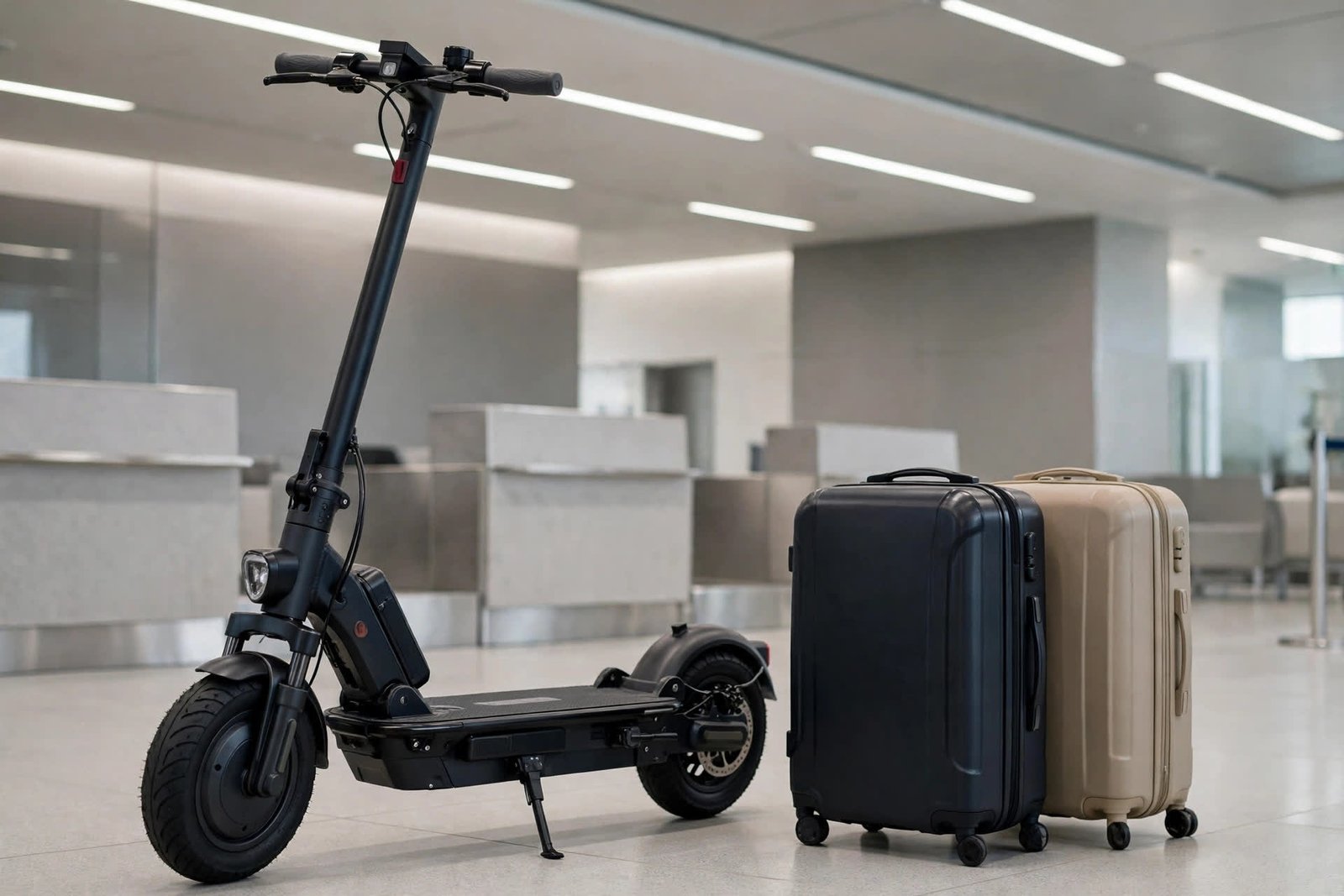
You are flying next week and you want your scooter there. The battery decides it — and the battery is 220 to 597 watt-hours, while the limit is 160. There is no packing trick, no disassembly trick, and no airline that makes an exception for a commuter scooter. This guide is the maths, and then what to do instead.
In this guide
- The short answer
- The three numbers that decide it
- How to find your scooter’s watt-hours
- Our scooters, by the numbers
- Why you cannot just take the battery out
- The mobility-scooter exception — and why it does not cover you
- What happens if you try anyway
- What to do instead — ship it
- What to do instead — rent one when you land
- What to do instead — drive
- The checklist before you fly with any battery device
- Related reading
- The bottom line
The short answer
No — not on a passenger plane, not in the cabin and not in the hold. Every electric scooter we cover has a battery over the 160 watt-hour limit that airlines and aviation authorities set for lithium batteries, and the battery cannot come out of the scooter to travel separately. If the scooter is going with you, it is going by road or by freight — or you are renting one when you land.
The three numbers that decide it
Three numbers decide whether any battery-powered device can fly, and they are the same on every airline because they come from the aviation authorities, not the airlines. The International Air Transport Association and the US Federal Aviation Administration set them, and the airlines apply them.
Under 100 watt-hours, a lithium battery can go in carry-on luggage without approval. That covers phones, laptops, cameras, and small power banks. No adult electric scooter is this small — the smallest scooter battery in our catalogue is more than twice this size.
From 100 to 160 watt-hours, a lithium battery needs the airline’s approval in advance. You ask, they decide, and the battery still travels in the cabin, never in checked luggage. A few of the smallest scooters ever made sit in this band — none of ours does.
Over 160 watt-hours, a lithium battery is forbidden on passenger aircraft — in carry-on AND in checked luggage. There is no approval to ask for, no form to fill in, and no fee that buys an exception. Every one of our scooters is over 160 watt-hours, so the answer for our readers is not “maybe” but “no”.
Spare batteries follow a stricter rule on top of this: they are never allowed in checked luggage at any size. A battery installed in a device may travel in the hold only if the device itself is allowed — and a scooter is not.
How to find your scooter’s watt-hours
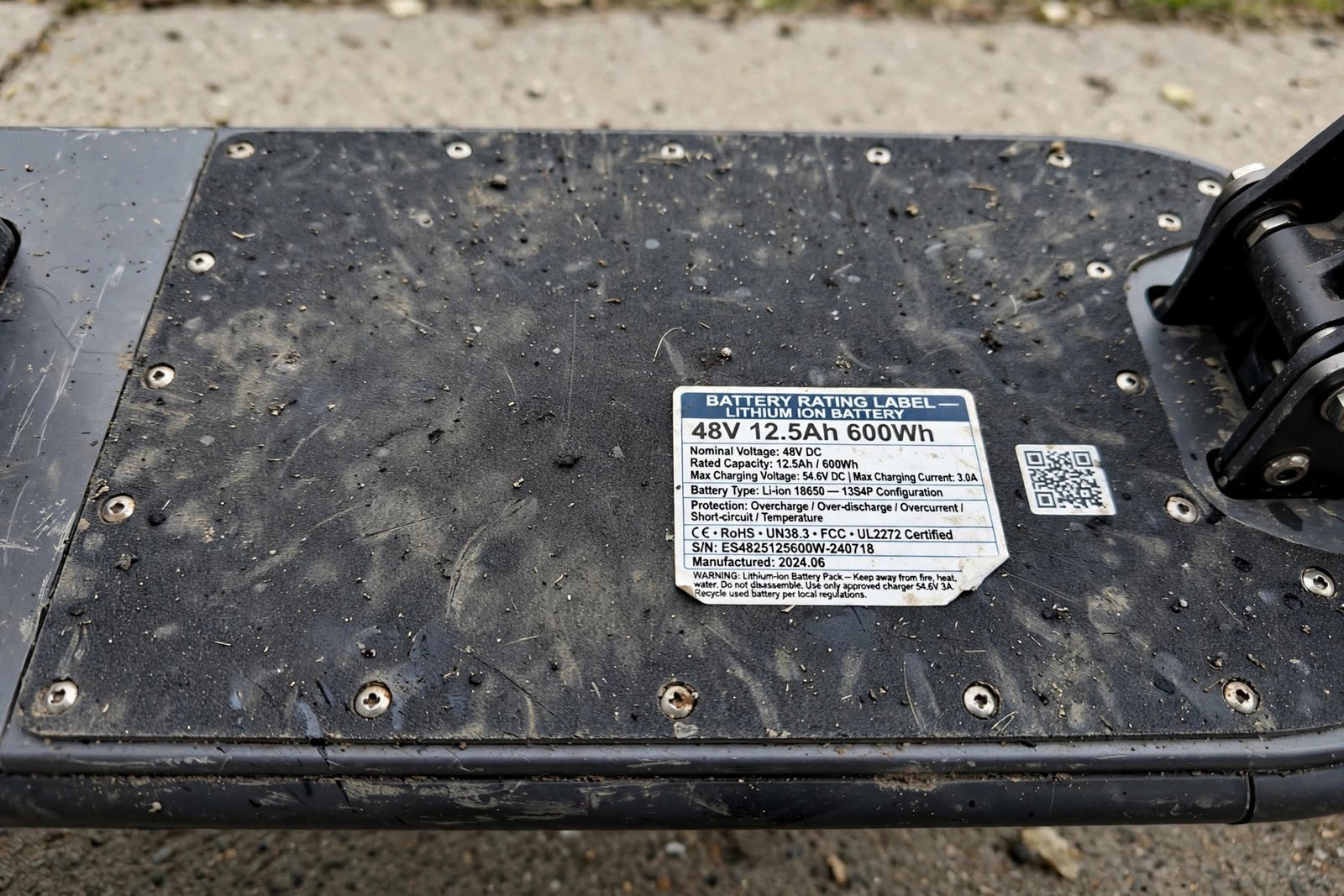
Watt-hours are the battery’s size, and they are printed on the battery or in the manual — but almost never in the listing’s headline. The formula is simple: watts-hours equals volts times amp-hours. A 36-volt battery with a 7.5 amp-hour capacity is 270 watt-hours. A 48-volt battery with a 12 amp-hour capacity is 576 watt-hours.
Check the label on the battery itself first. On a scooter, the battery is under the deck, so the label is usually on the underside of the deck or printed in the manual’s specifications page. If the listing gives volts and amp-hours separately, multiply them yourself — that is the number the airline cares about, and it is the number this guide uses for every scooter below.
If neither the listing nor the manual gives a watt-hour figure, do not guess one. Two of our scooters fall into this gap, and the honest answer for both is “check the label” — a scooter whose battery size you cannot state is a scooter you cannot plan a flight around.
Our scooters, by the numbers
| Scooter | Battery | Over the 160 Wh limit? |
|---|---|---|
| Segway Ninebot E2 Plus | 220Wh | Yes — by 60 Wh |
| Segway Ninebot E2 Pro | 275Wh | Yes — by 115 Wh |
| HopCycle Electric Scooter | 281Wh | Yes — by 121 Wh |
| Hiboy S2 Pro | 418Wh | Yes — by 258 Wh |
| Segway Ninebot MAX G2 | 551Wh | Yes — by 391 Wh |
| Hiboy S2 MAX | 557Wh | Yes — by 397 Wh |
| Segway Ninebot MAX G3 | 597Wh | Yes — by 437 Wh |
| Phantomgogo Electric Scooter | Not published — check the label | Almost certainly yes |
| WERHY 500W Adult Scooter | Not published — check the label | Almost certainly yes |
The smallest battery in the table is 220 watt-hours, and the limit is 160. There is no scooter here that is close to the line — the smallest is 60 watt-hours over it, and the biggest is nearly four times it. The gap is not a rounding error. It is the whole answer.
The two scooters at the bottom of the table deserve a word. The Phantomgogo and the WERHY 500W do not publish a watt-hour figure anywhere — not on the listing, not in the manual. Both are 36-volt scooters, and every 36-volt scooter battery of this size is well over 160 watt-hours. But this guide does not state a number it cannot source, so for those two the answer is “check the label” — and the label will say over 160.
Why you cannot just take the battery out
The obvious workaround is to take the battery out and ship it separately, the way some e-bike owners do. Our e-bike version of this guide covers that trick: an e-bike’s battery slides out of the frame, so the frame can fly and the battery can go by ground freight. A scooter’s battery cannot do that. It is bolted under the deck, and it stays there.
The pack is part of the scooter’s structure. On the Segway MAX scooters, the battery is held in by eighteen security screws on the base plate, and opening the deck voids the warranty. The battery is live even when the scooter is off, and the deck is not a compartment you open — it is the floor you stand on.
So there is no version of the trick that works. You cannot fly the frame and ship the battery, because the frame without its battery is a broken scooter, and you cannot ship the battery by air either, because the same 160 watt-hour limit applies to freight on passenger aircraft. The battery travels by ground, or it does not travel.
The mobility-scooter exception — and why it does not cover you
There is one exception to the 160 watt-hour limit, and it is worth naming because it is the one people hear about. Mobility devices — wheelchairs and mobility scooters used by people with a medical need — may carry batteries up to 300 watt-hours, with the airline’s approval, because the device is medically necessary. That exception exists for a wheelchair. It does not exist for a commuter scooter.
A recreational electric scooter is not a mobility device, and no airline will treat it as one. The exception is for a device the passenger needs in order to move, not a device the passenger wants in order to commute. If you need a mobility device at your destination, arrange it through the airline as a mobility device — do not try to pass a commuter scooter off as one.
What happens if you try anyway
If you turn up at check-in with a scooter, the airline will refuse it — and the refusal happens at the desk, not at the gate. The check-in agent will ask for the battery’s watt-hours, and a scooter over 160 watt-hours does not fly. The scooter stays behind, and so does your plan for getting around at the other end.
Do not try to hide it. A scooter in a suitcase is a lithium battery in checked luggage, which is the one thing the rules forbid outright — and security screening will find it. A hidden battery is not a clever workaround; it is a safety risk, and it can mean a fine, a missed flight, and a battery confiscated at the airport.
Check with your airline before you travel, not at the airport. Every major airline publishes its lithium battery policy, and every one of them draws the line at 160 watt-hours for devices like these. The policy will not have changed by the time you arrive, and the check-in agent does not have the power to change it.
What to do instead — ship it
Ground freight is the honest way to move a scooter across the country. A courier or freight service will take it by road, where the 160 watt-hour air limit does not apply. The scooter needs to be boxed, the battery needs to stay in the scooter, and the shipment needs to be declared as containing a lithium battery — the courier will tell you how.
The maths matters here. Shipping a 30 to 54 lb scooter across the country costs a real amount of money, and for the cheaper scooters in this guide it can cost a large fraction of what the scooter is worth. Shipping the HopCycle one way can cost a third of its price. The MAX G3 is the dearest, so the same shipping bill is a smaller share. Ship the scooter when it is worth more to you than the shipping bill; otherwise, rent one when you land.
What to do instead — rent one when you land
Renting is the cheapest answer for a short trip. Most cities with a scooter culture have rental shops, and scooter-share schemes run in many US cities — a scooter you unlock with an app, ride, and leave. The rental costs a few dollars an hour, and it costs nothing to fly with, because it never gets on the plane.
Rent before you need it. Check that the destination has rentals, and check the rental’s range against the distance you need to cover — a rental scooter is a stranger’s scooter, and its battery will not be full. A rental solves the transport problem and the storage problem at the same time: there is nothing to carry, nothing to charge, and nothing to lose.
What to do instead — drive
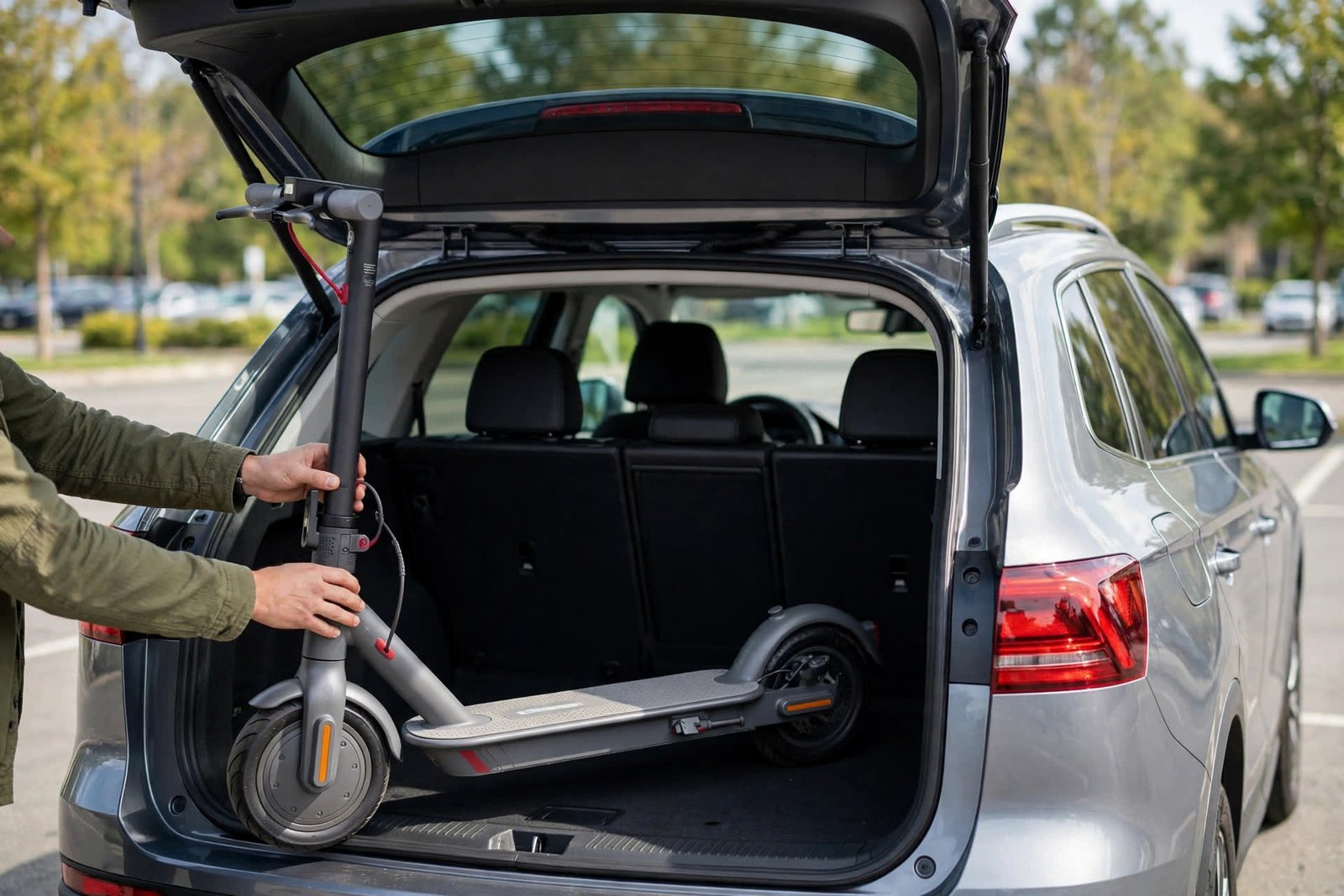
Driving is the only way the scooter travels with you, and it is the simplest of the three. Fold the scooter, put it in the trunk or the back seat, and drive. Our car transport guide for e-bikes covers the same problem for the bigger bike — a scooter is the easy version of it, because it folds smaller and weighs less.
The folded sizes are the ones that decide whether it fits. The E2 Plus folds to 42.1 by 17.5 by 19.8 inches, the HopCycle to about 41 inches long, and the MAX G3 to 48 by 23.2 by 23.3 inches. Measure your trunk before the trip, not at the kerb.
The weight decides whether one person can lift it in. The E2 Plus is about 31.7 lb and the HopCycle is 31.5 lb — a one-person lift into a trunk. The MAX G3 is 54.2 lb, which is a two-person lift for most people, and the S2 MAX is 40 lb. A scooter that folds small but weighs more than you can lift is still a problem at the kerb, so check the weight as well as the folded size.
The checklist before you fly with any battery device
The same rules cover everything with a lithium battery, so this checklist works for the scooter you leave at home and for the devices you do take. Carry-on only for spare batteries, never checked. Under 100 watt-hours needs no approval; 100 to 160 needs the airline’s approval in advance; over 160 does not fly.
Tape over the terminals of any spare battery, and keep each one in its own bag. A battery that cannot short cannot start a fire. Charge to around 30 to 50 percent before the flight — a half-charged battery is safer than a full one, and the airline may ask.
And the one rule that covers this whole guide: if you cannot state your battery’s watt-hours, do not try to fly with it. The number is on the label, in the manual, or in the table above. A device whose battery size you cannot state is a device you cannot plan a flight around.
While you are away, the scooter you leave behind needs looking after too. Store it indoors at around 50 to 60 percent charge, unplugged, in a cool dry place — not at full charge and not at zero. A battery left at zero for weeks can fall asleep so deeply that only a long slow charge wakes it, and a battery left full in a hot flat loses capacity while you are gone. Charge it to half, unplug it, and it will be ready when you get back.
Related reading
- Can You Take an E-Bike on a Plane? (The Battery Rules That Decide It)
- How to Transport an E-Bike by Car (Fold It Into the Trunk, or Use a Hitch Rack?)
The bottom line
The battery decides it, and the battery is 220 to 597 watt-hours against a 160 limit. No scooter we cover can fly, and no packing trick changes that — the battery is bolted under the deck and it stays there. Ship it by road, rent one when you land, or drive. Those are the three answers, and the flight is not one of them.
Next: Article #90 — Best E-Bikes for Back Pain (Upright, Step-Through, and Suspension That Actually Helps)