
Some links in this article are affiliate links. If you buy through them, we may earn a commission at no extra cost to you.
You just bought an e-bike. The question is not whether e-bikes are legal — in 46 states a compliant e-bike is a bicycle, and you ride it like one. The question is whether your bike is, and whether your state agrees. Do not read 50 states — read your bike.
In this guide
- The short answer
- Question 1 — what class is your bike?
- Question 2 — how old is the rider?
- Question 3 — does your state require a helmet?
- Question 4 — license, registration, or insurance?
- What changed in 2026
- Our three bikes — the class check
- Where each class can ride
- Can You Ride an E-Bike on the Sidewalk?
- Related reading
- The bottom line
Four questions decide it: what class is your bike, how old is the rider, does your state require a helmet, and does it ask for a license, a registration, or insurance? Answer those four and you know where you stand. Read a 50-state table and you know nothing — the table is out of date the week after it is written, and 2026 moved the law in five states at once.
This guide is general information, not legal advice. Laws change, and a city or county rule can be stricter than the state law — check the state statute and the local ordinance before you ride somewhere new, and check the operator’s page for a trail or a park.
The short answer
In most of the country, a compliant e-bike needs no license, no registration and no insurance — but only if it is compliant. Compliant means a motor rated at 750 watts or less, working pedals, and a class that fits the three-class system: Class 1 is pedal assist only to 20 mph, Class 2 adds a throttle to 20 mph, and Class 3 is pedal assist to 28 mph. Forty-two states use those three classes, and North Carolina makes it 43 on 1 December 2026. The exceptions are the whole story: New Jersey licenses and registers every e-bike, Hawaii registers them, New York caps Class 3 at 25 mph, and Massachusetts does not recognise Class 3 at all.
Question 1 — what class is your bike?
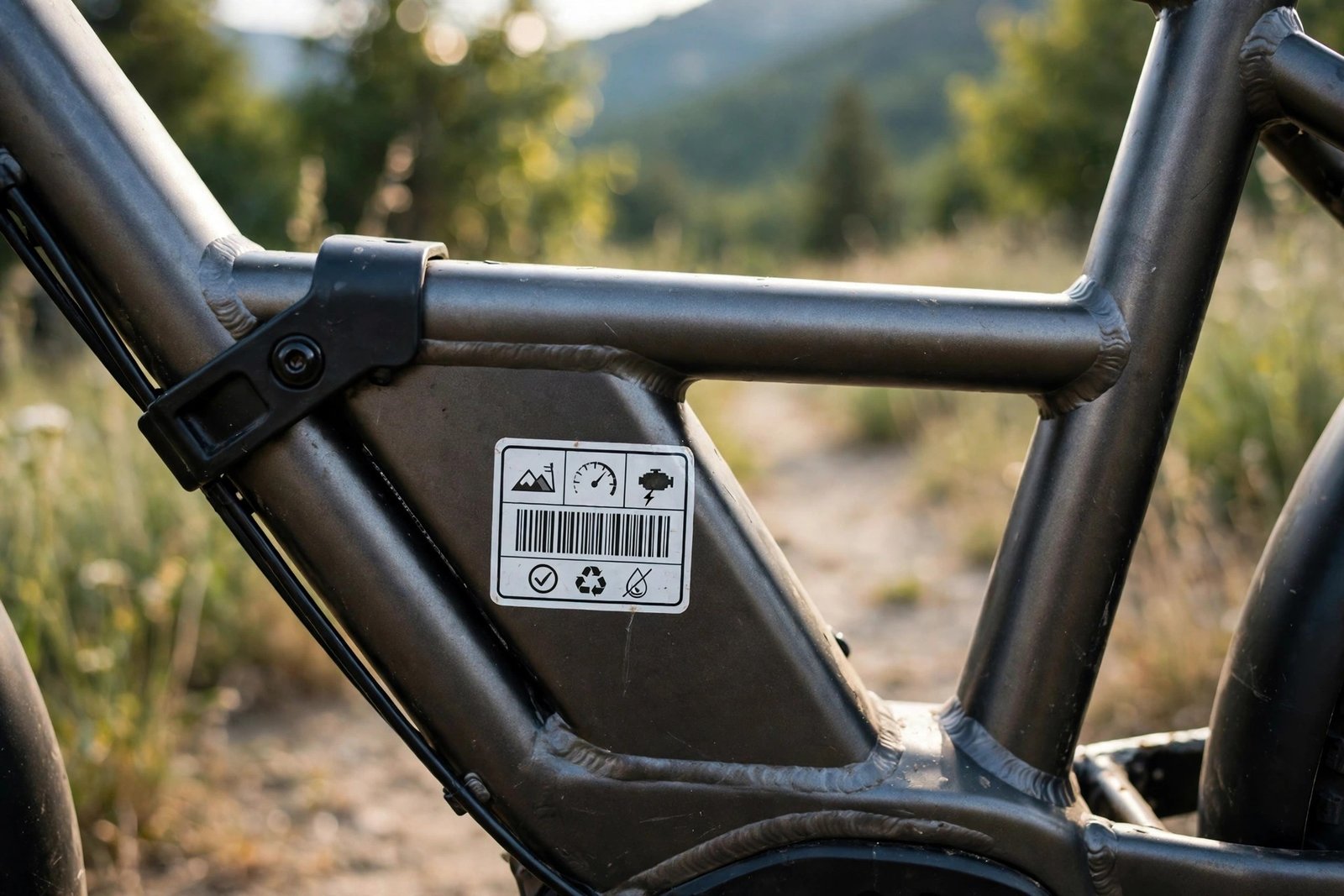
The class is the first question because it decides the other three. A 28 mph bike is a different legal machine from a 20 mph throttle bike, and the rules that follow it — age, helmet, and where it can ride — are different too.
Class 1: the motor helps only while you pedal, and stops at 20 mph. No throttle. The fewest restrictions of the three, and the widest access to paths and trails.
Class 2: the motor can move the bike without pedaling — a throttle — and stops at 20 mph. Most folding e-bikes and most budget e-bikes are Class 2, because a throttle is what a commuter wants at a red light. A Class 2 bike is a Class 1 bike with the throttle on — turn the throttle off and it rides as a Class 1.
Class 3: the motor helps only while you pedal, and stops at 28 mph. No throttle, in the standard definition — and a speedometer is usually required, because 28 mph on a bike path is fast enough that the law wants you to know your speed. Class 3 is the class with rules attached: a minimum age in most states, a helmet rule in many, and no access to some paths.
Two limits sit under all three classes. The motor must be rated at 750 watts or less — that is the federal ceiling, and a bike over it is not an e-bike in any state. And the bike must have working pedals — a device with no pedals is not an e-bike, and Connecticut wrote that into law in October 2025.
New York is the one state that rewrites the classes. New York’s Class 3 assists to 25 mph, not 28, it allows a throttle to 25 mph, and it exists only in New York City. A 28 mph Class 3 from another state is not a Class 3 in New York.
Question 2 — how old is the rider?
There is no age rule for a Class 1 or Class 2 bike in most states. Class 3 is where the age rule lives, and the usual number is 16. Alabama, California and Connecticut all set 16 for Class 3. New York goes further: no one under 16 may ride any e-bike in New York, whatever the class. Pennsylvania sets 16 too. The two states that set it lower are Minnesota, at 15 for any e-bike, and New Jersey, at 15.
The age rule is the one parents get wrong most often, because it is the one the listing never mentions. A Class 3 bike bought for a 14-year-old is a bike the 14-year-old cannot legally ride in most of the country — and in New York they cannot ride any e-bike at all. Check the age before you buy the bike, not after.
Question 3 — does your state require a helmet?
Most states set no helmet rule for an adult on a Class 1 or Class 2 bike. Where a helmet rule exists, it is usually about age, or about Class 3 — and the states that set one set it differently.
Connecticut is the strictest in the country: every rider and every passenger on an e-bike wears a helmet, at every age, in every class. The state law says so in plain words, and since 1 October 2025 a bare head is an infraction with a $90 fine. Connecticut is the only state where an adult must wear a helmet to ride an electric bike.
The age-based rules are the common ones. California requires a helmet for riders under 18. Massachusetts requires one for riders 16 and under. Hawaii requires one for riders under 18. New York requires one for every Class 3 rider, at any age. North Carolina joins the list on 1 December 2026, when Class 3 riders under 18 must wear one.
Question 4 — license, registration, or insurance?
In 46 states, the answer is none of the three. A compliant e-bike is a bicycle, and you ride it with no paperwork at all. Only two states ask for paperwork, and they ask for different things.
New Jersey asks for the most. Since 19 July 2026, every e-bike in New Jersey is reclassified as a motorized bicycle, and every rider needs a driver’s license or a motorized-bicycle license, and every bike needs registration with the Motor Vehicle Commission. Liability insurance is required for the motorized-bicycle category — the throttle-equipped bikes and the 21 to 28 mph bikes — while a pedal-assist-only low-speed e-bike needs registration but not insurance. And the high-speed devices — a motor over 750 watts and capable of more than 28 mph — are banned from every public surface in New Jersey, at any age, and can be seized.
Hawaii asks for one thing: a $30 one-time registration, filed with the county, with a decal on the bike. No license, no insurance, no annual renewal. Act 259, signed 15 July 2026, also wrote the three classes into Hawaii law — Hawaii became the 42nd three-class state on that day — and riders under 16 may operate a Class 2 or Class 3 only under direct supervision. Failure to register can mean a citation or the bike being impounded.
What changed in 2026
The law moved in 2026, and the five changes below are the ones that catch riders out.
New Jersey, 19 July 2026. The state abolished the three-class framework and reclassified every e-bike as a motorized bicycle. License, registration, and insurance for the throttle and higher-speed bikes — the heaviest e-bike regime in the country.
Hawaii, 15 July 2026. Act 259 adopted the three classes, added the $30 one-time registration, and set the under-16 supervision rule.
North Carolina, 1 December 2026. The state switches from a single 20 mph definition to the three-class system under Session Law 2026-46. Class 3 riders under 18 must wear a helmet from that date.
New York. No new law, but the old one bites: Class 3 at 25 mph, New York City only, no riders under 16 on any e-bike. A 28 mph Class 3 bought in another state is not a Class 3 in New York, and a 15-year-old on a Class 1 is not legal either.
Massachusetts. The state recognises only Class 1 and Class 2. There is no Class 3 in Massachusetts law — a 28 mph bike is not an “electric bicycle” there. If it is treated as a motorized bicycle, the rider needs to be 16 or older, hold a license or permit, wear a helmet, stay under 25 mph, and stay off the bike paths — and the bike needs registration.
Connecticut tightened the definition too: since 1 October 2026 the 750-watt ceiling is “not more than 750 watts”, so a motor rated at exactly 750 watts now qualifies there — before that date it did not.
Our three bikes — the class check
The guides out there are 50-state tables, and none of them tells you what class your bike is. Here is the check for the three bikes in our catalogue — and the honest answer is that one of them has no answer at all.
The Lectric XP Lite 2.0 is a Class 2. It ships as a Class 2 e-bike: throttle and pedal assist to 20 mph, on a 300-watt motor with 819 watts of peak. Turn the throttle off and it rides as a Class 1. At 49 lb it is the lightest folder in Lectric’s range, and it is also the simplest legally, because Class 2 is the class every state recognises. The Lectric XP Lite 2.0 (Check latest price) is the bike in this guide with the fewest legal surprises.
The Heybike Mars 3.0 is a Class 2 — until you change it. By default, the Mars 3.0 is set to Class 2 specifications, and Heybike’s own FAQ says so: to set it to Class 1, disable the throttle and set the top speed to 20 mph; to set it to Class 3, disable the throttle and unlock the top speed to 28 mph. Several retailers list it as a Class 3 — 750 watts rated, 1,400 watts peak, 95 Nm, up to 28 mph. The class is a setting, and the setting decides where it can ride. Set it to Class 3 and it carries the Class 3 rules: 16 and older in most states, a helmet in many, and off the paths. Unlock it past 28 mph and it is no longer an e-bike at all — it is a motor vehicle, and it needs whatever a motor vehicle needs in that state. The Heybike Mars 3.0 is the bike in this guide whose class you choose, and the choice is the legal decision.
The Funhang is the bike with no answer. The listing does not state a class — and neither does the manual. It has a throttle and pedal assist, and a top speed of 21.7 mph, which is above the 20 mph ceiling for Class 1 and Class 2 — so it does not fit either class as written, and it is not a Class 3 either, because Class 3 is pedal assist only. The buyer cannot tell from the listing whether this bike is legal where they ride, and this guide will not guess for them. If you own one, check the class label on the frame and the manual, and ask the seller in writing — because a bike with no stated class is a bike with no stated legal status. The Funhang Electric Bike (Check latest price) is the cheapest lesson in this guide: a listing that never says the class is a listing that never answers the legal question.
Where each class can ride
The class decides the road, the lane, the path and the trail — and the pattern is the same in most states, with local rules on top.
Class 1 goes the furthest. It rides wherever a bicycle rides: the road, the bike lane, and the paths and trails, including natural-surface trails in states that allow it.
Class 2 goes almost as far: the road, the bike lane, and surfaced paths and trails in most states — but a throttle bike on a natural-surface trail depends on the local ordinance. Check the trail’s own page before you ride it.
Class 3 stays on the road and the bike lane. In California, Class 3 is not allowed on a Class I bike path unless the local authority allows it. In Connecticut, Class 3 is banned from every trail and path in the state, with no local opt-in. A Class 3 bike on a path is the most common way a legal rider becomes an illegal one — the bike is legal, the road is legal, and the path is not.
The rule that covers all three: the operator’s page is the rule for a trail or a park. A state law that allows Class 1 on trails does not overrule a park that bans all e-bikes. Check the land manager before you ride.
Can You Ride an E-Bike on the Sidewalk?
There is no national sidewalk rule — the rule is set city by city, and the safe assumption is that the sidewalk is off-limits. Sidewalks are for pedestrians, and in almost every major US city the e-bike belongs in the bike lane or the street. Treat the sidewalk as closed unless a posted sign or the local code clearly says otherwise.
New York City bans every e-bike from every sidewalk, citywide. The only narrow exceptions are entering a driveway or avoiding an immediate hazard — a shortcut down the sidewalk is not one of them.
Chicago bans it too. No one over 12 may ride on a Chicago sidewalk, and e-bikes are treated like bicycles on this point — allowed on a sidewalk only where the sidewalk is marked as a bike path, or where it is the only way to reach a roadway, a bike path, or a bike-share station.
San Francisco bans sidewalk riding for anyone 18 or older, under Transportation Code Section 7.2. The exceptions are sidewalks designated for shared pedestrian and bicycle use, children under 13, and an adult riding with such a child.
Class 3 is the class the sidewalk bans reach first. Where a city allows sidewalk riding at all, it is usually Class 1 and Class 2 only, at low speed, yielding to pedestrians — and Class 3 is banned outright. A 28 mph bike has no place on a sidewalk anywhere.
The check is the same as for a trail: search “[your city] municipal code e-bike sidewalk” or “[your city] bicycle ordinance” before you ride. A few cities allow it — Los Angeles, for example, allows bicycles and e-bikes on sidewalks at a prudent speed, yielding to pedestrians — but a city that allows it is the exception, not the rule. If you cannot find your city’s rule in writing, ride in the bike lane.
Related reading
- E-Bike Classes Explained: Class 1 vs 2 vs 3, and Where You Can Legally Ride Each One
- Do You Need Insurance for Your E-Bike? (What Apartment Renters Should Check First)
- Article #52 “Electric Scooter Laws: Where Can You Actually Ride? (State by State, 2026)”.
The bottom line
Do not read 50 states — read your bike. Find the class on the label, check the four questions, and check the 2026 changes for the state you ride in. A Class 2 bike is legal almost everywhere with no paperwork at all; a Class 3 bike carries an age rule, a helmet rule, and a path ban; and a bike with no stated class is a bike with no stated legal status. The law moved in 2026, and the guide you read last year is wrong. Check the class, check the state, and check the trail before you ride.
Previous: Can You Take an Electric Scooter on a Train or Bus? The Rules That Actually Apply
Next: How Long Does It Take to Charge an Electric Scooter? (Real Times, Scooter by Scooter)