
Some links in this article are affiliate links. If you buy through them, we may earn a commission at no extra cost to you.
You take the train to work and you want your scooter there for the last mile. The question is not whether scooters are allowed on transit. The question is whether your scooter is, and whether your operator allows it. A folded scooter is 42 inches long and 30 to 54 lb, and those two numbers decide most of it — the rest is the operator’s own page, which is the rule.
In this guide
- The short answer
- The three numbers that decide it
- The fold-and-carry method
- The MTA — subway, buses, and the 30 lb rack
- NJ Transit — trains, buses, and the 100 lb limit
- The ban list — PATH and Europe
- The eight scooters — folded size, weight, and where they ride
- What to do at the door
- Related reading
- The bottom line
The guides out there are city-specific — New York, or Europe — and none answers the per-scooter fit question for our scooters. Folded length, weight, and the operator: those are the three numbers, and this guide works through all three, scooter by scooter.
The short answer
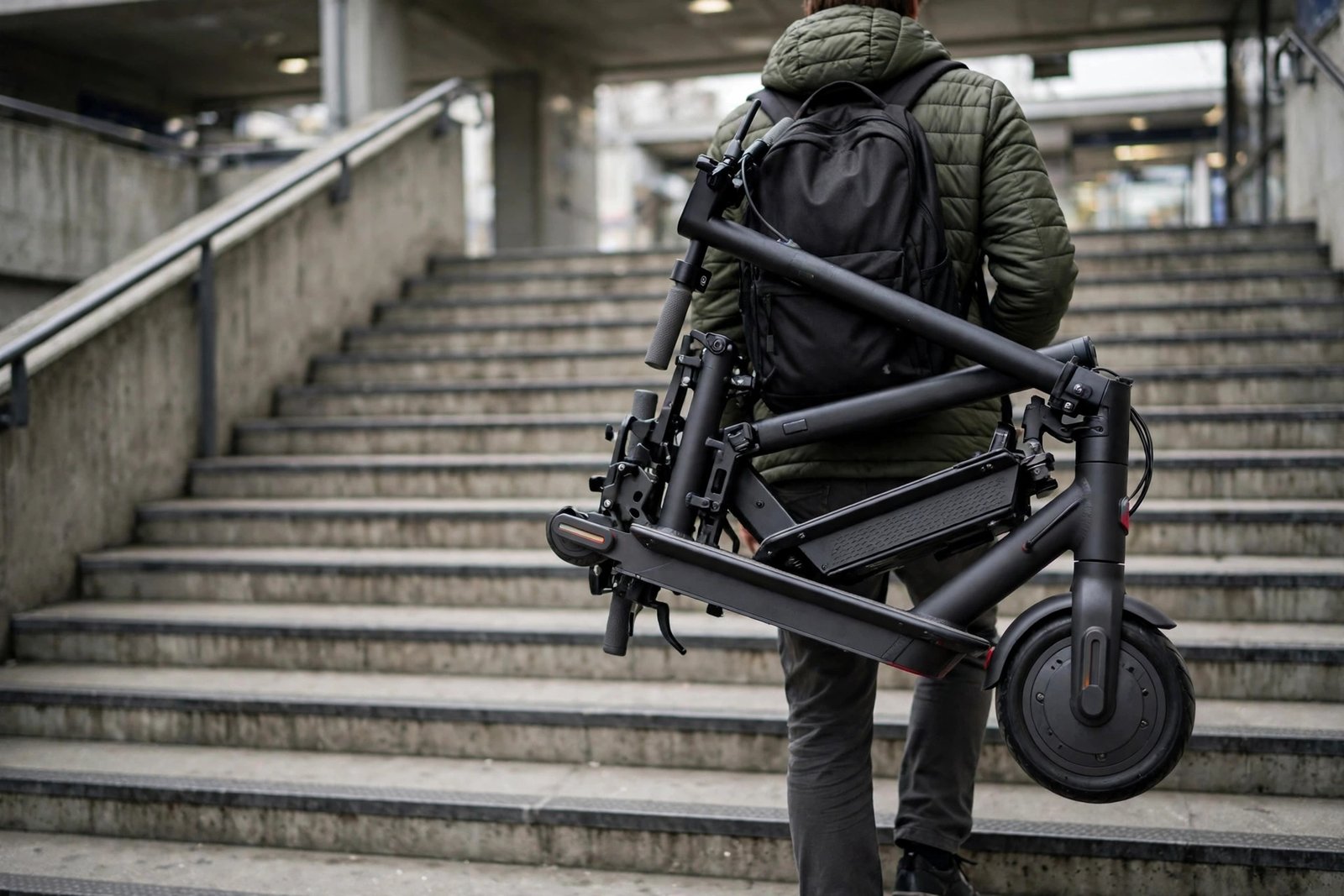
Yes, on most US trains and buses — folded, latched, switched off and carried, never ridden and never charged anywhere in the system. The MTA takes a folded scooter on the subway and local buses; NJ Transit takes one on its trains. PATH bans e-scooters outright, and so do the metros in Berlin, Munich, Madrid and Barcelona. And the weight decides where it rides: a folded scooter at 30 lb or under can go in a commuter-rail overhead rack — anything heavier rides on the floor, held, at your feet.
The three numbers that decide it
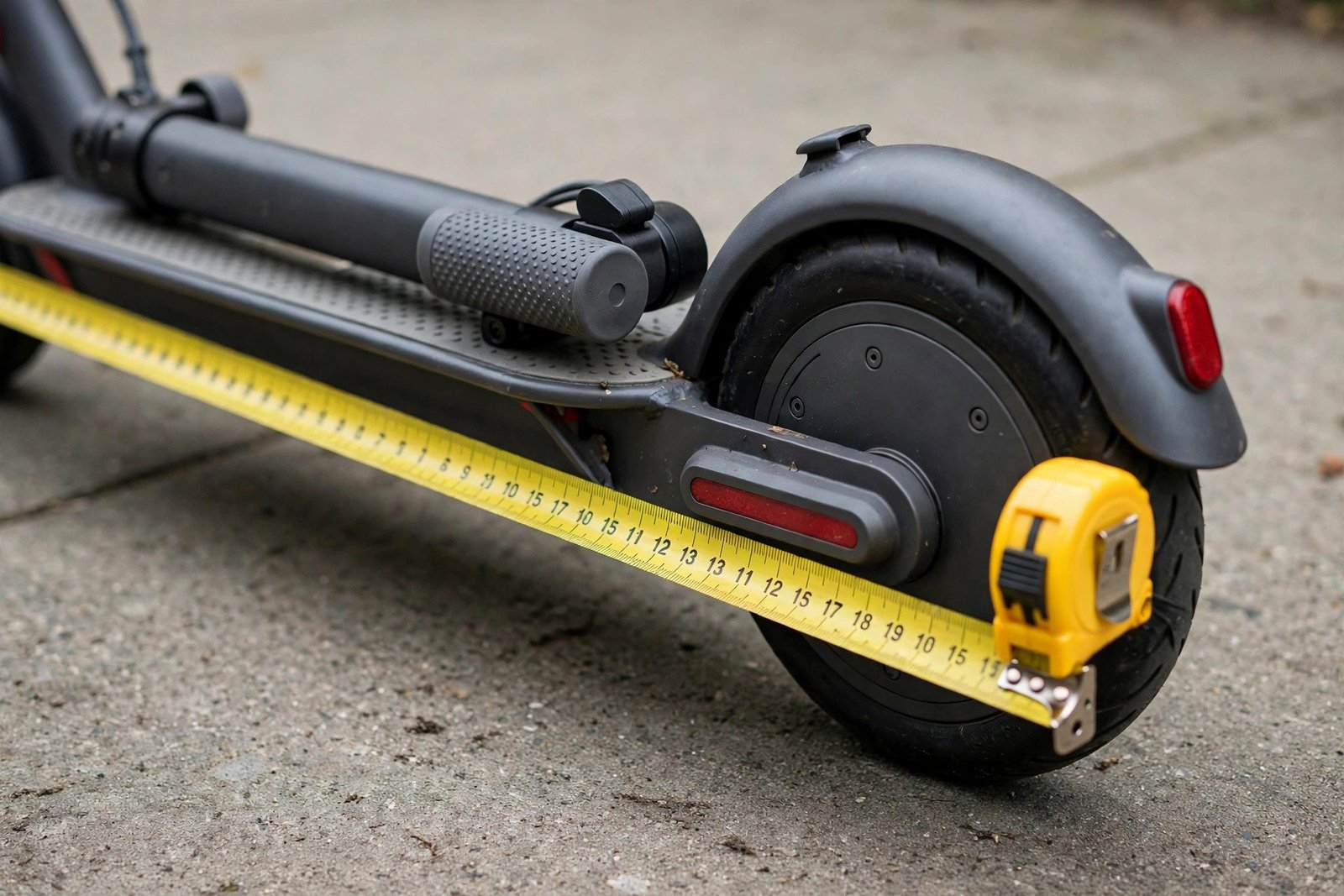
Folded length first. Measure it, do not guess. A folded scooter is 42 to 48 inches long, and the operator’s length limit is 80 inches on both the MTA and NJ Transit, so length is rarely the problem. What matters is where 42 to 48 inches goes once you are on board. It does not fit under a bus seat. It goes at your feet or in the open area by the door — held, never blocking an aisle, a seat, a door or an emergency exit. If it blocks any of those, the driver or the conductor can turn you away.
Weight second. Thirty pounds against 54 lb is the difference between the overhead rack and the floor. The MTA’s commuter-rail overhead rack takes a folded scooter only if it weighs no more than 30 pounds and fits securely. On the subway there is no rack limit to worry about — you carry it and hold it — but 54 lb up a flight of station stairs is a different trip from 30 lb. NJ Transit’s limit is 100 lb, and every one of our eight scooters is under it — but you must still be able to lift it up and down the stairs yourself. If you cannot lift it, it does not travel, whatever the limit says.
The operator third. MTA, NJ Transit, PATH and the European operators all say different things, and the operator’s own page is the rule — not a guide, not a forum post, and not this article. Rules change, and drivers and station staff apply them on the day. Where an operator’s page names only bikes, this guide says so rather than guessing. Check the page before you travel.
The fold-and-carry method
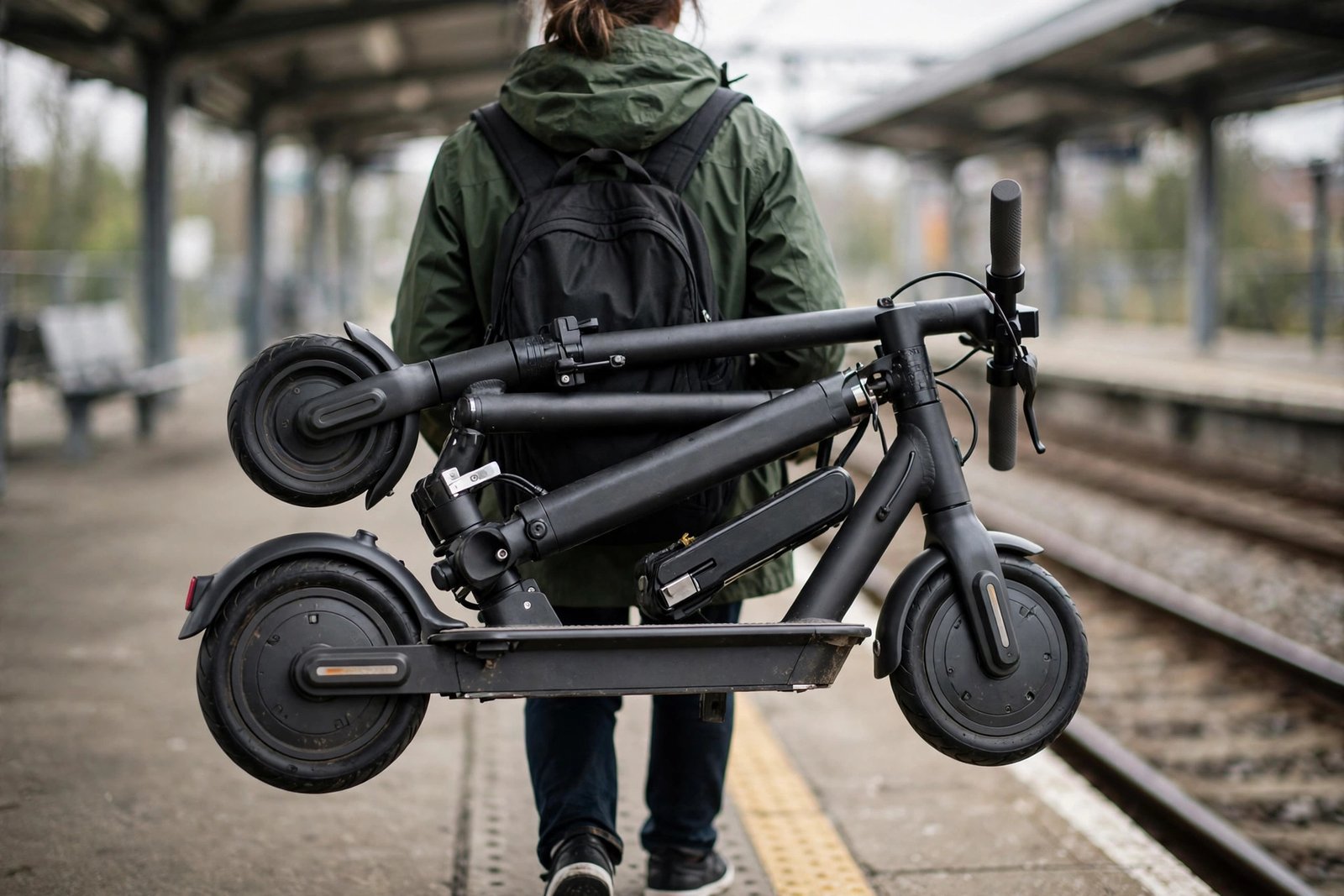
Every operator that allows a scooter allows it the same way. Folded and latched, switched off, carried — never ridden, never charged, anywhere in the system.
Fold it before you reach the fare gates, and latch it so it cannot unfold. A scooter that folds must stay folded and latched the whole time you are in the system — platform, stairs, escalator, elevator, train or bus. Switch it off before you board, and do not switch it on again until you are out of the station. Riding it, standing on it, or sitting on it with the power on is prohibited everywhere in the system. Never charge it in a station or on a vehicle — both the MTA and NJ Transit prohibit charging on any vehicle or in any station. Board after other passengers have boarded, and let them off first — the MTA’s rule, and good manners everywhere else. Keep it near you, where you can move it at once if staff ask.
The MTA — subway, buses, and the 30 lb rack
The MTA’s policy is written down, so it is the most detailed system in this guide. The MTA allows personal electric scooters on the subway and on local buses, under its personal electric vehicle policy, updated 24 April 2023. No scooter of any kind is allowed on MTA express buses — not folded, not carried, not at all.
On the subway, the folded scooter rides with you in the car. Stand near either end of the car, hold the scooter so it cannot roll or fall, and take no more than one seat’s worth of space — never in priority seating or wheelchair spaces, and always behind the yellow line on the platform. The MTA sets no rush-hour hours for folded scooters on the subway, and there is no weight limit on the subway itself — but a 54 lb scooter up two flights of stairs is a workout, not a commute.
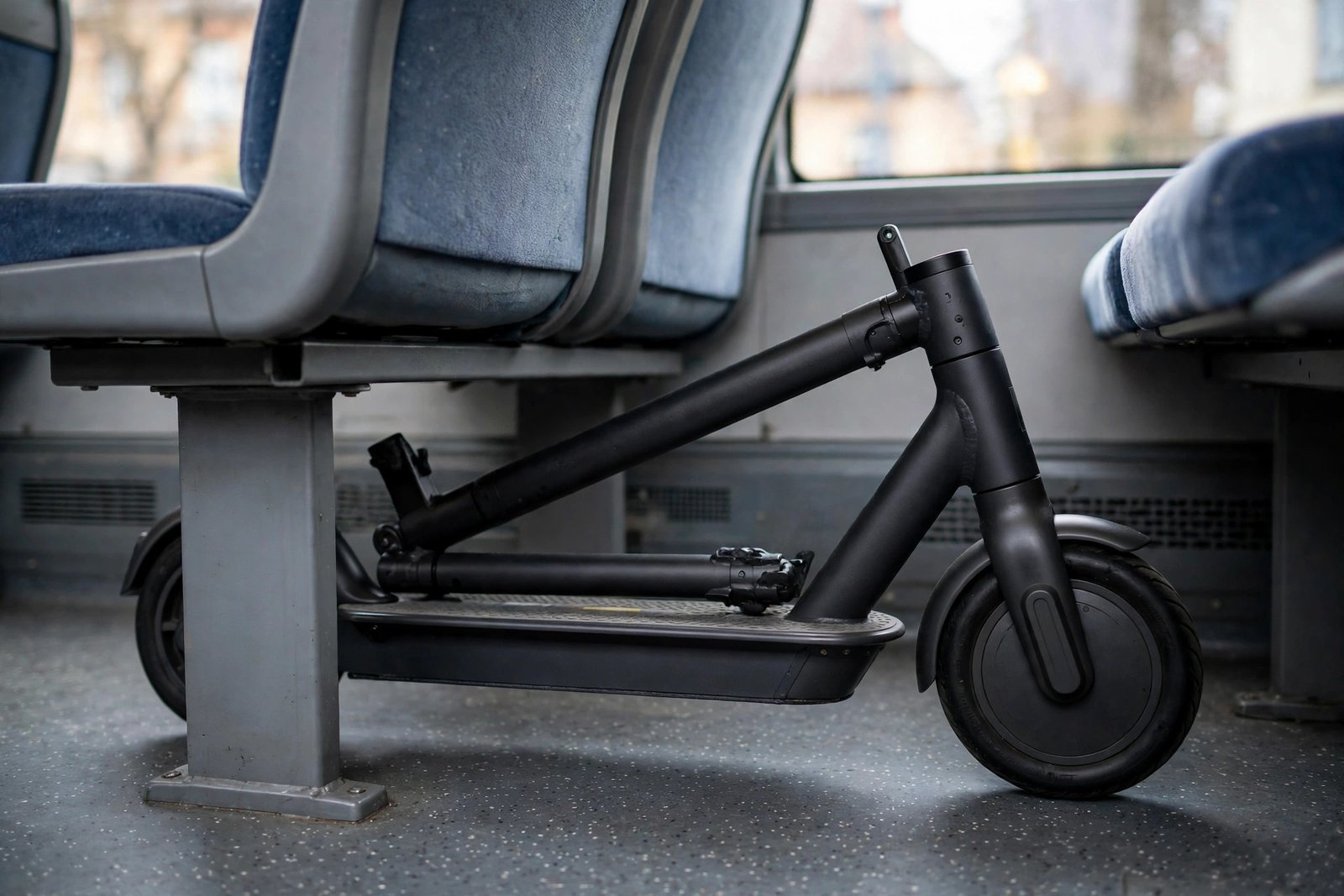
On local and Select Bus Service buses, only a foldable scooter is permitted, and only as long as it does not impede the movement of other passengers — not doors, exits, hatches, egress paths or seating. A folded scooter does not fit under a bus seat, so it rides at your feet or in the open area by the door, held. If the bus is crowded, wait for the next one.
On the LIRR and Metro-North, the same policy applies. A folded scooter may go in the overhead rack only if it weighs no more than 30 pounds and fits securely in the rack. Of our eight scooters, only one is at or under that limit. The MTA also treats a folded scooter the same as a foldable bicycle for time and number limits, and its dimension limits are a wheel no bigger than 27 inches, a length no more than 80 inches, and a height no more than 48 inches. Every one of our eight scooters fits those dimensions.
NJ Transit — trains, buses, and the 100 lb limit
NJ Transit welcomes personal e-bikes and electric scooters on its trains, subject to its limitations — and the limitations are a size and weight test, not a ban.
The vehicle must have a wheel diameter of less than 27 inches, be no more than 80 inches long and 48 inches high, and weigh less than 100 pounds. Every one of our eight scooters passes all four. A folding scooter is permitted aboard trains at all times, and it must be folded before boarding. A non-folding vehicle is a different story: it is not allowed on weekday trains arriving in Newark, Hoboken or New York between 6:00am and 10:00am, or departing between 4:00pm and 7:00pm. A scooter must remain powered off while on any NJ Transit vehicle or property, and riding or charging is strictly prohibited anywhere on the system. You must be able to lift your vehicle up and down the stairs, and let other passengers off and on first. It may not block doors, aisles or safety equipment, be left unaccompanied, or sit on empty seats. Train crews may limit vehicles on trains due to crowding, and may require customers to deboard and wait for the next available train. Hoverboards, tandem bicycles, gasoline-powered vehicles and third-party rental scooters are all prohibited on the system.
The ban list — PATH and Europe
Some operators do not allow a scooter at all, and no folding trick changes that. PATH bans e-bikes and electric scooters outright. Electric scooters have been barred since at least 2019, and electric bikes since 1 July 2021, citing their lithium batteries — the Port Authority’s own rules prohibit lithium-ion batteries in the system. Regular bicycles are allowed on PATH, folded ones at any time — but an e-scooter is not a bicycle, and the ban covers it anyway. If your commute runs through PATH, plan the trip without it.
Europe is the same story in four cities. Berlin’s BVG bans e-scooters in all vehicles and stations since 1 May 2024 — e-bikes are still allowed. Munich’s MVG bans them on the U-Bahn, trams and buses and in U-Bahn stations since April 2024. Madrid bans them on the Metro, EMT buses and regional buses, and the ban has been extended to 2027. Barcelona’s TMB bans them on the metro, buses and trains since February 2023 — a return was debated in September 2026, but no date has been set. Rome, Ireland’s NTA services and Vienna’s buses and trams keep them off board too. The reason is the same everywhere: lithium-battery fires — on the London Underground in November 2021, and on the Madrid and Barcelona networks in November 2022. The bans are about the battery, not the scooter — and a folded scooter is still a battery, so folding does not get around them. Check the operator’s own page before you travel — the rules are reviewed and the dates move.
The eight scooters — folded size, weight, and where they ride
Our eight scooters, folded, with the weight that decides where each one rides. The figures are the folded length and the weight — the two numbers the operator cares about.
| Scooter | Folded size | Weight | Overhead rack? |
|---|---|---|---|
| Phantomgogo Electric Scooter | About 44 in long | About 30 lb | Yes — the only one |
| HopCycle Electric Scooter | About 41 in long | 31.5 lb | No — 1.5 lb over |
| Segway Ninebot E2 Plus | 42.1 × 17.5 × 19.8 in | About 31.7 lb | No — 1.7 lb over |
| Hiboy S2 Pro | 45.3 × 16.5 × 19.3 in | 37.4 lb | No |
| Hiboy S2 MAX | 45.7 × 18.9 × 20.7 in | 40 lb | No |
| Segway Ninebot E2 Pro | 45.9 × 21.1 × 22.2 in | About 41 lb | No |
| Segway Ninebot MAX G2 | 47.6 × 22.4 × 23.8 in | 53.5 lb | No |
| Segway Ninebot MAX G3 | 48 × 23.2 × 23.3 in | 54.2 lb | No |
The Phantomgogo is the only one of the eight that fits the MTA’s overhead rack — about 30 lb, and the rack takes a folded scooter only if it weighs no more than 30 pounds. The maker’s manual says 30 lb and the Amazon listing prints 29.5 lb in one place, so either figure is at or under the limit — exactly at the line, and the rack still has to fit it securely. The HopCycle at 31.5 lb and the E2 Plus at about 31.7 lb miss the rack by less than 2 lb — and there is no rounding up at the rack. The two Segway MAX scooters are the heaviest here at 53.5 and 54.2 lb — both ride on the floor, held, and both are a two-handed carry up the stairs. None of the eight fits under a bus seat — on a bus, every one of them rides at your feet or in the open area by the door.
The prices are what a buyer would pay new, not a recommendation to buy for transit. The Phantomgogo Electric Scooter is the lightest and the cheapest, the HopCycle Electric Scooter and the Segway Ninebot E2 Plus follow, and the Segway Ninebot MAX G2 and the Segway Ninebot MAX G3 are the heaviest and the most expensive. The Hiboy S2 Pro, the Hiboy S2 MAX and the Segway Ninebot E2 Pro sit in the middle.
What to do at the door
The rule is the operator’s page, but the door is where it is applied. Fold it before the fare gates, latch it, switch it off, and carry it in. If the scooter will not latch folded, do not board — a scooter that unfolds on the train is a scooter that gets you removed. Board last and let other passengers off first. On a bus, hold it at your feet or in the open area by the door, clear of the aisle and the seats. If the bus is full, wait for the next one — the driver can refuse one that blocks the aisle. If a member of staff says no, do not argue — ask what would make it acceptable, and if the answer is that the operator does not take scooters, walk to the next leg of the trip. The operator’s page is the rule, and the person at the door applies it.
And the one trip that does not work at all: do not plan a journey that needs PATH, and do not plan one that needs a Berlin, Munich, Madrid or Barcelona metro with a scooter in it. Ride the scooter to the station, or take the bus instead — but do not stand at the PATH turnstile with a scooter and hope.
Related reading
- Can You Take a Folding E-Bike on a Train or Bus? The Rules That Actually Apply
- Can You Take an E-Bike on a Plane? (The Battery Rules That Decide It)
- How to Transport an E-Bike by Car (Fold It Into the Trunk, or Use a Hitch Rack?)
- Article #73 “How to Transport an Electric Scooter by Car (Trunk, Backseat, or Hitch Rack?)”
The bottom line
A folded scooter is 42 inches long and 30 to 54 lb — the question is whether your scooter is, and whether your operator allows it. Fold it, latch it, switch it off, and carry it. The MTA and NJ Transit take it; PATH and the European metros do not. Only the lightest scooter in our range fits the overhead rack — the rest ride on the floor, held, at your feet. Check the operator’s own page before you travel.
Previous: My Electric Scooter Was Stolen — What to Do in the First 30 Minutes (and How to Get It Back)
Next: E-Bike Laws by State (2026): Where You Can Ride, and What Your Bike’s Class Means