Some links in this article are affiliate links. If you buy through them, we may earn a commission at no extra cost to you.
You are upgrading, or you have stopped riding, or you need the cash — and the scooter by the door is worth something. The question is what, and how to get it without getting scammed. The guides tell you where to list it. None of them tells you what it is worth, because the worth is not in the listing — it is in the battery. A used scooter is a used battery with a frame around it, and the buyer knows it. This guide gives you the three numbers that decide the price, the test that proves the battery before the listing goes up, and the meeting rules that keep the sale safe.
In this guide
- The short answer
- The three numbers that decide it
- The nine comps — what a buyer would pay new
- The battery proof — run it before the listing goes up
- The pricing maths — what it is actually worth
- The platform — where you sell decides what you keep
- The listing — photos in the flat, the battery number up front
- The meeting — public, daylight, cash verified
- The apartment seller — the flat is the showroom
- Related reading
- The bottom line
The short answer
Price it against what the same scooter costs new, prove the battery with a ride, and sell it locally for cash. A well-kept scooter is worth roughly a third to a half of its new price within the first year — Levy Electric’s figure for the used market — and the battery is what moves you to the top or the bottom of that range. Put the battery number in the listing, take the photos in the flat, and meet the buyer in a public place in daylight. The rest is detail.
The three numbers that decide it
Three numbers decide what your scooter is worth, and all three are yours to find before you list it.
First, the new-price comp. What does the same scooter cost new today? That is the number your asking price has to beat — a buyer who can buy new for a little more will buy new, with a warranty. The comp is the ceiling, not the price.
Second, the battery proof. Charge it to 100 percent, ride it to 50 percent, and compare the distance with the distance it did when it was new. The battery is the price — a pack that still holds two-thirds of its range is worth far more than one that holds half. Run the test before the listing goes up, and put the number in the listing.
Third, the platform. Where you sell decides what you keep. A free local sale keeps every penny; a national sale costs a fee and a box; a shop trade-in costs the most and is the fastest. Pick the platform after the price, not before it.

The nine comps — what a buyer would pay new
Our nine scooters, with what each one costs new today. This is the number your asking price has to beat.
| Scooter | New price |
|---|---|
| Phantomgogo Electric Scooter | Check latest price |
| WERHY 500W Adult Scooter | Check latest price |
| HopCycle Electric Scooter | Check latest price |
| Segway Ninebot E2 Plus | Check latest price |
| Segway Ninebot E2 Pro | Check latest price |
| Hiboy S2 Pro | Check latest price |
| Hiboy S2 MAX | Check latest price |
| Segway Ninebot MAX G2 | Check latest price |
| Segway Ninebot MAX G3 | Check latest price |
These are new prices, not used prices, and not a recommendation to buy. The Phantomgogo Electric Scooter is the cheapest comp, the WERHY 500W Adult Scooter follows, and the HopCycle Electric Scooter and the Segway Ninebot E2 Plus sit at the budget end. The Segway Ninebot E2 Pro, the Hiboy S2 Pro and the Hiboy S2 MAX sit in the middle, and the Segway Ninebot MAX G2 and the Segway Ninebot MAX G3 are the premium comps. A buyer compares your asking price with this table, not with what you paid two years ago.
The battery proof — run it before the listing goes up
The buyer is not buying your scooter. The buyer is buying your battery, and they will test it before they pay. Run the test yourself first, and the number is yours to quote instead of theirs to discover.
Charge the scooter to 100 percent, then ride it until the display says 50 percent, and note the distance. Double that distance and you have the full-charge range as it stands today. Compare it with the rated range from when the scooter was new. A scooter rated at 25 miles that does 8 miles to 50 percent does 16 miles on a full charge — about two-thirds of its rated range, and a battery with about two-thirds of its life left. A pack that dies at under 60 to 70 percent of its rated distance has lost about a third of its capacity — that is the line between a battery with years left and a battery the buyer will have to replace. Scooter packs last roughly 300 to 500 charge cycles, and the test shows where yours sits in that span.
Put the number in the listing, in the first line, not the last. “8 miles to 50 percent, 16 miles full — about two-thirds of the 25-mile rated range” tells the buyer more than a paragraph of adjectives. A buyer who sees the number trusts the price; a buyer who sees “battery good” does not, and prices your scooter as if the battery were dead. The test costs one ride and buys you the top of the price range.
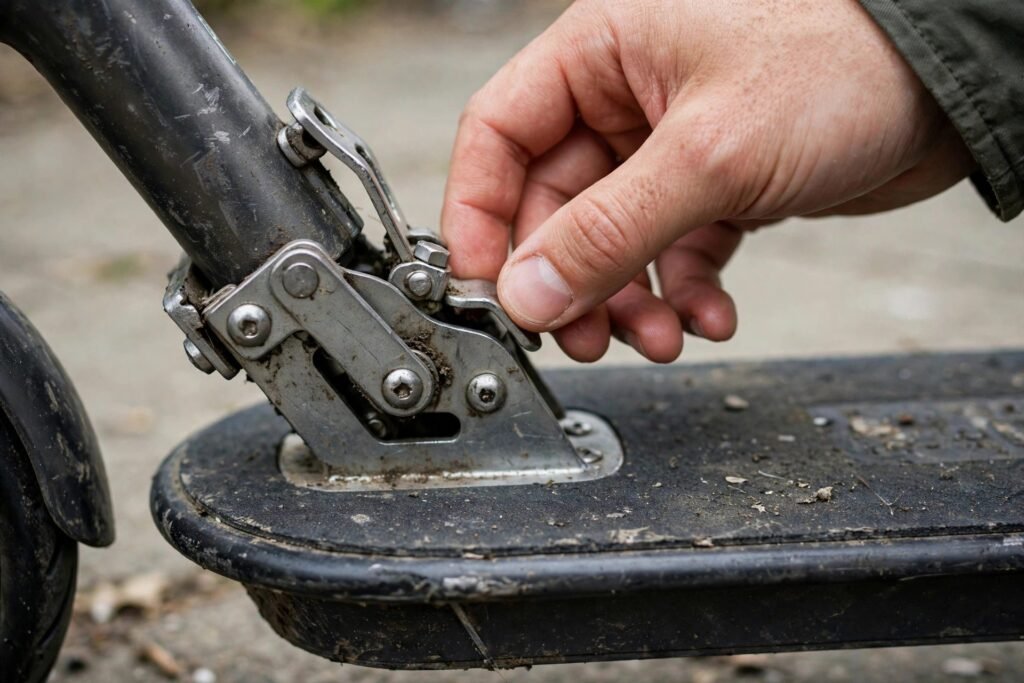
Run the other checks before the listing too, because the buyer will run them at the meeting. Fold and unfold the scooter several times — walk away from your own sale if the latch rattles loose or will not fully lock. Squeeze both brakes, check the tyres for wear and the display for dead pixels, and make sure the charger that came with the scooter is the one in the box. A scooter that fails a check at the meeting sells for less than a scooter that passed it at home.
One check is a stop, not a discount: the battery case. If the case under the deck is swollen, bulging or cracked, do not sell the scooter at all — take it to a battery recycling point. A swollen pack is a fire risk, not a listing, and no price makes it a fair sale.
The pricing maths — what it is actually worth
The market has a shape, and Levy Electric’s general figures describe it. A well-kept scooter holds roughly 30 to 50 percent of its retail price within the first year. In the first six months it holds more — roughly 70 to 85 percent of retail — and then it falls, because the first year is when the battery does most of its ageing. The battery moves you inside the range: a proven two-thirds pack sits at the top, an unproven one at the bottom.
Take a hypothetical scooter that cost $400 new. In its first six months it is worth roughly $280 to $340 — 70 to 85 percent of the new price. Within a year it is worth roughly $120 to $200 — 30 to 50 percent. The fall is the battery ageing and the new models arriving, and it is the same fall for every scooter in the table above. Your scooter’s number comes from the same maths: the new price from the table, times the fraction your battery and condition earn.
The buyer does the same maths from the other side. The asking price, plus a possible battery, against the new price with a warranty. A replacement scooter battery costs roughly $150 to $500 or more, depending on the pack, and the buyer knows it — if your asking price plus a new battery comes close to the new price, the buyer buys new. Price so the buyer still saves after a battery, and the sale happens. Our free Cost-to-Own Calculator runs the same maths for the whole first year — put in the price, the battery, and the miles, and it shows what the scooter really costs to own. Run your numbers before you list, not after the buyer has already done them.
The platform — where you sell decides what you keep
The platform is a trade between money and time, and the right one depends on which you need more.
Facebook Marketplace is the most money. It is free for local sales, it has the biggest local audience, and the buyer collects in person and pays cash — no fee, no postage, no box. List there first if you can wait a week for the right buyer.
eBay is the widest reach. A national audience and a buyer who cannot collect will pay for postage, but eBay takes a final-value fee of about 13 percent — 12.9 percent plus a small per-order fee — and packing a scooter for a courier is a job in itself. Use eBay when the scooter is worth enough that the fee still leaves you ahead, and the buyer is not local.
Craigslist and OfferUp are local cash. Both are free to list locally, and both are cash on collection like Marketplace — OfferUp takes a cut only on shipped sales. They are the second local option when Marketplace brings no buyer, and the audience is smaller.
A shop trade-in is the fastest money and the least of it. A shop pays roughly 40 to 60 percent of the private-sale value, and a pawn shop pays roughly 25 to 40 percent of the retail price — Levy Electric’s general figures. The shop takes the scooter the same day, with no listing, no meeting and no haggling, and the price is the cost of that speed. Take the trade-in when the scooter has to go today, not when the money matters most.
The listing — photos in the flat, the battery number up front
The scooter lives in the flat, and the photos are taken there. The photos are the listing — a buyer decides from them before reading a word. Clean the scooter, charge it to full, and photograph it in daylight by the window: the whole scooter from both sides, the deck, the display showing the charge, the folding latch, and the charger. A photo of a dirty scooter in a dark hallway tells the buyer the battery was treated the same way.
Write the listing honestly, and put the battery number first. The model, the age, the miles if the display shows them, the battery number from your test, the charger included, and the reason for selling. “8 miles to 50 percent, 16 miles full — about two-thirds of the 25-mile rated range” belongs in the first line, not the last — it is the thing the buyer is actually buying. A listing that hides the battery number gets the price of a dead battery, whatever the battery really holds.
Keep the serial number for the meeting, not the listing. The buyer will want it — it sits on a label on the underside of the deck, and on Segways it is in the app too — and they will check it against the police record before they pay. Have it ready, and do not post it where anyone can copy it.

The meeting — public, daylight, cash verified
The meeting is where the sale is made or lost, and the rules are the same as for buying one.
Meet in a public place, in daylight, and never at your door. A police-station meetup spot is the best of it if your town has one; a busy car park in daylight is the next best. The buyer comes to you in public, not to your flat, and the scooter never leaves your sight until the money is verified.
Let the buyer test-ride it. A short ride in the car park, with the price already agreed — the buyer checks the throttle, the brakes and the latch, and the ride is the last check before the money changes hands. Hold the payment while they ride, and do not hand over the scooter until the payment is verified. Cash means counting the notes in front of them. A bank transfer means watching it land in your account — a screenshot is not proof, and a pending payment is not a payment. Verify payment before transfer, every time, and the scooter stays yours until the money is yours.
Bring the charger, and the receipt if you still have it. The charger that came with the scooter is part of the sale, and a missing charger is a discount the buyer will take. A receipt with the purchase date backs up the age you wrote in the listing, and it costs nothing to bring.
The apartment seller — the flat is the showroom
The scooter lives in the flat, the photos are taken there, and the meeting is in public, not at the door. The flat is the showroom and the street is the sale. Keep the scooter clean and charged for the photos, charge it to full the night before the meeting so the buyer sees a full display, and fold it for the carry to the car park. A scooter that arrives clean, charged and folded sells for more than the same scooter carried down dirty and half dead.
Related reading
- Buying a Used E-Bike? The Checklist Before You Pay (Battery First)
- Electric Scooter Maintenance: The Owner’s Checklist (Weekly, Monthly, Seasonal)
- Article #56 “How to Sell Your Used E-Bike (What It’s Worth, and How to Get It)”.
- Article #76 “Buying a Used Electric Scooter? The Checklist Before You Pay (Battery First)”.
The bottom line
The battery is the price. Prove it with the 100-to-50 test, price it against what the same scooter costs new, and put the number in the first line of the listing. Take the photos in the flat, meet the buyer in public in daylight, and verify the money before the scooter changes hands. Do those things and the scooter sells for what it is worth, to a buyer who trusts the price — and the cash is in your hand before the scooter leaves it.
Previous: How to Ride an E-Bike in Winter (Snow, Ice, Salt, and the Fat-Tyre Advantage)
Next: Electric Scooter Battery Replacement: When It’s Worth It (and When to Buy New Instead)