
Some links in this article are affiliate links. If you buy through them, we may earn a commission at no extra cost to you.
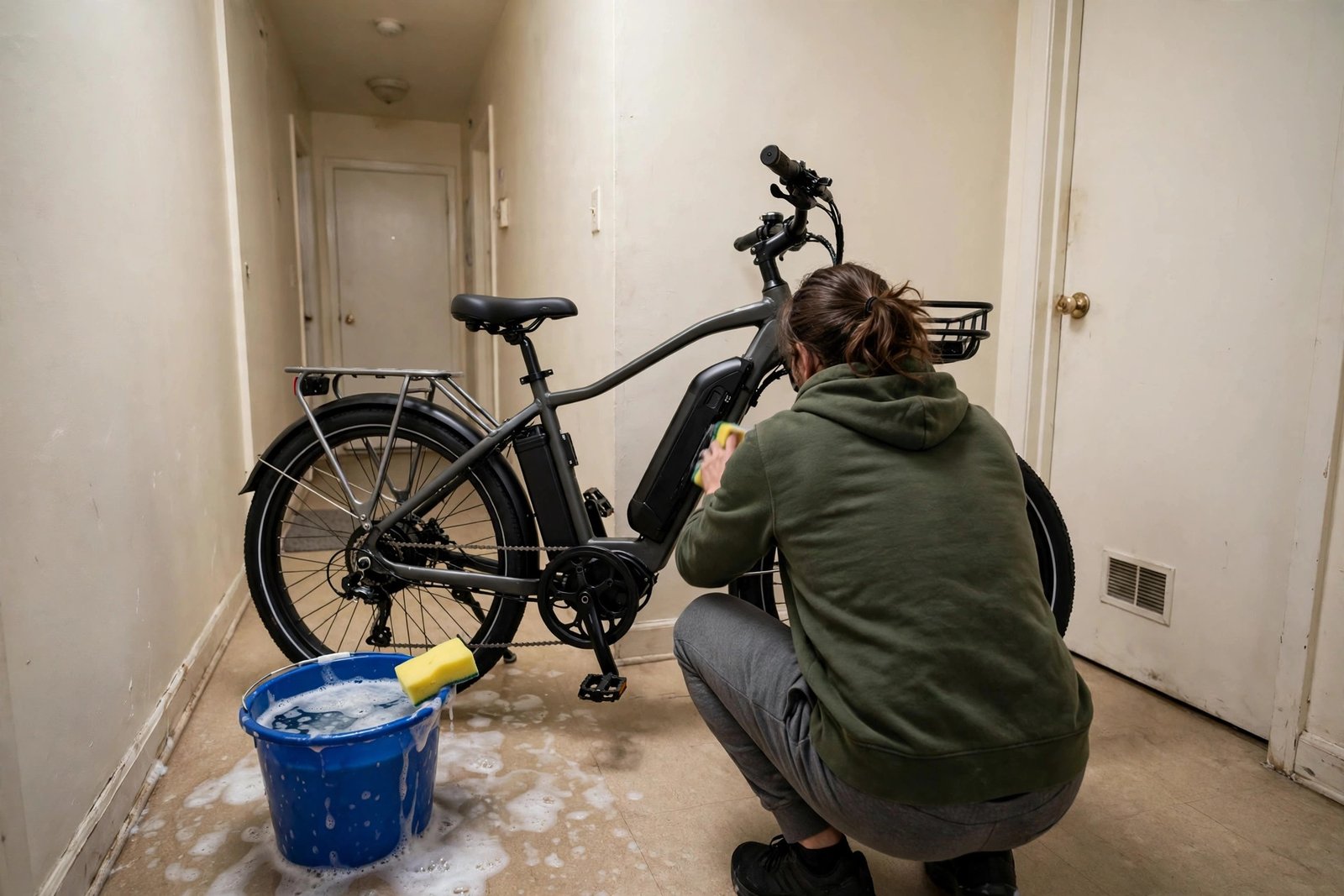
Your e-bike is covered in mud, and you have no hose, no balcony and no garage. The question every flat-dweller asks after a wet ride: how do I clean it in my flat without flooding the hallway or killing the electrics?
In this guide
- The short answer
- Rule 1 — battery out, display off, system off
- Rule 2 — no pressure washer, ever
- Rule 3 — degreaser and lube stay off the rotors and pads
- Rule 4 — dry it before it goes back in the hallway
- Rule 5 — lube the chain after, one drop per link
- The setup — the hallway, the cardboard, the bucket
- The wash, step by step
- The three bikes — the battery-out step differs
- What not to do
- How often
- Related reading
- The bottom line
The answer is a bucket, a sponge, and five rules. An e-bike is not a normal bike in the wash — the battery, the display and the motor change every step. A normal bike can be hosed down and left to drip. An e-bike cannot. The hallway wash is slower, but it is the wash that keeps the bike alive.
The short answer
Battery out, display off or covered, system off — then a bucket and a sponge, never a pressure washer. Wash it in the hallway on cardboard, dry it before it goes back in its corner, and lube the chain after — one drop per link. Thirty minutes, five rules, and the bike is clean without a drop of water where it should not be.
Rule 1 — battery out, display off, system off
Everything else in this guide depends on this rule, so it comes first. Battery out, display off or covered, system off — before any water touches the bike.
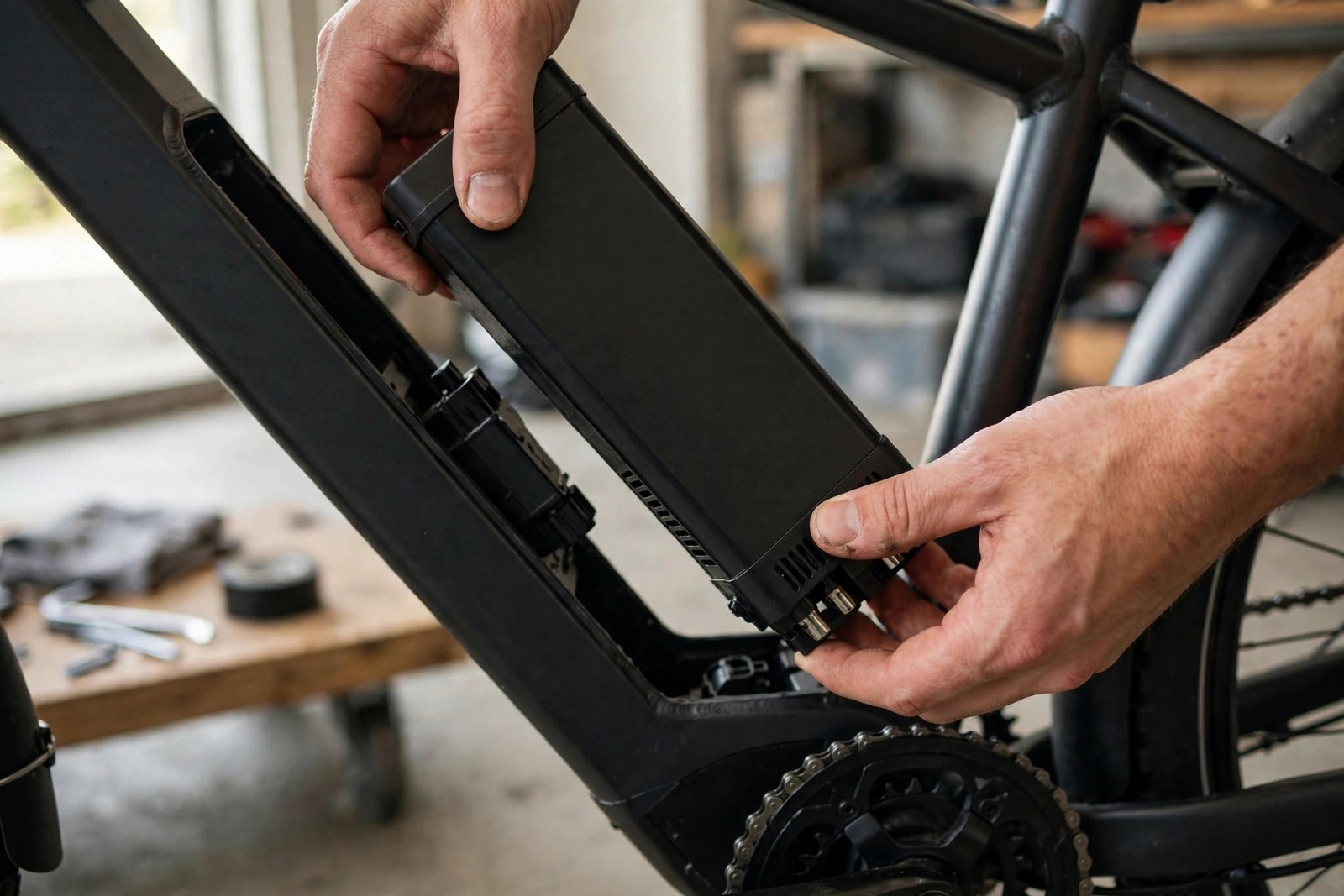
Take the battery out. On a bike with a removable battery, the battery is the most expensive part and the most water-sensitive — it comes out before the wash, every time, and it goes back in only when the bike is dry. A battery that is out of the bike cannot get wet, and a battery contact that is dry cannot corrode. Put the battery somewhere dry and out of the way, and wipe the battery bay with a dry cloth while it is empty.
Turn the system off. Power the bike down completely — not standby, not sleep, off. A live system with wet connectors is a short circuit waiting to happen, and a bike that is off cannot surge, cannot spin the wheel, and cannot drain the battery while you work. If your bike has a key, turn it to off and take the key out.
Cover the display. The display is the second most water-sensitive part, and it is also the part you cannot take off. Wipe the display with a damp cloth, never a wet one, and cover it with a small plastic bag while you wash the bars — a bag and a rubber band is all it takes, and it is the cheapest insurance in this guide.
Rule 2 — no pressure washer, ever
This is the rule that separates an e-bike wash from a normal bike wash. No pressure washer, ever — a bucket and a squeezed bottle is the rinse.
A pressure washer does not wash an e-bike. It forces water past seals, into bearings, into the motor, into the battery bay, and into every connector on the bike — places that are built to keep out rain, not a jet at close range. Rain falls down; a pressure washer pushes water sideways and up, into places rain never reaches. A bearing that takes in water rusts from the inside, and you will not know until it grinds. A connector that takes in water corrodes, and you will not know until the display goes dark on a ride.
The rinse is a bucket and a squeezed bottle. Fill the bucket with warm water and a little bike wash or mild soap, and keep a second bottle of clean water for rinsing. Squeeze the bottle over the frame and let the water run down — low pressure, from above, the way rain falls. A sponge does the cleaning; the bottle does the rinsing.
Rule 3 — degreaser and lube stay off the rotors and pads
The drivetrain is dirty, and the brakes are next to it. Degreaser and chain lube stay off the disc rotors and pads — always.
Degreaser is the problem first. It strips grease, and that is its job on a chain — but on a brake rotor it strips the friction the brakes need, and on a brake pad it soaks in and never comes out. A rotor with degreaser on it does not stop the bike, and a pad with degreaser in it never stops it again. When you clean the chain, keep the degreaser on the chain: a rag behind the chainring catches the drips, and the wheel stays out of the way.
Chain lube is the same story, and it comes up in Rule 5. One drop per link, on the chain, and nowhere else. Lube that lands on a rotor is lube that has to be cleaned off with isopropyl alcohol before the next ride — and lube that lands on a pad means a new pad.
Rule 4 — dry it before it goes back in the hallway
A wet bike in a flat is a rusting bike. Dry it before it goes back in the hallway — the chain and the bolt heads dry to the touch first.
Towel-dry the whole bike after the rinse: frame, fork, wheels, bars, and the battery bay. Then let it air-dry in the hallway for an hour before it goes back into its corner. The chain and the bolt heads are the parts that rust first, so they dry first — run a dry rag along the chain until it comes away clean, and wipe the bolt heads, the quick-release levers, and the spoke nipples. A chain that is left wet rusts overnight, and a rusted chain wears the cassette out with it.
Rule 5 — lube the chain after, one drop per link
The wash strips the chain. Lube the chain after, one drop per link — and only after the chain is dry.
The method is slow and exact, and that is the point. Turn the cranks slowly backwards with one hand and put one drop of chain lube on each link as it passes the top of the chainring. One drop per link, cranks turned slowly backwards — a drop on every link, and no drop anywhere else. Then keep turning the cranks for a minute so the lube works into the rollers, and wipe the outside of the chain with a clean rag. The lube belongs inside the rollers, not on the outside of the chain — the outside just picks up dirt, and dirt on the outside wears the chain out faster than no lube at all.
The setup — the hallway, the cardboard, the bucket
The five rules are the method. The setup is what makes it possible in a flat.
Pick the spot. The hallway is the wash bay — it is the only floor in most flats that can take a splash, and it is where the bike lives anyway. Cardboard under the wheels catches the drips and the mud, and it goes in the recycling when you are done. Two flattened boxes, one under each wheel, is enough.
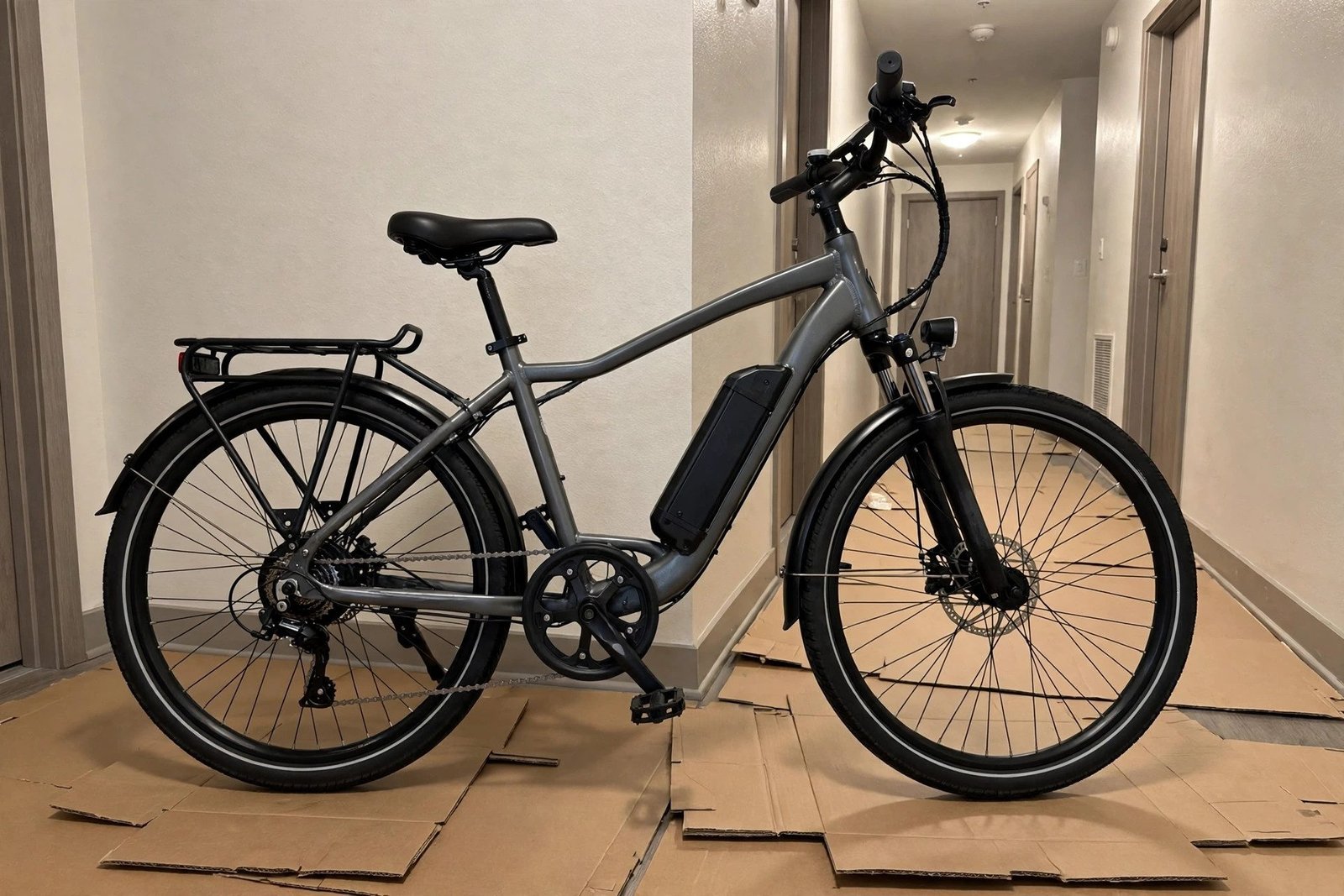
Gather the kit before the bike moves. A bucket, a sponge, two brushes — one stiff for the tyres and the cassette, one soft for the frame — and a bottle of water for rinsing. A bucket, a sponge, two brushes and a bottle of water do it in a hallway — that is the whole kit, and it fits in the bucket when you are done. Add a couple of rags, one for washing and one for drying, and a small plastic bag for the display.
The wash, step by step
The wash runs top to bottom, and the drivetrain comes last.
Start at the top. Wipe the bars, the display, the saddle and the top tube first, with a damp sponge — these are the cleanest parts, and they stay clean if you wash them before the mud moves up the bike. The display gets a damp cloth only, never a wet sponge, and the bag stays on while you work around it.
Then the frame and the fork. Sponge the frame from the top tube down, rinsing the sponge in the bucket as it picks up mud. Work from the top down, because the dirty water runs down — and a part you have already cleaned stays clean. The fork legs and the fenders take the most mud, so they take the most passes.
Then the wheels. Brush the tyres with the stiff brush — mud comes off rubber easily once it is wet — and sponge the rims and the spokes. The wheels are the dirtiest part of the bike, so they come after the frame, not before.
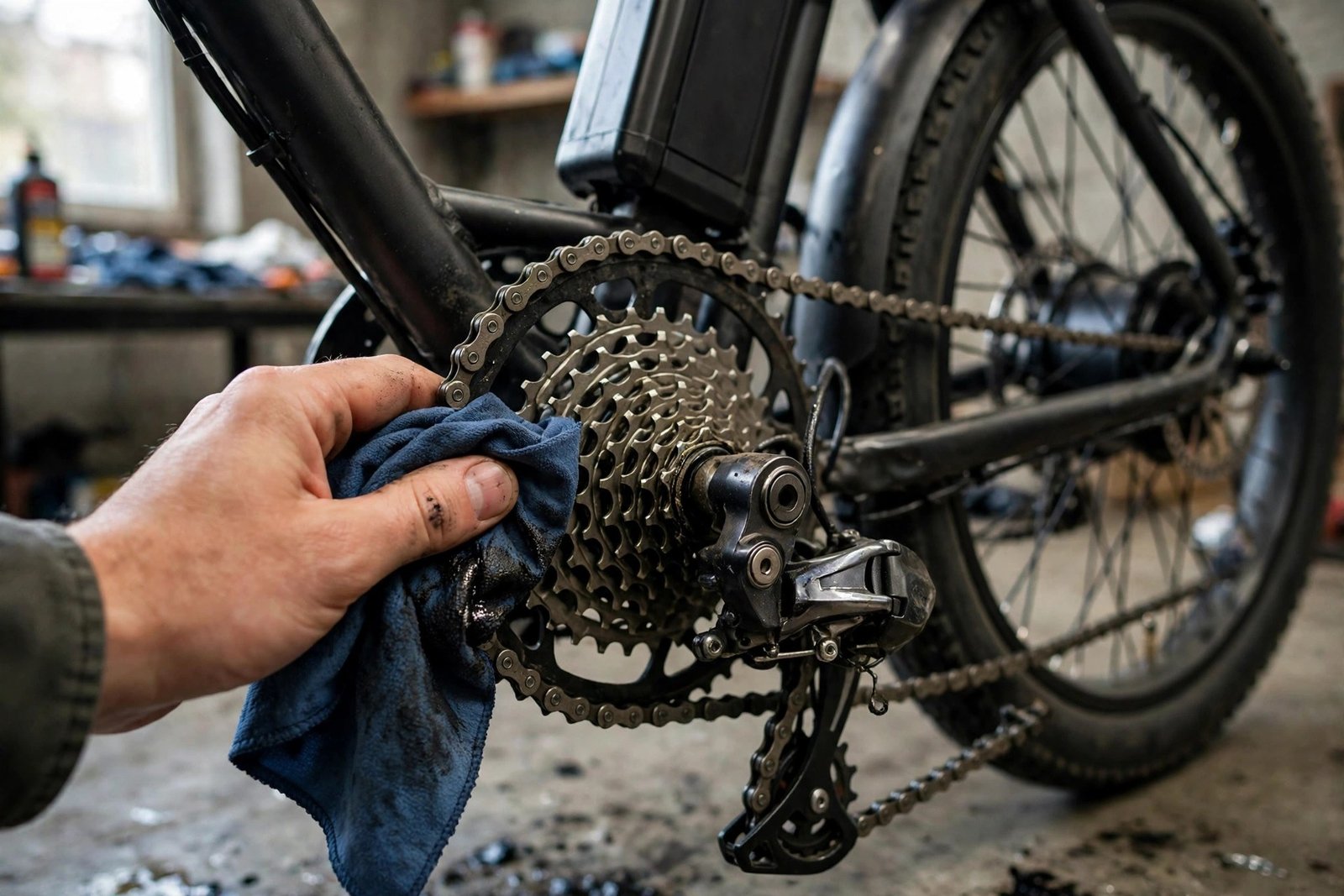
Then the drivetrain, last and separately. Degreaser on a rag, on the chain, with a second rag behind the chainring to catch the drips — and the rotors nowhere near it. The drivetrain is the only part that gets degreaser, and the degreaser is the only chemical that touches the bike. Scrub the cassette with the stiff brush, wipe the chainring, and then rinse the whole drivetrain with the squeezed bottle — low pressure, from above.
The three bikes — the battery-out step differs
The method is the same on every e-bike, but the battery-out step is not. The battery-out step differs by bike, and it is the one step to learn for your own model.
The Lectric XP Lite 2.0 (Check latest price) is the straightforward one: the battery slides out of the frame, and the bay is open and easy to wipe while it is empty. Take it out, wipe the bay dry, and put the battery somewhere dry while you wash.
The Funhang Electric Bike (Check latest price) is the same shape of job: a removable battery that comes out before the wash and goes back in only when the bike is dry. The step is the same, even though the bike is different — battery out, bay wiped, battery back only when dry.
The Heybike Mars 3.0 is the one with a catch. Its battery is removable — a 624Wh pack that slides out of the frame — but you must fold the frame first to get it out, and the key sits inside the fold area. That makes the battery-out step a two-part job: fold the frame, unlock the battery, slide it out. Do it before the wash, not during it, and give yourself the extra five minutes. The Mars 3.0 is also the heaviest example here at 70 lb, so fold it where it will be washed — do not carry it folded and wet through the flat.
And if your bike’s battery does not come out at all, the rule changes shape but not intent. Cover the battery and the charge port, and keep water away from that whole area — wipe around it with a damp cloth, never a wet sponge, and never let the rinse bottle run over it. The battery stays in, the water stays out, and the rest of the wash runs the same.
What not to do
The mistakes after a wash are as predictable as the steps.
Do not use a pressure washer. It forces water into bearings and electrics, and the damage shows up weeks later — a grinding bearing, a dead display, a battery that will not charge. The bucket is slower, and the bucket is the reason the bike still works.
Do not spray water at the display, the motor, or the charge port. These are the three places water does the most damage for the least cleaning, and none of them needs a rinse. Wipe them, cover them, and leave them alone.
Do not put the bike away wet. A wet chain rusts overnight, and a wet bike in a hallway corner rusts quietly for a week. Dry it, wait an hour, wipe it once more, and then put it away.
Do not lube a wet chain, and do not get lube on the rotors. The lube goes on a dry chain, one drop per link, and the rotors stay clean. A contaminated rotor is a brake that does not work, and you find out at the first junction.
How often
The wash is not a weekly ritual — it is a response to the ride.
After every muddy or wet ride, wash it the same day. Mud that dries on a chain grinds it, and salt from winter roads eats a frame in a week. A ten-minute bucket wash after a wet ride is the cheapest maintenance there is.
In dry weather, every two or three weeks is enough. Dust wipes off with a damp cloth, and the chain only needs a wipe and a fresh drop of lube. The chain is the clock — if it looks dry or sounds gritty, it needs lube, and if it is black with grime, it needs a wash first.
Related reading
- E-Bike Maintenance Checklist for Beginners: Before Every Ride, Weekly, Monthly
- How to Store Your E-Bike for Winter (Battery, Tires, Chain — the Flat-Dweller’s Checklist)
- Can You Ride an E-Bike in the Rain? IP Ratings Explained in Plain English
- Article #51 “Electric Scooter Maintenance”.
The bottom line
An e-bike is not a normal bike in the wash — the battery, the display and the motor change every step. Battery out, display off or covered, system off. No pressure washer, ever. Degreaser and lube stay off the rotors and pads. Dry it before it goes back in the hallway. Lube the chain after, one drop per link. A bucket, a sponge, two brushes and a bottle of water do it in a hallway — thirty minutes, and the bike is clean, dry, and still working.
Previous: How to Transport an Electric Scooter by Car (Trunk, Backseat, or Hitch Rack?)
Next: How to Charge an E-Bike When You Have No Outlet (No Garage, Street Parking, No Problem)