
Some links in this article are affiliate links. If you buy through them, we may earn a commission at no extra cost to you.
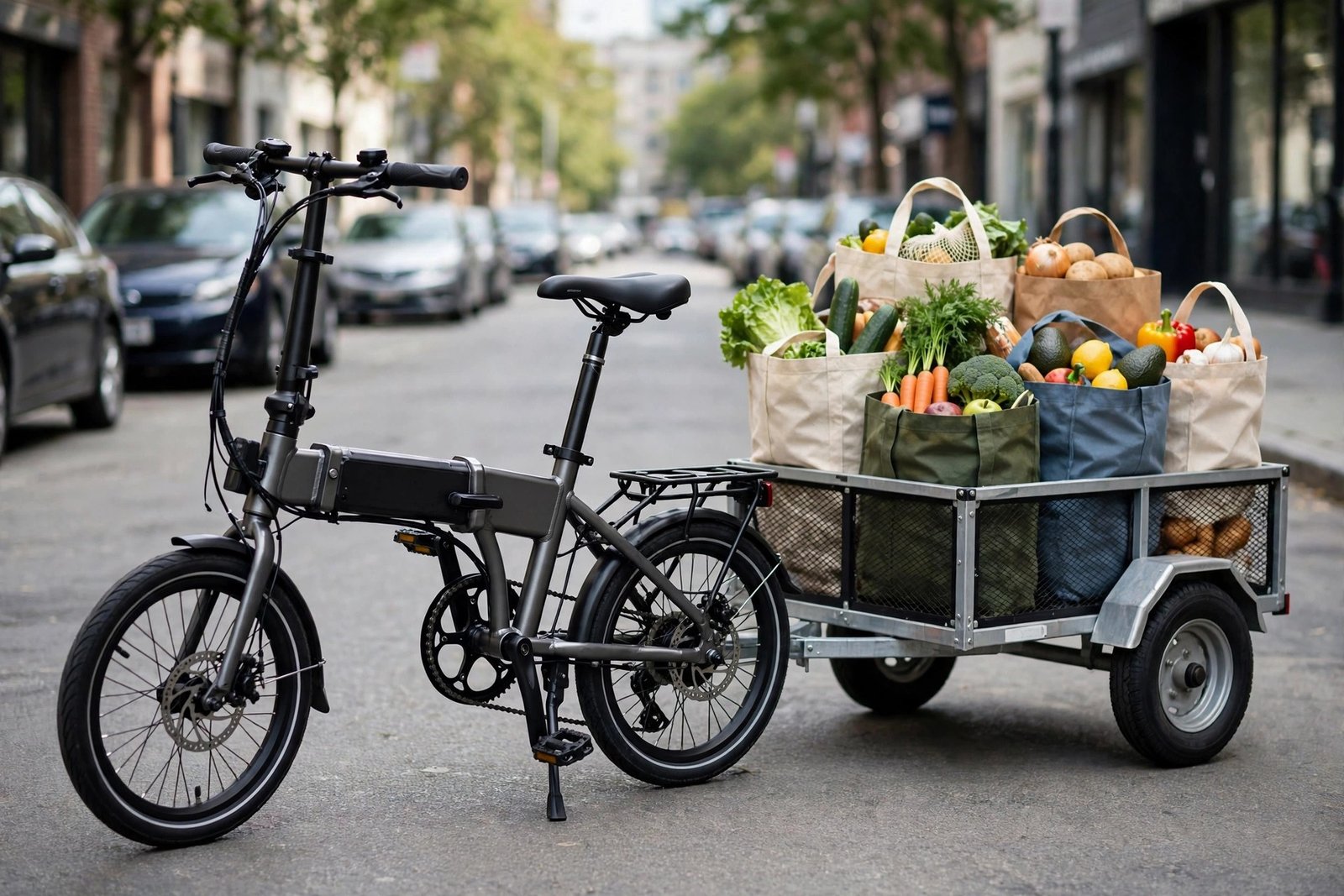
You do the weekly shop on your e-bike and you cannot carry it all. The milk, the tins, the bottles, the bag of rice — it does not fit in a backpack, and a backpack full of groceries ruins your back before you are halfway home. The answer is not a cargo bike. The answer is a trailer that folds into your closet.
In this guide
- The short answer
- The maths — 60 lb, 88 lb, and a trailer against a cargo bike
- The trailer — the Aosom, and what it actually is
- The hitch — seatpost or axle, and the 30 mm check
- The folded size — the honest part
- The tow bikes — what pulls 88 lb
- The weekly shop — loading, riding, and locking
- Before you buy — the ten-minute check
- Related reading
- The bottom line
A cargo bike costs well over a thousand dollars, and it does not fit in a flat. A trailer costs a fraction of that, hitches to the bike you already own, and carries the whole shop on its own two wheels. You do not need a new bike. You need a trailer.
The short answer
Buy a two-wheel cargo trailer with a removable box, hitch it to your seatpost, and put the heavy shopping in the trailer instead of on your back. A weekly shop for one or two people is about 60 lb of groceries. A backpack carries 20 to 30 lb before your shoulders give out. A trailer rated for 88 lb carries the whole 60 lb shop with room to spare — and your back carries nothing at all.
The maths — 60 lb, 88 lb, and a trailer against a cargo bike
Three numbers decide whether the trailer trick works for you.
Sixty pounds is the shop. A full weekly shop for one or two people — milk, bread, tins, bottles, fruit, a bag of rice — weighs about 60 lb. That is the load the trailer has to carry, and it is the load a backpack cannot. A backpack tops out at 20 to 30 lb of groceries before it hurts, and the hurt is the point: the weight sits on your shoulders and your lower back for the whole ride home.
Eighty-eight pounds is the trailer. The Aosom Bicycle Cargo Trailer is rated for 88 lb, so a 60 lb shop leaves 28 lb of headroom. The trailer’s wheels carry the weight, not you and not your bike — the load rides on the trailer’s own two 16-inch wheels, and the bike only has to pull it.
A trailer against a cargo bike. The Aosom. A cargo bike costs well over a thousand dollars — and then it still needs somewhere to live, which a flat does not have. A trailer plus the bike you already own is a grocery hauler for a fraction of a cargo bike’s price. Even if you buy the bike too, an Aipas M1 Pro plus the Aosom is still less than a cargo bike alone, and the trailer folds flat, so the pair still fits in a flat.

The trailer — the Aosom, and what it actually is
The pick is the Aosom Bicycle Cargo Trailer with Removable Box — Amazon’s Choice. It is the only trailer in our catalogue with a verified link, and it is the right shape for the job: a two-wheel box trailer, not a flatbed, so the groceries sit inside a box instead of strapped to a platform.
| Aosom Cargo Trailer | |
|---|---|
| Capacity | 88 lb |
| Overall size | 56.75 × 23.25 × 31.5 in |
| Box size | 24 × 16.5 × 11.8 in, removable |
| Weight | 22 lb |
| Wheels | Two 16-inch rubber wheels |
| Hitch | Seatpost clamp — seat tube under 30 mm |
| Cover | Waterproof cover, 600D Oxford cloth |
| Extras | Red, yellow and white reflectors |
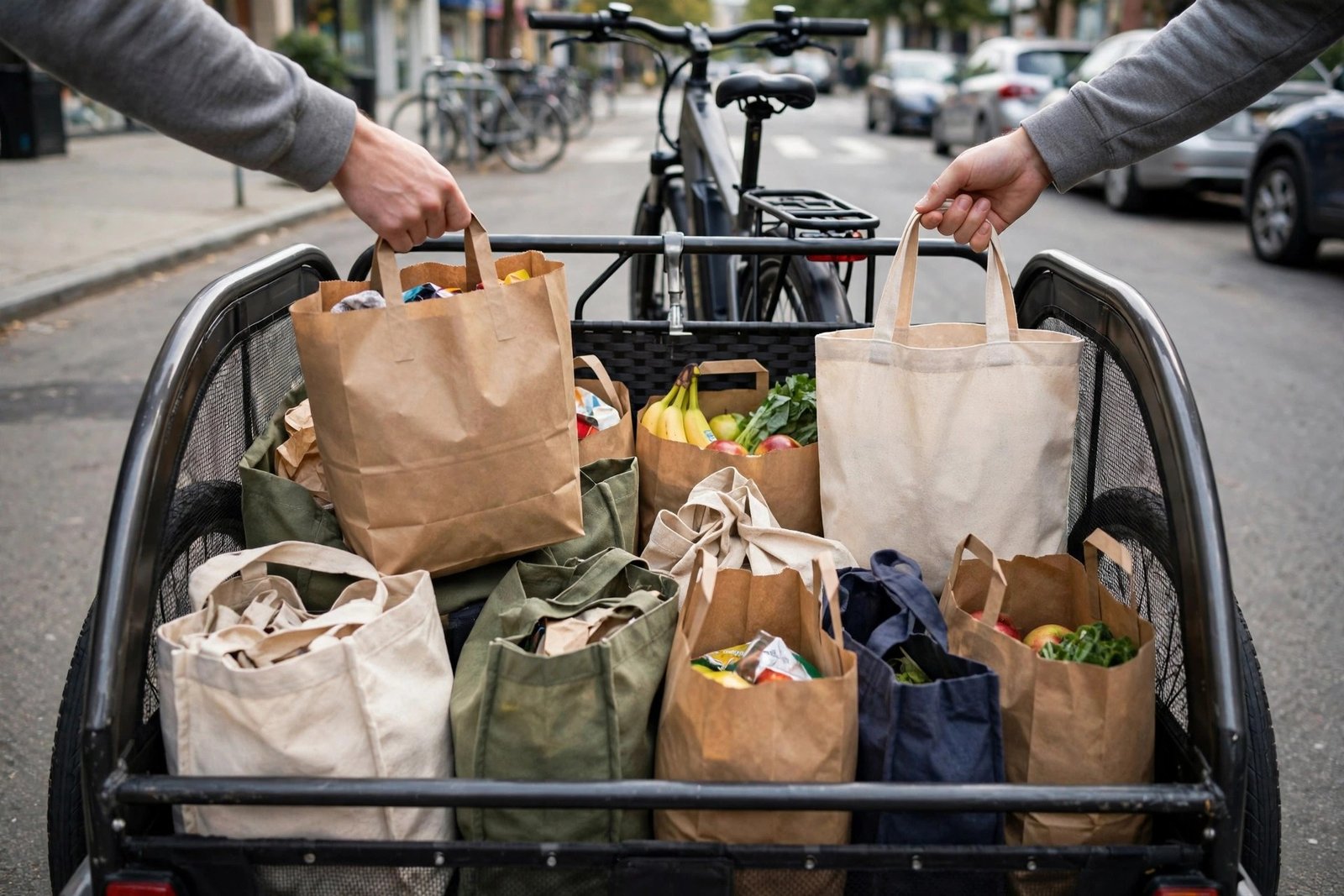
The box is the reason this trailer works for groceries. It is 24 inches long, 16.5 inches wide and 11.8 inches deep, and it lifts out of the frame. You carry the box into the shop, fill it at the till, and lift it back into the trailer — the groceries never have to be loaded one bag at a time on the pavement. A removable box turns the trailer into a shopping basket with wheels.
The box is the size it needs to be. Two paper grocery bags fit side by side in a 24-inch box, and the 11.8-inch depth takes the tall bottles lying flat. The heavy stuff goes in first and lowest — milk, tins, bottles at the bottom, bread and fruit on top — because a trailer loaded top-heavy sways, and a trailer loaded low tracks straight behind the bike.
The cover matters more than it looks. The box comes with a waterproof cover in 600D Oxford cloth, and the trailer carries red, yellow and white reflectors. Groceries in the rain stay dry, and a trailer is low and wide — the reflectors are what other road users see first.
The weight is the number people get wrong. The trailer itself weighs 22 lb, and it carries 88 lb — four times its own weight. That ratio is what makes the maths work: light enough to pull empty, strong enough to carry the shop full.
The hitch — seatpost or axle, and the 30 mm check
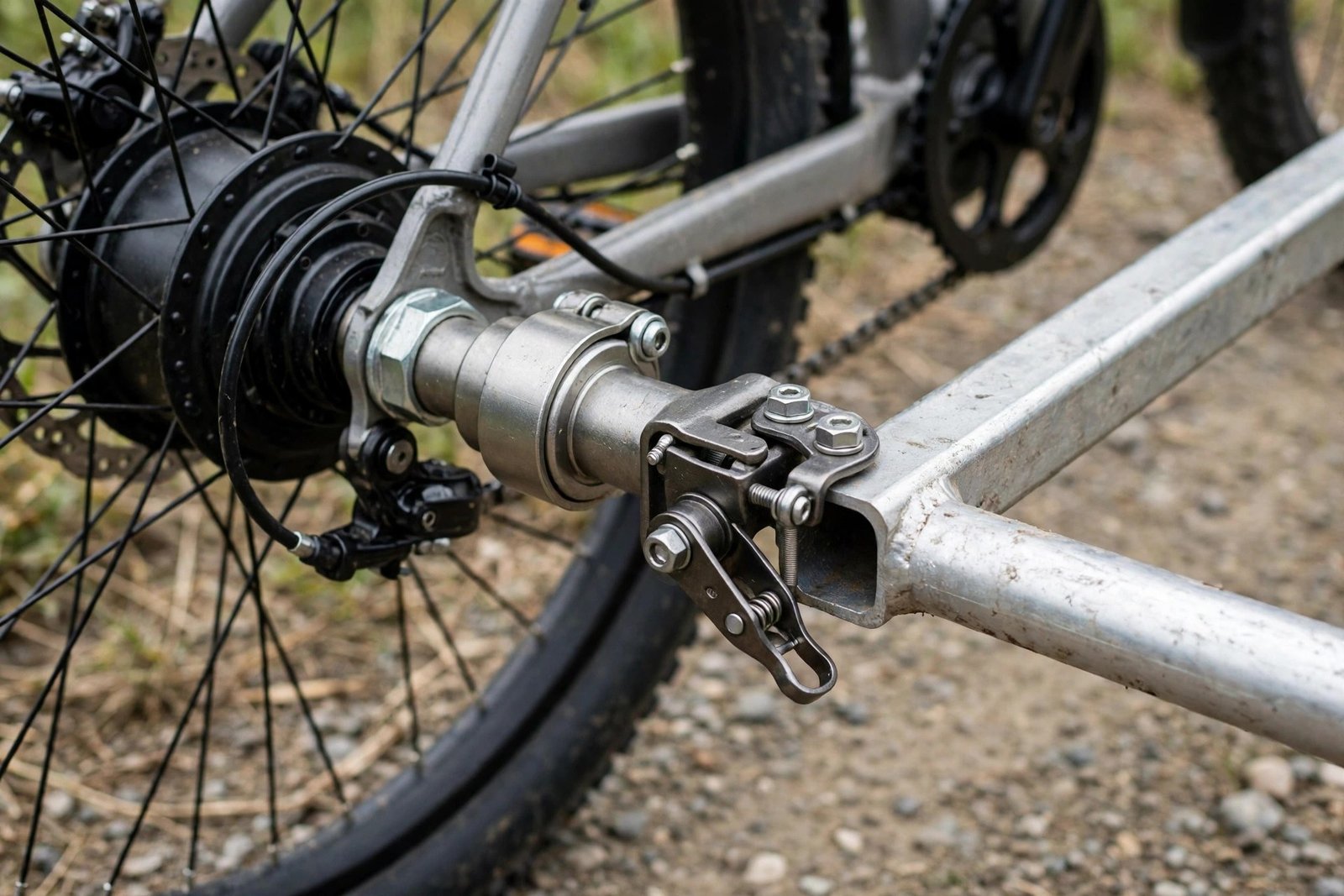
The hitch is the part nobody writes about, and it is the part that decides whether the trailer fits your bike at all. There are two kinds of trailer hitch, and they attach in different places.
A seatpost hitch clamps to the seat tube, under the saddle. The Aosom uses one: a versatile coupler that clamps to the seat tube, with a red button that lets the connector on and off without tools. The seat tube must be under 30 mm in diameter — that is the number on the listing, and it is the check you run before you order. Measure your seatpost with a ruler or a tape measure. If it is under 30 mm, the coupler fits. If it is over, it does not, and no amount of tightening changes that.
An axle hitch bolts to the rear axle instead, and some trailers use a rack hitch that bolts to a rear rack. Neither of those is the Aosom. If your bike has no exposed seatpost — some folders hide the post inside the frame, and some step-throughs run a different tube — a seatpost hitch has nothing to clamp to, and you need a different trailer, not a different coupler.
This is the question the roundups never answer for budget folders: which of our bikes takes a seatpost hitch. The honest answer is that we have not verified the seatpost diameter of the Mars 3.0 or the Aipas M1 Pro — the number is not published in our verified facts for either bike — so the draft does not claim the trailer fits either one. Measure your own bike’s seatpost, compare it with the 30 mm limit, and the answer is yours in thirty seconds. A number you measure yourself beats a claim in a roundup.
The folded size — the honest part
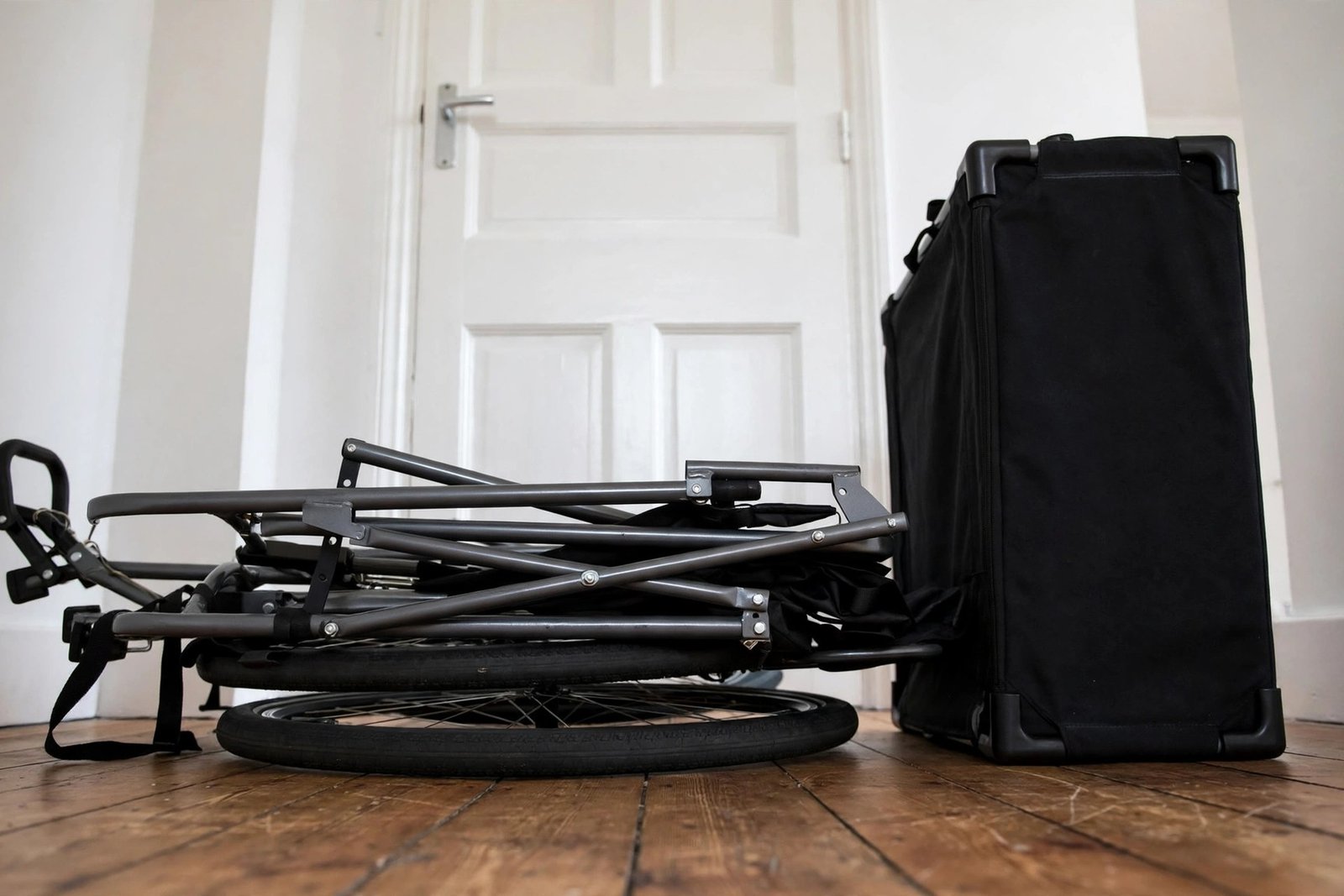
Here is the part the other guides skip, and the part this guide will not fake. Aosom says the trailer’s frame folds, but it does not publish folded dimensions for this model. The comparison table on the listing marks it as foldable, and then stops. No folded length, no folded width, no folded height — and a folded size borrowed from a different trailer would be a made-up number, so this guide prints none.
That matters, because the folded size is the number that decides whether the trailer lives in your flat. A trailer that folds flat lives in a closet. A trailer that does not fold lives on a balcony, and a balcony is not storage. What is verified is this: the frame folds, the box lifts out, the trailer weighs 22 lb, and the box is 24 × 16.5 × 11.8 inches. The box comes out and goes on a shelf; the frame folds flat and leans against a closet wall. Before you buy, the check is simple: fold the frame on arrival, measure it yourself, and if it does not fit your closet, send it back. A trailer you cannot store is a trailer you will stop using, whatever it cost.
The tow bikes — what pulls 88 lb
A trailer does not need a powerful bike. It needs a bike with enough torque to pull the load from a standstill and enough payload to carry you plus the trailer’s tongue weight. The trailer’s 88 lb rides on its own wheels — the bike’s motor pulls it, it does not carry it. That is why a folder you already own can do this job.
The Heybike Mars 3.0 is the roomiest tow bike in the catalogue. It makes 750W rated and 1,400W peak, with 95 Nm of torque, and its payload is 440 lb — the biggest number in our catalogue. Torque is what gets a loaded trailer moving from a red light, and 95 Nm is more than enough for 88 lb on two wheels. It is a 70 lb bike on 20 × 4.0-inch fat tyres, with a 624Wh battery that is UL 2271 and removable — though the frame must be folded first to get the battery out. No price is quoted here: check the listing.
The Aipas M1 Pro is the second tow bike. It makes 1,800W peak and 110 Nm of torque, with up to 85 miles of pedal-assist range from a 48V 17.5Ah battery. More torque than the Mars 3.0, and the same job: pull the trailer, not carry it. Its payload is printed as both 450 lb and 500 lb in different sources, so this guide does not fix it to one number.
Neither bike needs to be a cargo bike. A cargo bike carries the load on its own frame, and that is why it costs well over a thousand dollars and weighs as much as a person. A trailer carries the load on its own wheels, and that is why a folder with a strong motor does the same job for a tenth of the price.
The weekly shop — loading, riding, and locking
The routine is the part that makes the trailer stick, because a trailer you use once a month is a trailer you sell. The routine is: box in, shop, box out, ride home, box into the kitchen.
Load it low and even. The heavy stuff — milk, tins, bottles — goes at the bottom of the box and centred over the axle. A trailer loaded low tracks straight; a trailer loaded high and to one side pulls the bike sideways at every turn.
Ride it wider and brake it earlier. A trailer adds about four feet behind your back wheel, so turns get wider and stops get longer. Take corners a foot wider than you would without the trailer, and start braking a second earlier — the trailer’s 88 lb pushes the bike forward when you stop. On the flat, you will barely feel it: the trailer tracks in the bike’s wheel line, and the motor does the pulling.
Lock both, not one. A trailer has no lock of its own, and a trailer left hitched to a locked bike is a trailer a thief unhitches in ten seconds. Lock the bike to the rack, and lock the trailer to the bike or to the same rack with a second lock — a cable through the frame is enough. Article #45 works through the locking in full, and the rule there applies here too: lock the frame, not just a wheel, to something the thief cannot lift or unbolt.
The shop itself gets easier, not just the ride. The box goes into the shop with you, fills at the till, and lifts back into the trailer. No juggling bags on the handlebars, no backpack straps cutting into your shoulders, no second trip because the first load did not fit. One trip, one box, the whole shop.
Before you buy — the ten-minute check
Before you order, run the check. Measure your seatpost, measure your closet, and weigh one shop.
Minute one, the seatpost. Measure the diameter of your seat tube where the coupler would clamp. Under 30 mm, the Aosom’s coupler fits. Over 30 mm, it does not — and you need a trailer with a different hitch, not a different trailer.
Minutes two and three, the closet. Measure the space where the trailer will live — the closet floor, the space behind the door, the gap beside the wardrobe. The box is 24 × 16.5 × 11.8 inches and it lifts out, so it goes on a shelf by itself. The frame folds flat and leans against the wall. If the closet takes the box and the folded frame, the trailer lives in the flat.
Minutes four to ten, the shop. Do one weekly shop and weigh the bags when you get home — a bathroom scale works. If the shop is under 60 lb, the Aosom’s 88 lb rating covers it with room to spare. If the shop is over 88 lb, you need a bigger trailer or two trips — and most weekly shops for one or two people are not over 88 lb.
Then order the trailer, hitch it, and do the shop. A trailer that fits your seatpost, fits your closet, and carries your shop is a trailer you will use every week. A trailer that fails one of the three is a trailer you will use once.
Related reading
- How to Transport an E-Bike by Car (Fold It Into the Trunk, or Use a Hitch Rack?)
- What Does an E-Bike Really Cost to Own? The First-Year Costs Nobody Mentions
- Best E-Bikes for Heavy Riders (300 lb+): Weight Limits That Actually Matter
The bottom line
You do not need a cargo bike. You need a trailer that folds into your closet. A weekly shop is about 60 lb, the Aosom carries 88 lb, and it costs far less than a cargo bike. Measure your seatpost, measure your closet, weigh one shop — and the bike you already own becomes the grocery hauler.
Previous: How to Lock an Electric Scooter (So It Stays Yours): Locks That Actually Work
Next: Best Budget Commuter E-Bikes Under $500: What $500 Actually Buys You