

Some links in this article are affiliate links. If you buy through them, we may earn a commission at no extra cost to you.
Your scooter weighs about 31 lb. A thief does not need tools to steal it — they need two hands and ten seconds. Pick it up, carry it to a van, drive away. That is the whole problem, and it is why locking a scooter is a different job from locking a bike. A scooter has no frame triangle, no tube you can thread a lock through, and two small wheels that come off with a couple of Allen keys. The lock is not an accessory. It is the only thing standing between your scooter and a van.
The numbers back it up. In Los Angeles, 1,046 motorized devices were reported stolen in 2024 — up 22.3% on the year before, and four times the 2021 count. In one UK police force area, e-scooter thefts rose from 22 incidents in 2017 to 752 in 2021. Scooters are stolen because they are light enough to lift, and most of them were never designed to be locked. This guide is about the routine that keeps yours out of those numbers.
The one rule: a lock that secures a scooter to itself is not a lock
A lock that secures a scooter to itself is not a lock — it is a handle. That is the whole guide in one sentence, and everything below follows from it. The lock must go through a structural part of the scooter AND around something fixed to the ground. If either half is missing, the scooter is not locked. It is decorated.
1. The locking points — and the traps
Bikes have a frame triangle: shackle through the rear triangle, the rear wheel and the rack, done. A scooter has a folding stem, a deck you cannot get a lock through, and two small wheels.
First: through the folding hinge assembly, where the stem meets the deck, and around the anchor. This is the best point on every scooter we sell. The hinge is structural and non-removable — if a thief cuts here, they have destroyed the thing they are stealing.
Second: around the stem tube itself, high up near the handlebars, plus the anchor. Third: through the front fork and the anchor — better than the wheel alone, because the fork is part of the frame.
Fourth, and last resort: through a wheel only. A wheel-only lock is better than nothing, and not much better.
The traps are the parts that look lockable and are not. Never lock through the handlebars — they slide out of the stem on most scooters. Never lock through a fender or a bolted-on accessory — a thief unscrews it and walks away with the scooter. Never lock through a wheel that can be unbolted. The rule is simple: if a part can be unscrewed or removed, it is not a locking point.
“The hinge where the stem meets the deck. That is the point — structural, non-removable, and the one a thief cannot cut without destroying the scooter.”
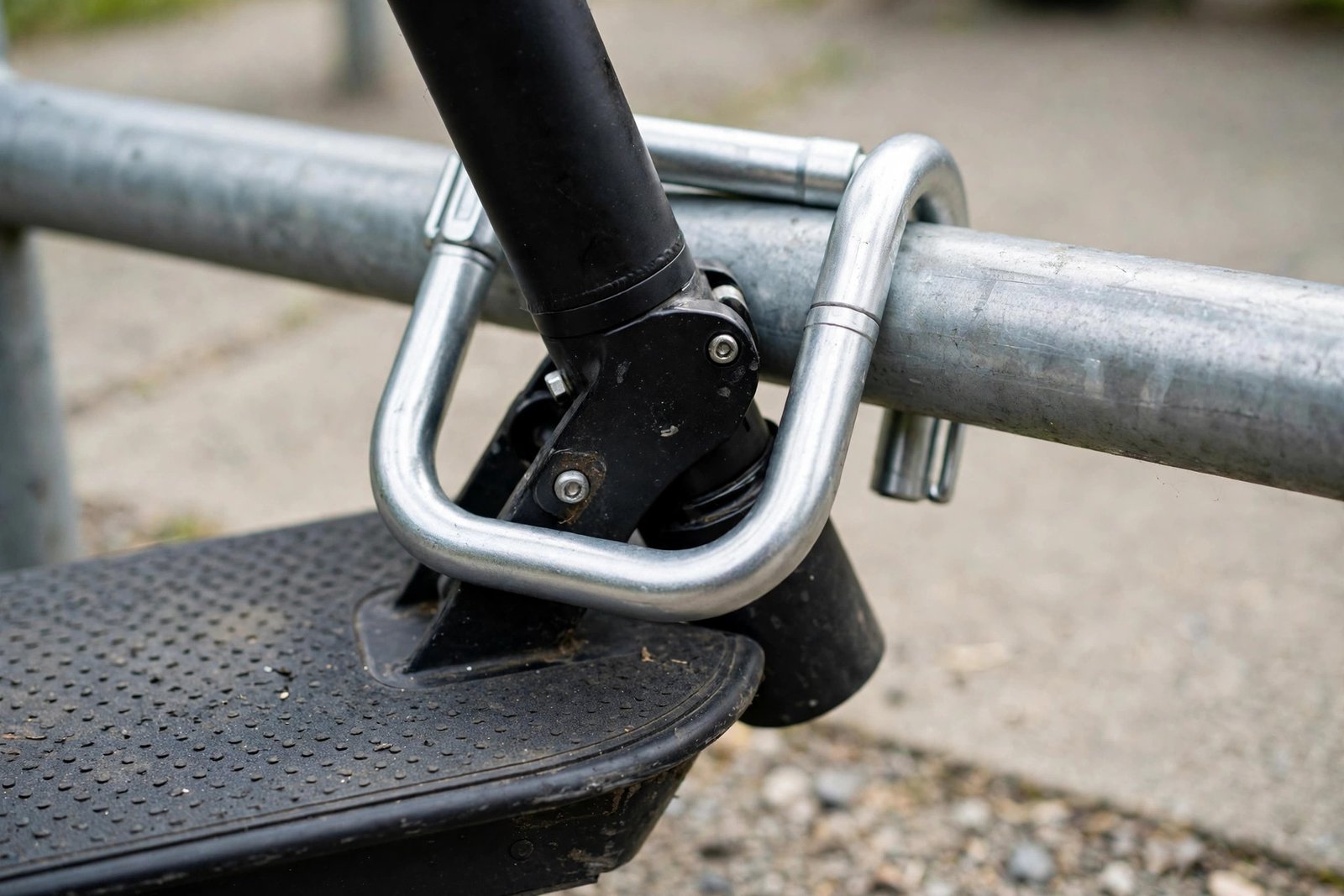
| Scooter | Weight | Best locking point | Approx price |
|---|---|---|---|
| HopCycle Electric Scooter | About 31 lb | Deck–stem hinge | Check latest price |
| WERHY 500W/350W Adult Scooter | Not published | Deck–stem hinge | Check latest price |
| Segway Ninebot E2 Plus | Not published | Deck–stem hinge | Check latest price |
| Segway Ninebot E2 Pro | Not published | Deck–stem hinge | Check latest price |
The hinge is the best point on all four — every one of these is a folding scooter, and the hinge is the same design on each. What differs is the stem diameter, and that decides whether a given lock reaches around it. That is the next section’s problem, and the one most buyers miss.
2. The locks, ranked honestly
Cable locks: skip them. Braided cable is cut with hand shears, and the armoured-looking sleeve is cosmetic. A prepared thief carries bolt cutters and works fast in daylight — cables die instantly. As your only lock, it is not a lock.
Folding locks: the best fit for scooters. Hardened steel plates riveted together, folding flat into a holster on the stem, opening into a loop long enough to reach around a stem, a post and back. The honest weakness is the rivets: on a cheap folding lock the joints can be drilled out, so buy a named maker, not the cheapest listing. We do not have a verified folding lock in our catalogue yet, so this guide names the category, not a product — and it does not link to one.
U-locks: the strongest per pound, if they fit.
Chain locks: leave them at the office. A good chain is strong, but it weighs 4 to 8 lb, and you will not carry it on a scooter you chose for being light.
3. The Mini-7 fit check — measure before you buy
Here is the flag this guide exists to make. The Kryptonite Evolution Mini-7 is our primary lock, and its opening is 3.25 inches. That is the number that decides whether it works on your scooter.
A scooter stem tube is roughly an inch and a half to two inches across, and a standard rack rail is about the same. A slim stem plus a slim rail fits inside 3.25 inches — just. A thick post does not. A fat stem plus a wide anchor does not. If the shackle will not close around both, the lock is useless on that rack, however strong the steel is.
Measure your stem, and measure the rail you actually lock to. If the numbers do not fit, do not buy the Mini-7 and hope — buy the folding lock instead, whose loop is longer, or a longer-shackle U-lock.
The Mini-7 itself is the right lock when it fits: a 13 mm hardened steel shackle, a double deadbolt, a Sold Secure Gold rating, and a 4 ft cable in the box for the front wheel. Kryptonite rates it 7 out of 10 on its own scale.
4. The anchor matters more than the lock
The anchor matters more than the lock. A Gold-rated U-lock around a signpost that lifts out of the ground secures nothing. A Gold-rated U-lock around a rack bolted to concrete secures the scooter.
Lock to a rack bolted to concrete, a metal post set in cement, or a heavy steel railing anchored to a building. Check the anchor before you check the lock: wiggle it, lift it, look at the bolts. If it moves, walk to the next one. Never lock to a signpost that lifts out, a thin fence, or a rack that is itself only chained to something.
Then lock it properly. Fill the internal space of the lock as completely as you can — slack is leverage, and a pry bar loves an empty shackle. Keep the lock off the ground, where a thief can smash it with a hammer. Point the keyhole down, so it cannot be filled with glue or picked easily.
“A busy rack in daylight beats a Gold-rated lock in a dark alley. Thieves work where nobody is watching.”

5. Habits that outperform hardware
The best lock in the world is beaten by the worst habit. These habits cost nothing and outperform hardware.
Keep stops short. Thieves typically spend less than three to five minutes on a lock before abandoning it. If the scooter will sit all day, it needs the best lock you own and the best rack you can find, not the quick lock.
Vary the rack. The same scooter at the same rack at the same time every day is a schedule a thief can plan around.
Use two locks in a high-risk spot. A U-lock through the hinge plus the cable through the front wheel is two jobs, not one.
Register the scooter, fit a tracker, and make it yours. A GPS tracker hidden in the stem or battery compartment tells you where it went. A motion-sensitive alarm lock — the other category we do not yet have a verified link for — screams when the scooter is moved. And personalise the scooter with stickers or paint: thieves prefer generic models, and a distinctive scooter is easier to identify and harder to sell.
6. At home: fold it and bring it inside
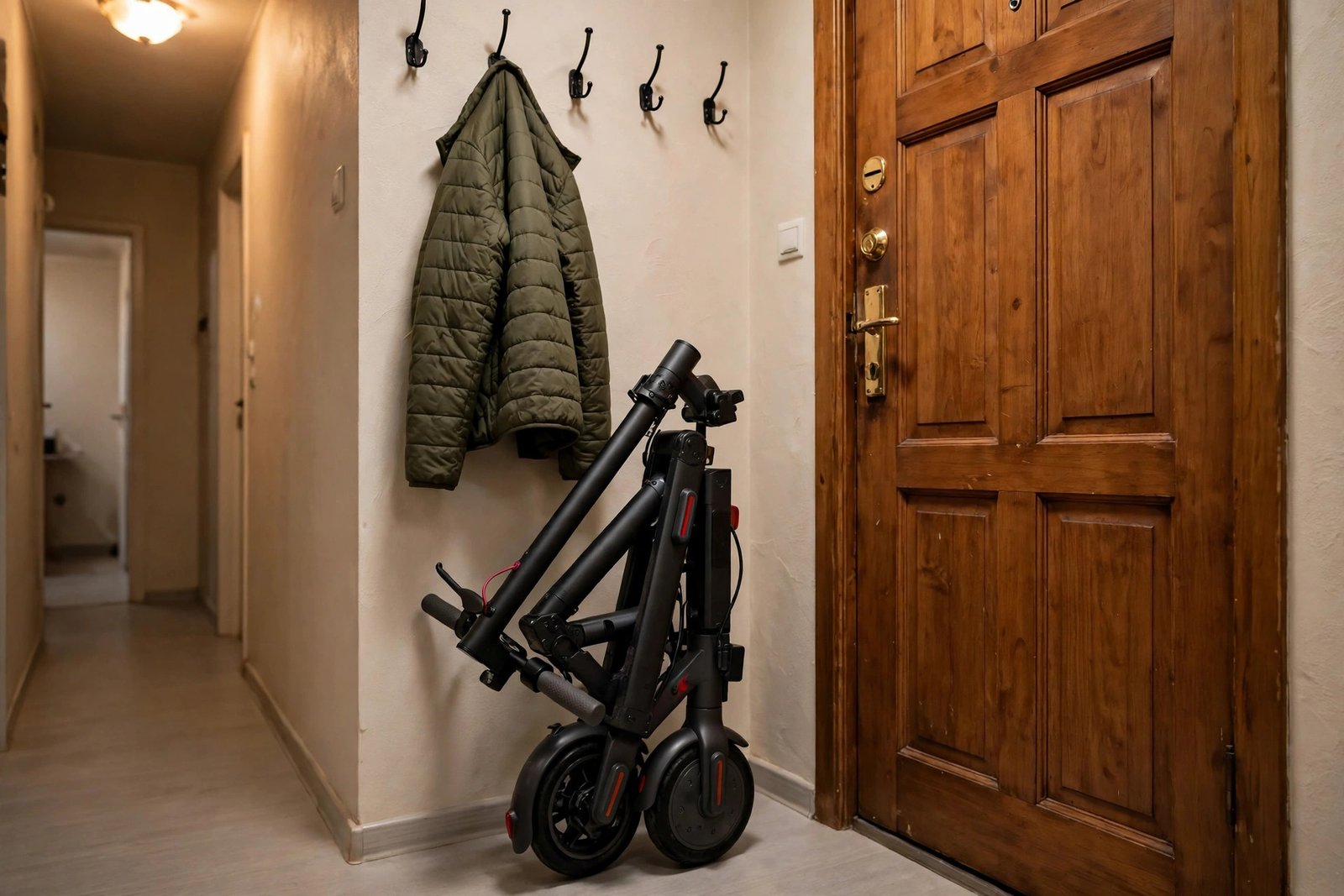
Here is the apartment angle, and it is the best lock in this guide. Your scooter lives inside the flat, so theft happens at the rack, at work, or outside the café — not at home. The scooter folds, and it weighs about 31 lb. Carry it up the stairs and stand it in the hallway.
The hallway, not the stairwell. A stairwell is a fire escape, not storage — and a scooter left there is both a hazard and an easy grab. Inside the flat, by the front door, is where it lives.
“The best lock is the front door. Fold the scooter, carry it inside, and there is nothing to steal.”
7. The honest limit: nothing stops a grinder
Nothing you can carry stops a cordless angle grinder. That is the honest limit, and any guide that hides it is selling you something. A determined thief with a grinder cuts a 13 mm shackle, a folding lock and a chain alike.
What a good lock buys you is noise, sparks, time and attention — a real deterrent in a busy place, almost worthless in an empty alley at 2 am. That is why the anchor, the spot, the short stop and the busy rack matter as much as the lock itself. The routine is the defence, not the lock. A Gold-rated lock on a scooter left overnight in a dark alley is a donation.
The two locks
Kryptonite Evolution Mini-7 Bike U-Lock
The primary lock, and the one to buy if the scooter is genuinely at risk. A 13 mm hardened steel shackle with a double deadbolt, Sold Secure Gold, Kryptonite’s own 7 out of 10, and a 4 ft cable in the box for the front wheel. The opening is 3.25 by 7 inches — measure your stem and your rack first, as the fit check above says. Check latest price.
Kryptonite Keeper Mini-6 U-Lock
The cheaper second lock, for quick stops in low-risk places. A 12 mm hardened steel shackle in a smaller body — 3.25 by 6 inches — with a frame bracket in the box. One honest note: the listing publishes no independent attack grade for this model, so do not read a Gold rating into it. It is Kryptonite’s entry lock: enough for a café stop in a busy street, not the lock for an all-day stay in a hard area. Check latest price.
Frequently asked questions
Can I lock my scooter with just a cable lock?
You can, and a thief can cut it in seconds with hand shears.
Where is the best place to lock an electric scooter?
Through the folding hinge where the stem meets the deck, around a rack bolted to concrete, in a busy spot, in daylight.
Will a U-lock fit around my scooter’s stem?
Measure it. The Mini-7’s opening is 3.25 inches — a slim stem plus a slim rail fits, just. A thick post or a fat stem does not, and then you need a folding lock or a longer shackle.
Is a folding lock better than a U-lock for a scooter?
For fit, yes; for strength per pound, no. A folding lock’s loop reaches further and folds flat on the stem. A U-lock’s shackle is thicker and harder to cut. If the U-lock fits, take the U-lock. If it does not, take the folding lock.
What if my scooter is stolen anyway?
Report it to the police with the serial number, check the local resale listings, and tell your insurer. Our stolen guide walks through the first 30 minutes — it is in the keep-reading list below.
Disclosure
We have not tested these locks or scooters ourselves. Every weight, price and specification in this article comes from the maker’s own listing or manual, or from an independent review — and where the sources disagree, the article says so. Prices are approximate and change often; check the latest price on Amazon before you buy. This article contains affiliate links: if you buy through them, we may earn a small commission at no extra cost to you. That does not change what we recommend.
Keep reading
- My E-Bike Was Stolen — What to Do in the First 30 Minutes (and How to Get It Back) — the first 30 minutes after a theft.
- How to Lock and Protect Your E-Bike — the same principles for bikes, the layered method.
- Do You Need Insurance for Your E-Bike? (What Apartment Renters Should Check First) — when a lock is not enough.
Previous: Best E-Bike for College Students (Check the Dorm Rules First)
Next: Best Budget Commuter E-Bikes Under $500: What $500 Actually Buys You
