
Some links in this article are affiliate links. If you buy through them, we may earn a commission at no extra cost to you.
You plug your scooter in at night and wonder when it will actually be full — and whether leaving it plugged in overnight is safe. The answer is between three and a half and seven and a half hours, and the charger sets the pace, not the outlet. A bigger battery does not always mean a longer charge — it usually comes with a bigger charger. The slowest charge in our range is not the biggest battery — it is the smallest charger.
In this guide
The guides give you a range — three to eight hours for most scooters — and the formula. None runs the formula on our scooters’ real battery and charger numbers, scooter by scooter. And none ties charging to the apartment routine — when to plug in, when to unplug, and where the scooter sits while it charges. This guide does both.
The short answer
Most of our scooters take four to seven hours from empty to full on the charger in the box. The fastest is the MAX G3 at about three and a half hours, on its 209-watt built-in charger. The slowest is the E2 Plus at about seven and a half hours, on a 36-watt charger into a 220Wh pack. And the number that matters for your day is not the full time — it is the time to 80 percent, because the last fifth is slow. Plan on 80 percent, not 100, and the scooter is ready hours sooner.
The three numbers that decide it
Three numbers decide every charge time, and all three are on labels you own.
First, the battery, in watt-hours. Watt-hours are the size of the tank — a 597Wh battery holds more than twice the energy of a 275Wh one, and takes longer to fill on the same charger. Read the watt-hours off the battery label, not the range claim — the range is a best case, the label is the fact. If the label gives volts and amp-hours, multiply them: 36 times 11.6 is about 418 watt-hours.
Second, the charger, in watts. Watts are the size of the tap — multiply the charger’s volts by its amps, and a 42-volt, 2-amp charger is 84 watts. A 2-amp charger is half the pace of a 4-amp charger, and the charger that came with a budget scooter is usually the slow one. The E2 Plus ships with a 36-watt charger — that is why a small battery still takes seven and a half hours.
Third, the taper. A lithium battery does not charge at one speed. It charges fast while it is empty and slows down as it fills — the last 20 percent is a slow constant-voltage finish, taking about half as long again as the bulk charge that got you to 80 percent. That is why the full time always looks longer than the maths says it should.
The formula is simple: hours are roughly the battery in watt-hours divided by the charger in watts, plus 10 to 20 percent for losses. Take the E2 Pro: 275 watt-hours divided by its 70-watt charger is 3.9 hours, and 10 percent for losses gives about 4.4 hours. Segway’s own manual says about five and a half hours. The formula is a floor, not the answer — and the slower the charger, the further it falls short, because the taper dominates. The maker’s stated time is the anchor everywhere in this guide, and the formula is the check.
The nine scooters — battery, charger, and the real time
Our nine scooters, with the numbers from the makers’ manuals or the listing.
| Scooter | Battery | Charger | Full charge | Plan on (80%) |
|---|---|---|---|---|
| Segway Ninebot MAX G3 | 597Wh (46.8V, 12.75Ah) | 209W built-in (53.6V, 3.9A) | About 3.5 hours | About 2.5 hours |
| Segway Ninebot MAX G2 | 551Wh (36V, 15.3Ah) | 121.8W built-in (42V, 2.9A) | About 5 hours | About 4 hours |
| Hiboy S2 MAX | 557Wh (48V, 11.6Ah) | 109W (54.6V, 2A) | 6 to 7 hours | About 4.5 hours |
| Hiboy S2 Pro | 418Wh (36V, 11.6Ah) | 84W (42V, 2A) | 4 to 6 hours | About 4 to 4.5 hours |
| Segway Ninebot E2 Pro | 275Wh (36V, 7.65Ah) | 70W (41V, 1.7A) | About 5.5 hours | About 3.5 to 4 hours |
| HopCycle Electric Scooter | 281Wh (36V, 7.8Ah) | 42V charger (amps not stated) | About 5 hours | About 3.5 hours |
| Phantomgogo Electric Scooter | Check the label | Check the label | About 5.5 hours | About 4 hours |
| Segway Ninebot E2 Plus | 220Wh (21.6V, 10.2Ah) | 36.3W (24.2V, 1.5A) | About 7.5 hours | About 5.5 hours |
| WERHY 500W Adult Scooter | Check the label | Check the label | Check the label | Check the label |
The MAX G3 is the fastest charge in our range and the biggest battery in it — 597 watt-hours filled in about three and a half hours, because the built-in charger pushes 209 watts, more than twice any other here. It also takes a second DC charger at the same time, cutting the full charge to about two and a half hours — but that charger is sold separately, and three and a half hours is the figure in the box.
The MAX G2 is the one with two answers, and both are printed. Segway’s US manual says about five hours; the listing and the EU manual say six. The formula lands at five, so five is the number this guide uses — and six is the number to expect if the battery is cold.
The two Hiboys sit in the middle, and the maths checks. The S2 MAX carries 557 watt-hours on a 109-watt charger: 557 divided by 109 is 5.1 hours, plus losses, and Hiboy says six to seven. The S2 Pro carries 418 watt-hours on an 84-watt charger: 418 divided by 84 is 5 hours, and Hiboy says four to six. Both are honest ranges, and both are the maker’s numbers.
The E2 Pro is the warning about the formula. Its 275-watt-hour pack on a 70-watt charger should take about four and a half hours by the maths, and Segway says five and a half. A small charger spends more of its time in the slow finish, so the gap between the formula and the real time is biggest where the charger is smallest.
The E2 Plus is the slowest charge in our range, and the smallest battery in it. Its 220-watt-hour pack on a 36-watt charger takes about seven and a half hours — Segway’s manual, Wilson’s and the listing all say the same, though one manual table prints six. A small battery on a tiny charger is the worst combination in this table.
The HopCycle and the Phantomgogo are the two with a gap in the numbers. The HopCycle’s listing states a 36-volt, 7.8-amp-hour battery — 281 watt-hours — and about five hours to full, but it never states the charger’s amps, so the formula cannot be run. The Phantomgogo’s own manual states about five and a half hours and a 30 lb frame, but it does not publish the battery size at all. Both times are the maker’s stated time, and both 80-percent figures are about three-quarters of the full time — the same proportion the calculator gives for a verified pack.
The WERHY is the row with no numbers, and that is honest, not lazy. The H8 to H11 family listings give different packs — 187, 441, 499 and 609 watt-hours all appear for different WERHY models — and different charge times, and our linked scooter’s listing does not settle which pack it carries. A number we cannot verify is a number we do not print — check the label on the battery and the charger before you plan around the WERHY’s charge time.
These are new prices, not a recommendation to buy for charging speed. The Segway Ninebot MAX G3 is the dearest and the fastest, the Segway Ninebot MAX G2 follows, and the Hiboy S2 MAX, the Hiboy S2 Pro and the Segway Ninebot E2 Pro sit in the middle. The HopCycle Electric Scooter, the Phantomgogo Electric Scooter and the WERHY 500W Adult Scooter are the cheapest, and the Segway Ninebot E2 Plus is the slowest to charge of the nine.
Why the last 20% is the slow part
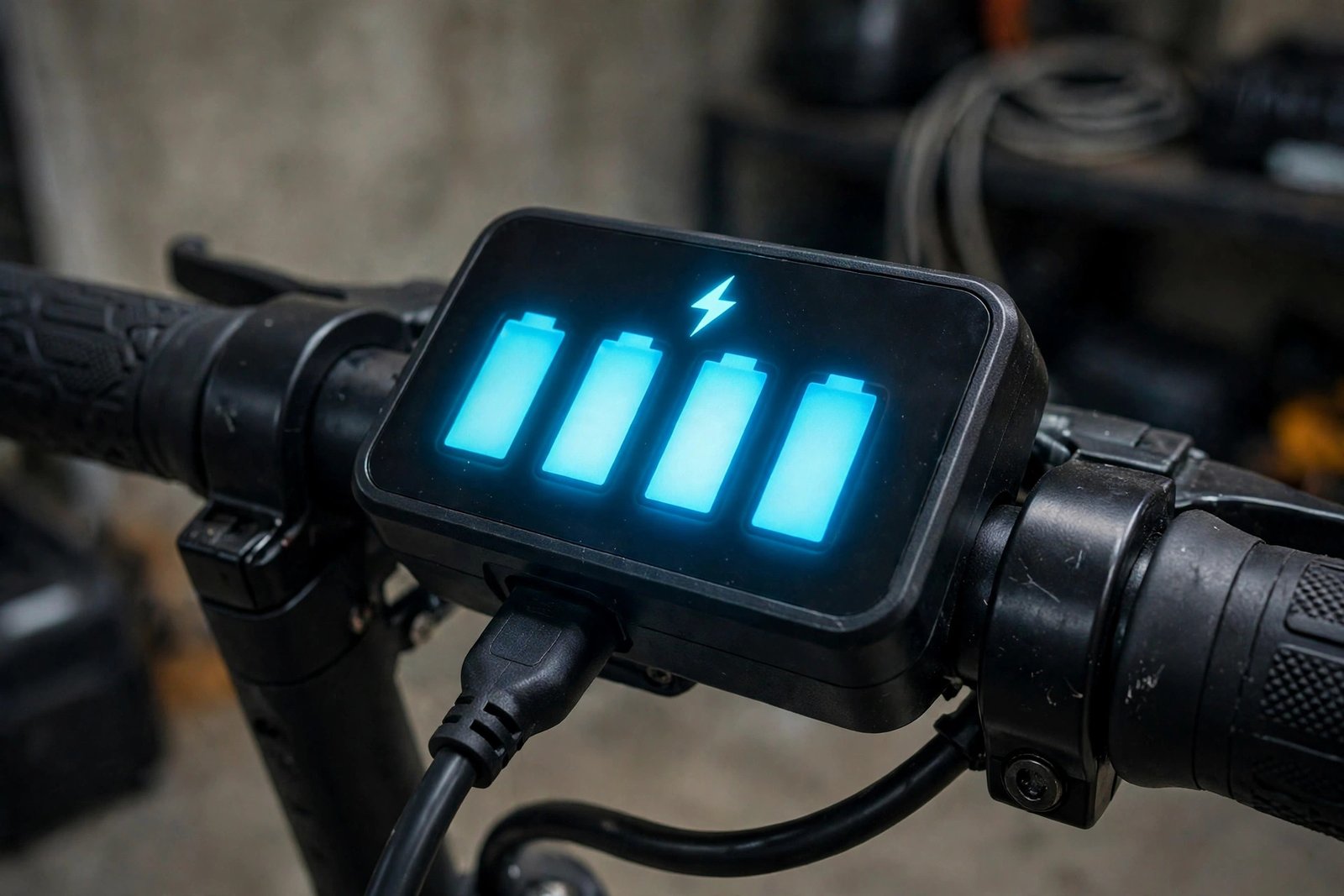
The taper is not a defect — it is how a lithium battery stays safe. The charger pushes full current while the battery is empty, then holds the voltage steady and lets the current fall as the battery fills. The last fifth is a trickle, and it takes far longer than a fifth of the time.
Our Charging Time Calculator shows it plainly. A 48-volt, 15-amp-hour pack — 720 watt-hours — on a 2-amp charger, which is 96 watts, takes 7 hours 6 minutes from 20 percent to full, and 4 hours 44 minutes from 20 percent to 80 percent. The last fifth costs 2 hours 22 minutes — about half as long again as the bulk charge. That is why 80 percent is the number to plan on: the last fifth buys a fifth of the range for half as much time again.
Put the calculator to work on your own scooter — the Charging Time Calculator takes your battery in watt-hours and your charger in amps and gives you the time from any starting charge. Read both numbers off the labels, not off the listing — the listing rounds, and the label does not.
The apartment routine — charge while you are awake
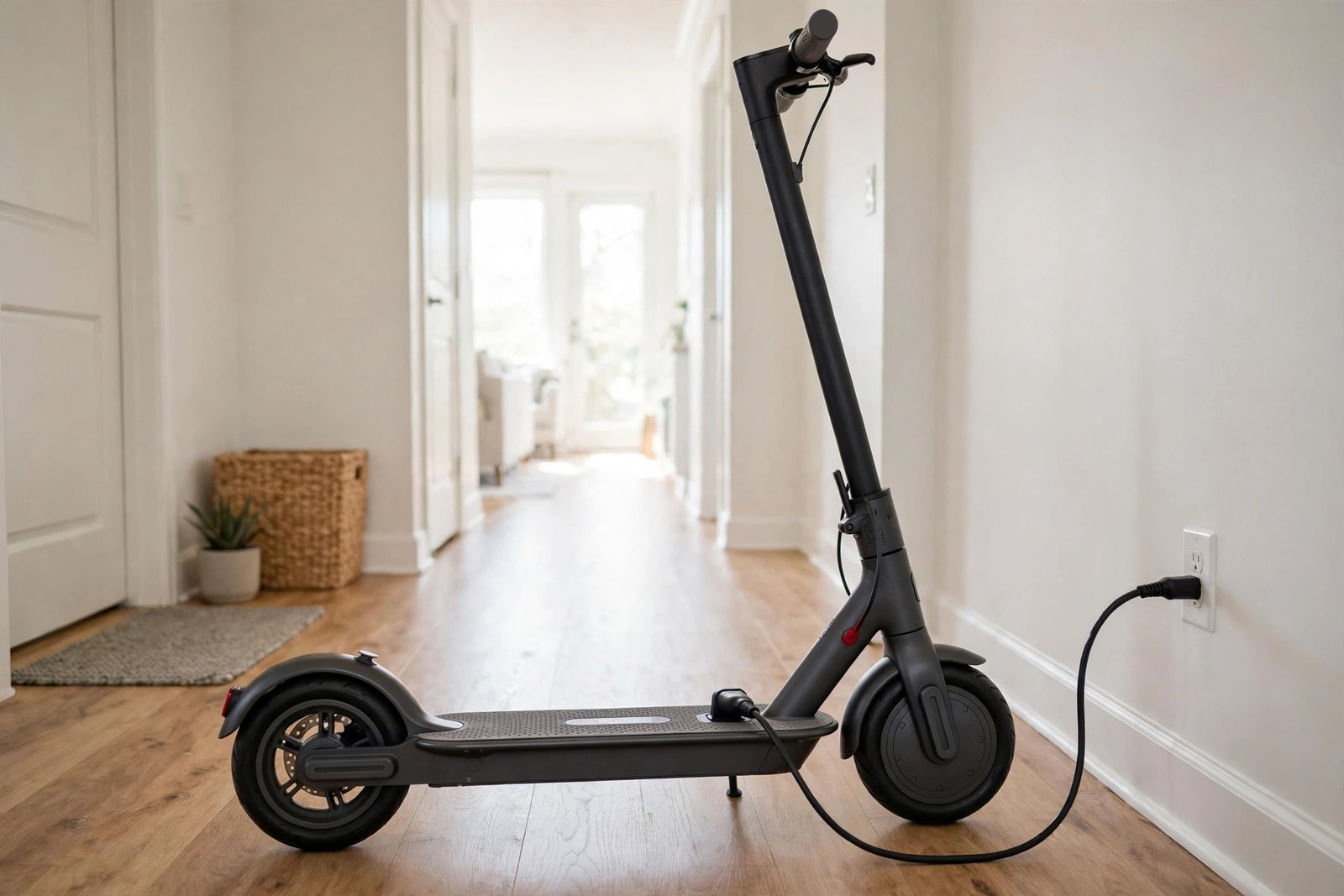
The charge time is only half the question. The other half is whether the scooter is safe while it charges in your flat — and the answer is yes, if you charge it the way the fire services say.
Charge while you are awake and present, and never overnight. A lithium battery that fails does so while it charges, and a sleeping household cannot smell smoke or hear a charger popping. Plug it in when you get home, unplug it when it is full. The MAX G3 is full in three and a half hours, so an evening charge covers it; the E2 Plus needs seven and a half, so it goes on after work, not at bedtime.
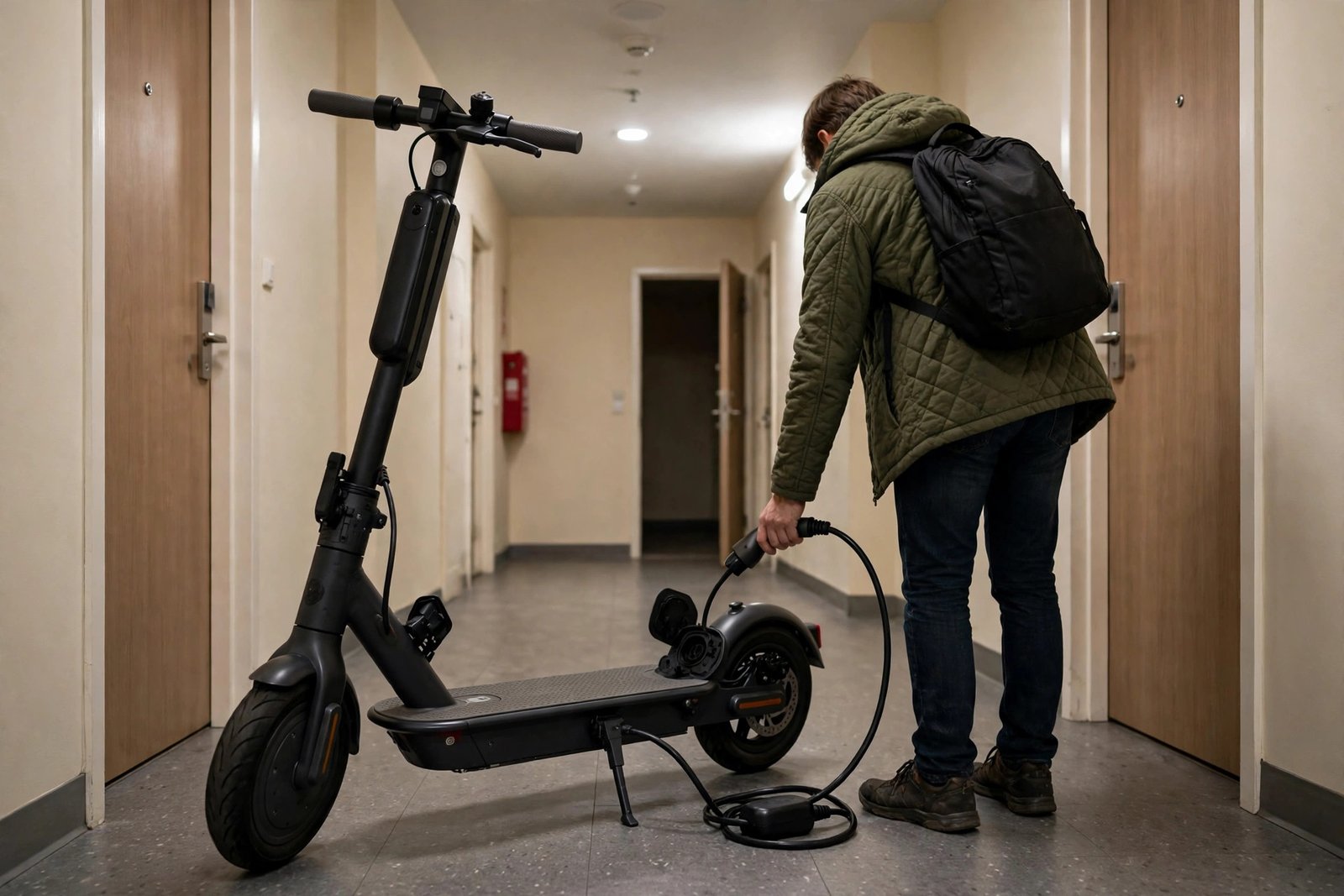
Never charge near an exit. The scooter must never sit in front of the front door, the hallway, or the stairwell while it charges — a burning battery in the only way out is the accident the rule exists to prevent. Charge it in the room, away from the door, with a clear path out.
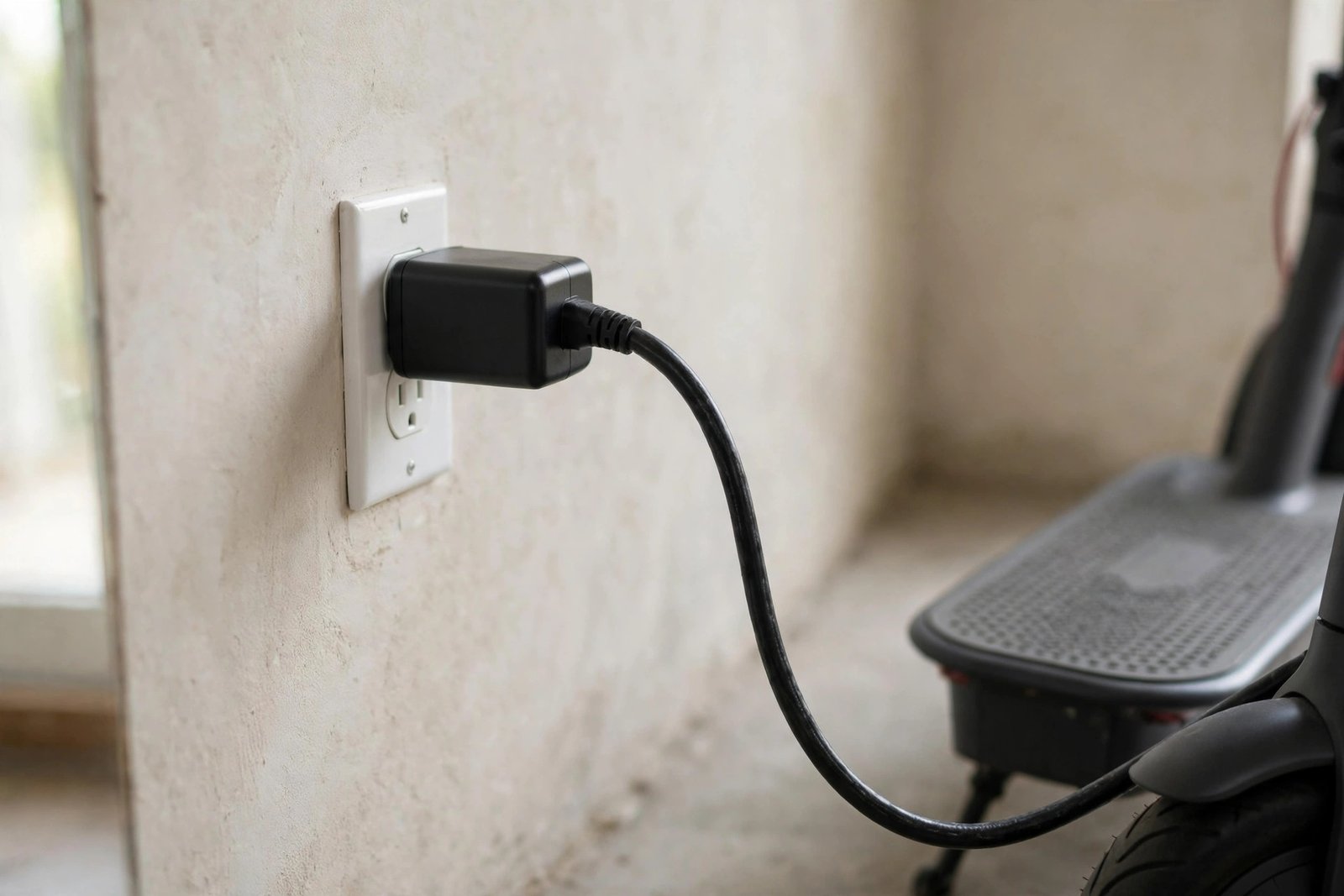
Plug it straight into a wall outlet. No power strips, no extension cords, no multi-plug adapters. A strip adds resistance and heat, and a scooter charger pulling 200 watts through a cheap strip is a fire risk the fire services name. One scooter, one wall outlet.
Use the charger that came with the scooter. A charger from another scooter may fit the plug and still be wrong — the wrong voltage can damage the pack, and the wrong amps can cook it. The E2 Plus charger puts out 24 volts; a 42-volt charger would damage its 21.6-volt pack. If the charger is lost, replace it with the maker’s own charger for your exact model.
Never charge a frozen battery, and never charge in extreme heat. Bring the scooter inside and let it warm to room temperature first — Segway’s own manuals give a charging range of 32 to 113°F, and charging below freezing damages the cells. In summer, keep it out of direct sun and away from radiators, and never charge above 105°F.
What makes a charge slower — or shorter
Four things move the time away from the table, and all four are worth knowing before you blame the scooter.
Cold is the first. A battery at 40°F takes noticeably longer than the same battery at 70°F, because the chemistry slows down and the charger backs off. Bring the scooter inside an hour before you plug it in, and the charge runs at the maker’s time. A scooter charged in an unheated hallway in January is always slower than the table says.
The wrong charger is the second. A replacement with fewer amps than the original stretches the charge — a 1-amp charger on a 275Wh pack takes twice as long as the 1.7-amp charger that came with it. Check the amps on the replacement against the original before you buy it.
An old battery is the third — and it works the other way round. After about 500 charge cycles the pack holds less energy, so the light turns green sooner — not because it charged faster, but because there is less battery left to fill. A scooter that used to take five and a half hours and now takes four has not got a better charger; it has a smaller battery than it used to, and the range shows it first.
The last fifth is the fourth. If you only ever charge to 80 percent, every charge in this guide is about a quarter shorter than the table’s full time — and the battery lasts longer for it, because a lithium pack kept away from full charge ages more slowly. The 80-percent habit buys you time twice: less waiting, and a battery that keeps its capacity longer.
Related reading
- How Long Does It Take to Charge an E-Bike? (Real Times, Bike by Bike)
- Can You Charge an E-Bike Battery Inside Your Apartment? The Honest Safety Answer
- How Long Does an E-Bike Battery Last? (and How to Make Yours Last Longer)
- Can I Charge My E-Bike at Work? (The Commuter’s Guide — Ask First, Then Plug In)
The bottom line
The charger sets the pace, not the outlet — and the last 20% is the slow part. The MAX G3 fills in about three and a half hours on a 209-watt charger; the E2 Plus takes about seven and a half on a 36-watt one. Read the watt-hours off the battery label and the watts off the charger, run the formula, and trust the maker’s time over the maths. Plan on 80 percent, charge while you are awake, and never charge near the exit.
Previous: E-Bike Laws by State (2026): Where You Can Ride, and What Your Bike’s Class Means
Next: How to Ride an E-Bike in Winter (Snow, Ice, Salt, and the Fat-Tyre Advantage)