

Some links in this article are affiliate links. If you buy through them, we may earn a commission at no extra cost to you.
You are halfway to work, the scooter doing 15 mph down a road you ride every day, and then the back end goes soft. A nail, a thorn, a shard of glass — something you never saw — and your morning is now a walk to the office carrying a scooter. That flat is the whole argument in one moment: a pneumatic tire rides better, and a solid tire never does this to you. The choice is made the moment you pick the scooter — so ask the tire question before you buy, not after your first flat.
The trade-off fits in one line. A pneumatic tire — an air-filled tire — wins on comfort, grip and range. A solid tire wins on never getting a flat. The rest of this article is about which side of that line your street sits on.
What each tire actually is
A pneumatic tire is a rubber tire full of air, with a valve stem you pump it up through. Most modern scooter pneumatics are tubeless: no inner tube, the tire seals onto the rim, and the best ones carry a self-healing jelly layer that seals small punctures on its own.
A solid tire has no air at all — rubber all the way through, so nothing can puncture and nothing needs pumping. There are three kinds. A plain solid tire is a solid band of rubber — the firmest ride. A honeycomb tire is solid rubber with air pockets cut into it, so it gives a little more. An inner-hollow tire — Segway’s name — is a solid tire with a hollow core, which absorbs more shock than solid rubber. All three are flat-proof. None of the three rides like air.
Your street decides — three questions
Before you compare scooters, answer three questions about your own ride, because the right tire depends on the road.
First, how smooth is your road? Smooth tarmac and cycle lanes forgive a solid tire. Cracked pavements, potholes and speed bumps do not — every bump goes straight into your feet and knees.
Second, how far do you ride? A ten-minute hop to the station on solid tires is fine. Forty minutes each way, twice a day, is where a pneumatic tire earns its keep.
Third, how wet does it get? Rain changes the answer. A pneumatic tire grips better in the wet than a solid one, because the air lets the rubber press into the road. Solid tires slide more easily on wet paint, metal covers and smooth wet stone.
The pneumatic side — comfort, grip, and the PSI catch
A pneumatic tire does three things a solid tire cannot: it soaks up bumps, it grips in the wet, and it rolls with less resistance, so the same battery goes a little further. On a potholed street it is the suspension — many budget scooters have none at all.
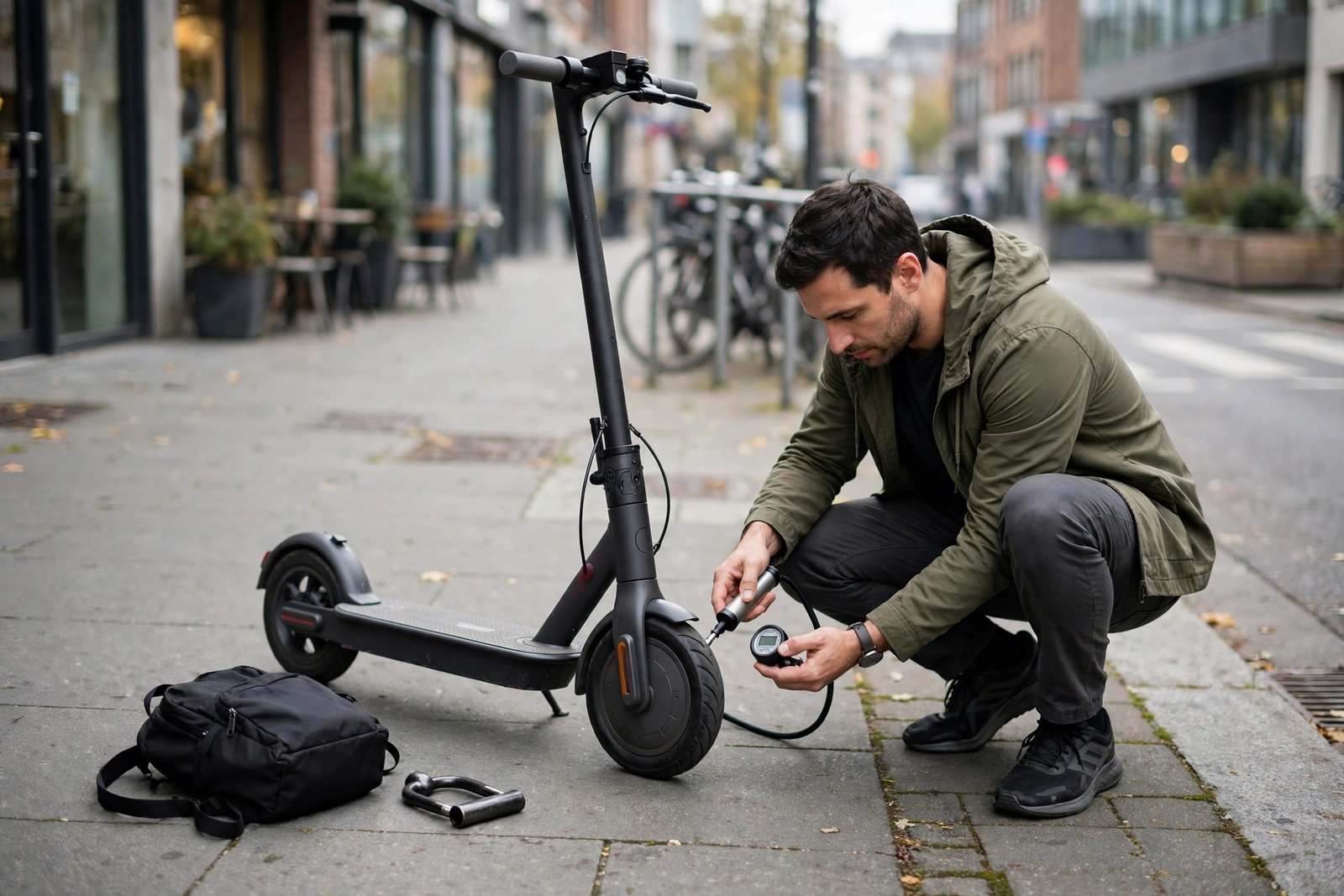
There is one catch. A pneumatic tire at the wrong pressure is worse than a solid tire. Under-inflated, it squirms, wears fast, and punctures easily. Over-inflated, it bounces and grips less. The pressure is a number, printed in the manual, and it takes thirty seconds a week to check. The Segway E2 Pro runs at 45 psi, give or take 3; the MAX G3 runs 42 to 48 psi; scooter tires in general sit around 45 to 50 psi. Run your tire size through our Tire Pressure Calculator and write the number on a sticker on the stem.
“A pneumatic tire at the wrong pressure is worse than a solid tire. Check it once a week and the comfort, the grip and the range all stay yours.”

Segway Ninebot MAX G3 — Check latest price
The pneumatic pick, and the best tire in this article. 11-inch self-sealing tubeless tires — the jelly layer inside seals punctures up to 4 mm on its own — plus dual hydraulic suspension, so the tires are not doing the suspension job alone. Up to 28 mph and up to 50 miles claimed, with a 286 lb payload. This is the scooter for a rough road, a long commute, or rain. The honest flag is the price: roughly three times the budget picks.
Segway Ninebot E2 Pro — Check latest price
The pneumatic pick for half the money. 10-inch air-leakage-proof tubeless tires at 45 psi, a 350W motor with 750W peak, and traction control — a feature the cheaper Segways do not have. Segway claims about 25 miles; independent testing at full speed gets roughly half. No suspension, so the tires do all the cushioning — which is exactly why the 45 psi number matters on this scooter. UL 2272 certified, with Apple Find My.
The solid side — never flat, and the price you pay for it
A solid tire’s promise is simple: it cannot go flat, so it cannot ruin your morning. No pump, no pressure checks, no roadside repair. For a short, flat, smooth commute — a mile to the station — that is a genuinely good deal.
The price is the ride. A solid tire transmits every crack and bump straight into your feet, and it grips less in the wet. On a smooth road you will barely notice. Honeycomb and inner-hollow designs take the edge off, but they do not close the gap to air. If your road is rough, a solid tire is a daily tax you pay in comfort.
“A solid tire cannot go flat, so it cannot ruin your morning. The price is the ride — every crack in the road goes straight into your feet.”

Segway Ninebot E2 Plus — Check latest price
The solid pick, and the lightest scooter in this article. 8.1-inch inner-hollow tires — solid, puncture-proof, maintenance-free, with a hollow core that absorbs more shock than solid rubber. A 300W motor with 500W peak, 15.5 mph, about 32 lb — light enough to carry up a flight of stairs one-handed. This is the scooter for the short, flat, smooth commute: a mile to the station, into the office, under the desk. One honest flag: one retailer listing wrongly calls these tires “pneumatic tubeless” — Segway’s own specification and manual say inner hollow. Trust the manual, not the listing.
WERHY 500W/350W Adult Scooter — Check latest price
The cheapest solid pick in this article. 8.5-inch honeycomb solid tires — the air pockets do the cushioning that plain solid rubber cannot — with a 350W or 500W motor, 19 or 22 mph depending on which motor you pick. This is the flat-proof promise at the lowest price, on a smooth road. The honest flag: the listing quotes different ranges for different variants, so this article quotes none.
The middle ground — self-healing, honeycomb, and one listing that lies
The middle ground is a self-healing tubeless pneumatic tire: air for the ride, a jelly layer for the flats. The MAX G3’s tires seal punctures up to 4 mm on their own — a nail smaller than that never becomes a flat at all. It is not flat-proof — a big cut still beats it — but it takes the most common flat off the table. If you want the comfort and you hate flats, self-healing tubeless is the tire to look for first.
And then there is the scooter this article looked at and left out. The Gotrax SD1’s listing says two different things: the title says the front tire is air-filled, and the product details say solid. That is not a pick — it is a warning. When a listing disagrees with itself, do not buy on the tire claim alone. Check the tire with your own eyes when it arrives: a valve stem means air, no valve stem means solid.
HopCycle Electric Scooter — Check latest price
The budget pneumatic pick. 8.5-inch pneumatic tires, a 500W peak motor, 18 mph, and about 31 lb — light for a scooter with air tires. This is the scooter for the rider who wants the pneumatic ride at a solid-tire price. Two honest flags: the listing’s headline range figure is contested, so this article does not repeat it; and the weight — the listing says about 31 lb, one roundup says 23 lb.
What to carry, and what to check before you buy
Your tires decide what goes in your bag. On a pneumatic scooter, carry a small hand pump and check the pressure once a week — thirty seconds, and the tires stay at the pressure the manual asks for. A pocket pump costs less than one taxi ride home after a flat. On a solid scooter, carry nothing for the tires — carry a lock instead. Either way, the lock is the same: our pick is the Kryptonite Mini-7 (Check latest price).
Before you buy, check three things on the listing. First, the tire line — it should name the type in plain words: “pneumatic”, “tubeless”, “solid” or “honeycomb”. If it does not, the seller is hiding the weakest part of the spec. Second, the valve test — when the scooter arrives, look for a valve stem on the rim: stem means air, no stem means solid, whatever the listing said. Third, the pressure number — a pneumatic manual always gives a PSI figure. No PSI figure anywhere, no trust in the rest of the spec.
“A pump in your pocket costs less than one taxi ride home after a flat. On a solid scooter, spend that pocket space on a lock instead.”
| Scooter | Tire type | Size | Price |
|---|---|---|---|
| Segway Ninebot MAX G3 | Self-sealing tubeless pneumatic | 11 in | Check latest price |
| Segway Ninebot E2 Pro | Tubeless pneumatic, 45 psi | 10 in | Check latest price |
| HopCycle Electric Scooter | Pneumatic | 8.5 in | Check latest price |
| Segway Ninebot E2 Plus | Inner-hollow solid | 8.1 in | Check latest price |
| WERHY 500W/350W Adult Scooter | Honeycomb solid | 8.5 in | Check latest price |
What not to do
Do not buy a scooter without knowing its tire type. It changes your daily ride more than the motor, and it is the spec sellers hide most often. Do not run pneumatic tires soft — an under-inflated tire punctures more easily than a correctly inflated one. Do not ride a solid-tire scooter in the rain like a pneumatic one — slow down before wet paint, metal covers and smooth stone. And do not assume a bigger tire is a softer tire — an 11-inch solid tire still rides harder than an 8.5-inch pneumatic one. Size helps. Air helps more.
So which one is it for you?
Smooth road, short trip, and you hate maintenance: buy solid — the E2 Plus if you carry it upstairs, the WERHY if the price is the point. Rough road, long ride, or rain: buy pneumatic — the E2 Pro if your budget is tight, the MAX G3 if you want the best tire here and the suspension to match. Want the comfort and hate flats? Look for self-healing tubeless first. Whichever you buy, check the tire line before you pay, and the pressure — or the valve — when it arrives.
Frequently asked questions
Are solid tires better than pneumatic tires on an electric scooter?
Neither — they solve different problems. Pneumatic rides softer, grips better in the wet, and rolls further. Solid never goes flat and needs no maintenance. Your road decides.
Do pneumatic scooter tires go flat often?
Less often than you think, if the pressure is right. Most flats come from under-inflated tires — a soft tire pinches and punctures easily. Keep the pressure at the manual’s number.
What PSI should my electric scooter tires be?
The number in your scooter’s manual — not a guess. The E2 Pro runs at 45 psi, give or take 3; most scooter tires sit around 45 to 50 psi. Run your tire size through our Tire Pressure Calculator and check it weekly.
Are honeycomb tires as good as pneumatic tires?
Softer than plain solid, but not as soft as air. The air pockets give a little where solid rubber does not, and they never go flat. On a rough road you will still feel it.
Can I change solid tires to pneumatic tires on my scooter?
Usually not without changing the wheel. They need different rims — a pneumatic tire needs a rim that holds air and a valve stem. Check with the maker first.
Which scooter tire is best for rain?
Pneumatic, by a clear margin. Air lets the rubber press into the road. Solid tires slide more easily on wet paint, metal covers and smooth stone — slow down before them.
Disclosure
We have not tested these products ourselves. Every price, tire type and specification comes from the maker’s own specification or manual, or from an independent review — and where the sources disagree, the article says so. Prices are approximate and change often; check the latest price on Amazon before you buy. This article contains affiliate links: if you buy through them, we may earn a small commission at no extra cost to you.
Keep reading
- What PSI Should My E-Bike Tires Be? The Right Pressure for Fat Tires, Commuters and Scooters — the pressure numbers and the calculator.
- How to Fix a Flat Tire on Your E-Bike or Scooter (the Commuter’s Roadside Guide) — for the morning the tire goes flat anyway.
- E-Bike Maintenance Checklist for Beginners — the weekly check for tires, brakes and battery.
Previous: Can I Charge My E-Bike at Work? (The Commuter’s Guide — Ask First, Then Plug In)
Next: Your E-Bike Battery Is Swelling, Smoking or Hot? What to Do in the First 60 Seconds