What PSI Should My E-Bike Tires Be? The Right Pressure for Fat Tires, Commuters and Scooters
The number on your tire’s sidewall is the answer, but which number, and what happens when you ignore it? The PSI for fat tires, commuters and scooters.
Some links in this article are affiliate links. If you buy through them, we may earn a commission at no extra cost to you.
You are halfway to work, the bike feels sluggish, the motor is working harder than usual, and by the time you arrive you have used more battery than the same trip took yesterday. Nothing is broken. Your tires are just soft — and soft tires are the most common, most ignored, most easily fixed problem in e-biking.
Tire pressure is a two-minute job that most riders never do. It decides how far your battery takes you, how the bike handles, whether you get a puncture, and how long your tires last. This article explains the right pressure for fat tires, commuter tires and scooter tires, what goes wrong when you get it wrong, and how to check it properly — with the one number that matters printed on the tire itself.
Try our free Tire Pressure Calculator — it covers every vehicle, from e-bikes to pickup trucks, and adjusts for speed, weather and load.
The short answer: read the sidewall, check weekly
Every tire has its pressure range printed on its sidewall — a minimum and a maximum in PSI. That range is the answer to this article. Stay inside it, check it once a week, and you have done the whole job.
The rest of this article is about where inside the range to sit, and what happens when you drift out of it:
Fat tires (20″ × 4.0″ and similar): roughly 20–30 PSI (per eBikeOracle). Low pressure is the point of a fat tire — the big soft contact patch is what gives it grip and comfort.
Commuter tires (narrower, 27.5″ or 700c): often 50–70 PSI (per eBikeOracle). Higher pressure is what makes a commuter tire roll fast on tarmac.
Scooter tires (small, 8″–10″): the printed range is the only safe number — small tires run at higher pressures than fat tires, but the exact figure varies by model, so do not guess from the e-bike numbers above.
If you remember one thing, remember this: the sidewall beats every number in this article. Tires differ, and the range printed on your tire is the one that applies to your tire.
What PSI should my e-bike tires be?
The honest answer is a range, not a single number — because the right pressure depends on the tire, the rider, and the road.
Start in the middle of the printed range. If your sidewall says 30–50 PSI, start at 40. Then adjust by feel: if the ride feels harsh and skittish on rough roads, let a little out; if the tire feels squirmy in corners or the bike feels sluggish, put a little in. Small changes — 2–3 PSI at a time — are enough to feel the difference.
Heavier riders and heavier loads need more pressure. A tire carries you, the bike, and whatever you are carrying. If you are a heavier rider, or you ride with panniers or a child seat, sit toward the top of the printed range. A tire that is right for a 140 lb rider on an empty bike is too soft for a 220 lb rider with groceries.
The road matters too. Smooth tarmac rewards higher pressure; rough roads, gravel and wet surfaces reward lower pressure, because a softer tire grips better and absorbs bumps instead of bouncing over them. There is no single perfect number — there is a right range for your tire, and a right place inside it for your ride.
A bicycle pump gauge dial, showing PSI, BAR and kPa. Read the number, compare it with the range on the sidewall — that is the whole check. (Photo: londoncyclist, CC BY 2.0.)
A gauge dial — the only number that matters is the one it shows on your tire.
What happens when the pressure is too low?
Low pressure is the more common mistake, and it costs you in four ways:
You lose range. A soft tire squashes flat against the road, and the motor has to work harder to push that flat patch along. Low pressure is one of the easiest range losses to fix — and one of the most common reasons a bike “suddenly” gets fewer miles per charge.
You get pinch flats. When a soft tire hits a pothole or a kerb, the tube gets pinched between the rim and the obstacle — the classic snake-bite puncture, two small holes side by side. Correct pressure is the best puncture protection you own.
The bike handles badly. A soft tire squirms in corners, feels vague at speed, and makes the bike wander. On a heavy e-bike at 20 mph, that vagueness is not a comfort issue — it is a safety issue.
The tire wears out faster. A soft tire flexes more with every rotation, the sidewalls work harder, and the tread wears unevenly at the edges. You pay for low pressure twice: in range, and in a tire you have to replace sooner.
The fix is free and takes two minutes. That is what makes low pressure so frustrating — it is a problem with no excuse.
You may also like: The two tools that make this article easy are the OlarHike Tire Inflator — a pocket-size inflator with a digital gauge — and the HOTO Electric Bike Tire Pump. Either one lives in a bag or a pannier and turns a two-minute check into a thirty-second one.
What happens when the pressure is too high?
Too much pressure is the less common mistake, and it is less costly — but it still matters:
The ride gets harsh. A rock-hard tire transmits every bump straight to your hands and your back. On a long commute, that is the difference between arriving fresh and arriving shaken.
You lose grip. A tire grips because it conforms to the road. An over-inflated tire touches the road on a smaller patch, and on wet or loose surfaces that smaller patch is what slides first.
The tread wears in the middle. An over-inflated tire bulges, so the centre of the tread does all the work and wears out while the edges still look new.
The rule is simple: never exceed the maximum printed on the sidewall, and do not treat the maximum as the target. The maximum is a limit, not a recommendation — most riders are happiest somewhere in the middle of the range.
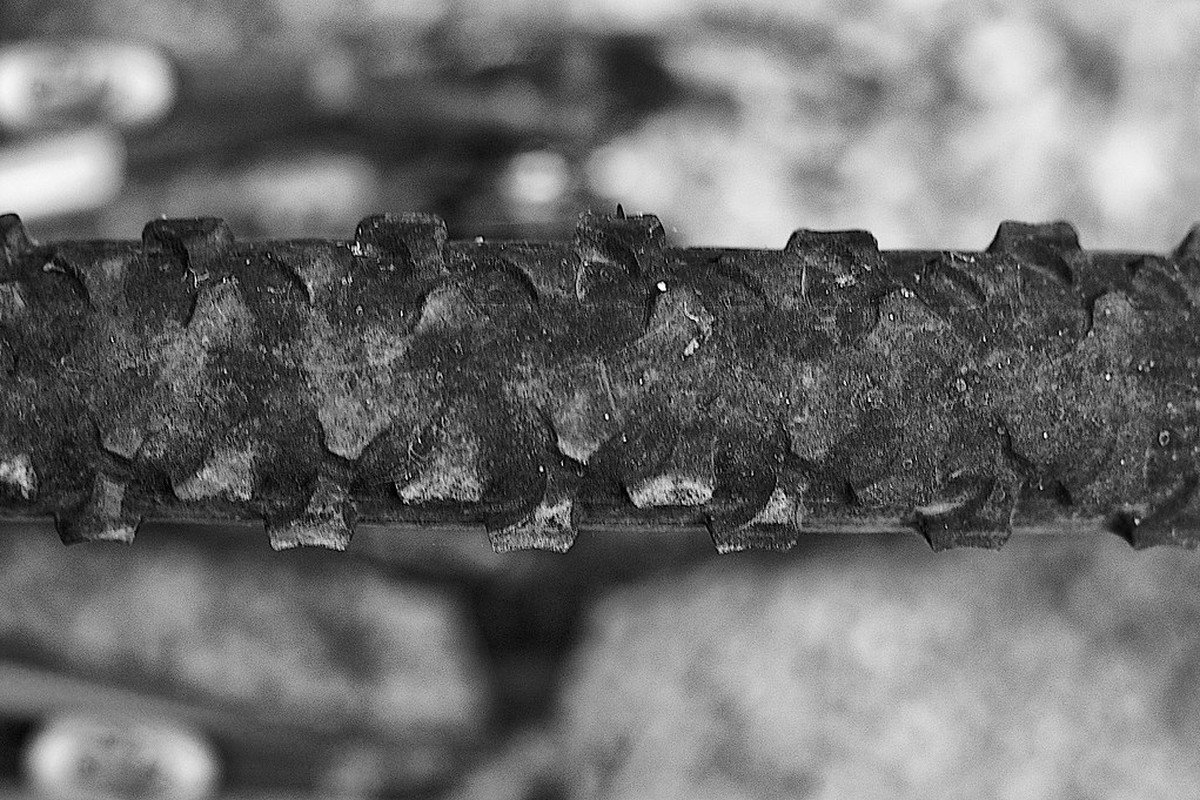
Tread is what grips — and a soft tire wears its tread out at the edges first.
Tread depth is what holds the road in the wet and on loose surfaces. Check the tread when you check the pressure — if it is smooth in the middle or bald at the edges, the tire is telling you something. (Photo: cogdogblog, CC0, via Flickr.)
How often should I check tire pressure?
Once a week. That is the schedule Himiway gives in its service guide — “Tire Pressure (PSI): Check pressure weekly” — and it is the right interval for a simple reason: tires lose a little air every week, even when nothing is wrong. A tire that was perfect on Monday is a few PSI softer by the following Monday, and a few PSI softer again the Monday after that. Weekly checks catch the drift before it becomes a problem.
Check more often when:
You are about to ride a long way. A long ride on soft tires wastes battery you will need at the end of it.
The temperature has dropped. Cold air contracts — a tire that was right in summer will read low on the first cold morning of autumn. Check when the seasons change.
The bike has been standing for weeks. A parked bike loses air just like a ridden one, and a tire that has gone flat under the weight of the bike can damage its own sidewall.
The check itself takes less time than putting your helmet on. Press the gauge onto the valve, read the number, compare it with the sidewall. If it is low, add air. That is the whole routine.
A floor pump with a gauge does the whole job: inflate, read, stop.
A floor pump with a built-in gauge is the easiest way to check and inflate at home — one tool, no separate gauge needed. (Photo: Ewok Slayer / CPSC, public domain, via Wikimedia Commons)
How do I read the number on the sidewall?
Look at the side of the tire — the smooth rubber between the tread and the rim. Somewhere in the small print you will find the pressure range, usually written as “MIN – MAX PSI” or “INFLATE TO 30–50 PSI”. It is sometimes moulded into the rubber rather than printed, so you may need to turn the wheel slowly and look closely, in good light.
Two things to watch for:
The range is for the tire, not the bike. A fat tire and a commuter tire on two different bikes have different ranges. Always read the tire you are standing next to.
PSI, BAR and kPa are three ways of saying the same thing. Most gauges show PSI; some show BAR as well. If your sidewall says 2.0–3.5 BAR and your gauge shows PSI, 1 BAR is about 14.5 PSI — but the easiest fix is to use a gauge that shows the same unit as your sidewall.
The range printed on your tire’s sidewall — this is the number the article keeps coming back to.
The sidewall tells you the range — this one says inflate to 30–50 PSI. Find it once, remember it, and the weekly check takes seconds.
Can I use a car tire inflator on an e-bike?
Yes — with two conditions. First, the valve has to fit: most e-bike tires use a Schrader valve (the same as a car tire) or a Presta valve (narrower, with a small screw tip). A car inflator fits a Schrader valve directly; a Presta valve needs an adapter, which costs very little and lives on your keyring. Second, the inflator has to reach the pressure your tire needs without overshooting it — a car inflator built for 35 PSI car tires is coarse at the low pressures a fat tire needs, so check the result with a proper gauge rather than trusting the inflator’s own dial.
The petrol-station air hose is the same story: it works, but it is a blunt tool. Use it if you have to, add air in short bursts, and check with your own gauge before you ride away. A portable inflator made for bikes — with a digital readout in PSI — is the better tool, and it fits in a bag.
How do I know if my gauge is accurate?
Cheap gauges drift. A gauge that reads 40 PSI today and 36 PSI tomorrow on the same tire is not measuring anything — it is guessing. Three ways to keep yourself honest:
Compare two gauges. Check the same tire with your pump’s gauge and a separate handheld gauge. If they agree within a couple of PSI, both are probably fine. If they disagree by 5 PSI or more, one of them is wrong — and you do not know which one.
Prefer digital. A digital gauge gives the same reading every time you press it, and it does not depend on a needle and a spring that wear out. It is not perfect, but it is more consistent than a cheap dial gauge.
Replace a gauge that wanders. If the same tire gives a different reading every time you check it, the gauge is the problem, not the tire. A gauge that cannot repeat itself cannot be trusted at all.
Best product for tire pressure
OlarHike Tire Inflator — a pocket-size inflator with a digital gauge, made for exactly the job in this article: check the pressure, add air, read the number, stop. It is the one we link to because it is the one we have verified — a real product, a working affiliate link, and a price you can check before you buy. Check latest price on Amazon
What we will not pretend otherwise: our spec research records the OlarHike’s stated maximum as 150 PSI, but one source cites a lower figure for car tires (51 PSI) — we have not resolved which figure the live listing states, so check the listing before you buy, and do not take our word for the number. What we can say is that any e-bike tire’s range sits far below either figure, so the inflator’s maximum is not the question — its gauge and its size are. What matters is that it is small enough to carry, reads in PSI, and stops you guessing.
Ranges are typical cold pressures. Your exact number is on your vehicle’s placard or in the owner’s manual — that beats any calculator.
Frequently asked questions
What PSI should my e-bike tires be?
Read the range printed on your tire’s sidewall — that is the only number that applies to your tire. As a rough guide, fat tires run around 20–30 PSI and commuter tires around 50–70 PSI (per eBikeOracle), and scooter tires run higher than fat tires but vary by model. Start in the middle of your printed range and adjust by feel.
How often should I check tire pressure?
Once a week, per Himiway’s service guide — tires lose a little air every week even when nothing is wrong. Check more often before a long ride, when the temperature drops, or after the bike has been standing for weeks.
What PSI do fat tires need?
Roughly 20–30 PSI (per eBikeOracle) — low pressure is the point of a fat tire, because the big soft contact patch is what gives it grip and comfort. Always confirm against the range printed on your own tire’s sidewall.
Does low tire pressure really cut my range?
Yes. A soft tire squashes flat against the road and the motor works harder to push it along, so the same trip uses more battery. It is one of the most common and most easily fixed causes of “suddenly” shorter range.
Can I use a car tire inflator on an e-bike?
Yes, if the valve fits — most e-bike tires use a Schrader valve like a car tire, or a Presta valve that needs a small adapter. Car inflators are coarse at low pressures, so always check the result with a proper gauge rather than trusting the inflator’s dial.
How do I know if my tire pressure gauge is accurate?
Compare it with a second gauge on the same tire — if they agree within a couple of PSI, both are probably fine. Prefer a digital gauge for consistency, and replace any gauge that gives a different reading every time you check the same tire.
Photo credits: the photographs in the middle of this article — the bicycle pump gauge dial photograph, Bicycle pump by londoncyclist, is from Flickr, licensed CC BY 2.0; the bicycle floor pump photograph, Bike pump, is from Wikimedia Commons, public domain; the bicycle tire tread photograph, The Wheel Beneath by cogdogblog, is from Flickr, licensed CC0. Each image was cropped to 1200 by 800.