
Some links in this article are affiliate links. If you buy through them, we may earn a commission at no extra cost to you.
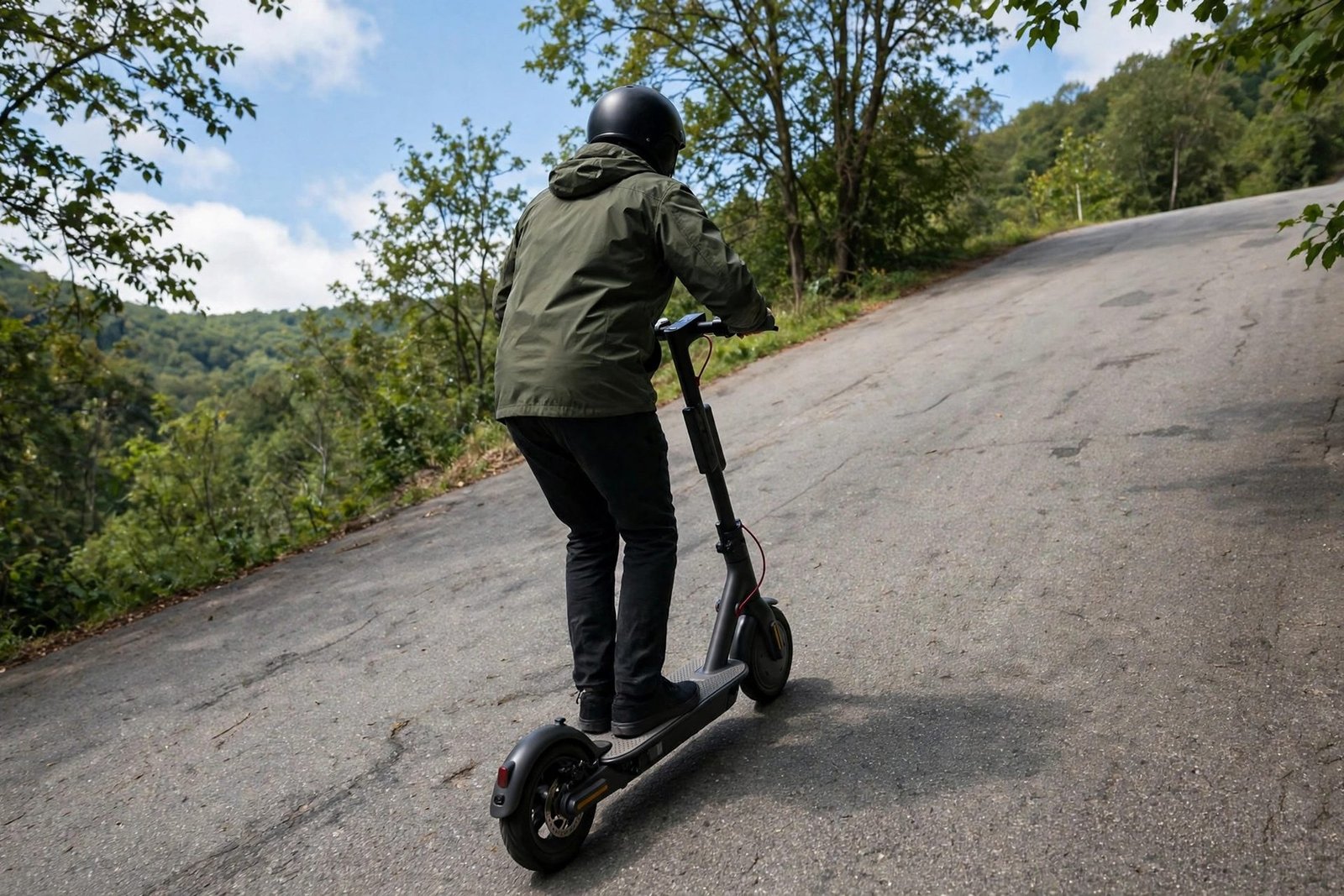
Your commute has a steep hill in it, and your scooter slows to a walk on it. The motor whines, the speed drops, and by the top you are pushing with one foot. The question is the one every rider with a slope asks: which scooter will actually climb it without slowing to a walk?
In this guide
- The short answer
- The three numbers that decide a climb
- The grade maths — 10% is not 10°
- The picks — seven scooters, steepest first
- The lead pick — Segway Ninebot E2 Pro
- The long-range pick — Segway Ninebot MAX G3
- The second pick — Segway Ninebot MAX G2
- The Hiboy pair — S2 MAX and S2 Pro
- The lightest pick — HopCycle
- The budget pick — Segway Ninebot E2 Plus
- The apartment test — a hill scooter that also folds
- Hills eat range — plan for it
- Before you buy
- Related reading
- The bottom line
The wattage on the box will not tell you. A hill is a motor question first, and a weight question second — and the grade number on the listing is the least reliable part. This guide gives you the three numbers that decide a climb, the grade maths, and seven scooters from our own catalogue, with the tested one first.
The short answer
Buy the scooter whose climbing was tested, not the one whose wattage is biggest. The Segway Ninebot E2 Pro (Check latest price) is the fastest single-motor hill climber under $500 in an independent tested guide — 19 seconds on a 10% grade, 200 ft test — and that time is worth more than any wattage figure on a listing. If your hill is steep and your budget is under $500, the E2 Pro is the answer. If your budget stretches further, the MAX G3 climbs with a bigger range buffer. And if your hill is gentle, almost any scooter here will do it — the honest limit is the 300W E2 Plus.
The three numbers that decide a climb
Three numbers, and nothing else. The motor, the rider, and the grade.
The motor. The motor does the climbing, and the only honest measure of a motor is what it did on a real hill. Wattage is a weak proxy — two 500W motors can climb very differently, because the climb depends on torque, gearing and the controller, not the rated figure on the box. A test time beats a wattage figure every time. The E2 Pro’s 19 seconds on the 10% grade test is a measured result on a real hill, and it is the reason the E2 Pro leads this guide.
The rider. The same hill is a different climb for a different rider. A 200 lb rider on a 15% grade is a different climb from a 150 lb rider on the same hill — fifty extra pounds is fifty extra pounds the motor has to lift, every foot of the way up. That is why the payload matters as much as the motor: the MAX G3 is rated to 286 lb and the MAX G2 to 265 lb, both under 300 lb — a heavier rider needs to know the limit before the hill, not on it. If you are near the top of a scooter’s payload, buy the bigger motor — the margin is the climb.
The grade. The number on the listing is the least reliable part of the whole purchase. Listings mix percent and degrees freely, roundups copy each other’s figures, and a “30° climb” claim can mean three different things. Do not buy a scooter for its climb-grade percentage — this guide cites no grade percentage for any pick, because no live listing states one we can stand behind.
The grade maths — 10% is not 10°
A grade in percent and a grade in degrees are two different units for the same hill, and the listings mix them freely. 10% is not 10°. A 10% grade rises 10 feet for every 100 feet forward — about 5.7°. A 10° slope rises about 17.6 feet for every 100 feet forward, a 17.6% grade, nearly twice as steep as 10%. The degree number is always bigger than the percent number for the same hill, so a listing that prints degrees makes its hill sound steeper than one that prints percent.
The claim to watch for is the big degree number. A “30° climb” is a 58% grade — the hill rises 58 feet for every 100 feet forward — and no commuter scooter climbs that. A 30° slope is a staircase, not a road. When a listing claims 30°, it is either measuring something else, or it is a number nobody checked. Read every climb claim as a percent until the listing says otherwise — and if it does not say which unit it means, the number means nothing at all.
The test that matters uses percent, on a real hill. The tested guide behind our lead pick ran its scooters up a 10% grade for 200 feet and timed them. A 10% grade is the hill to judge by. If a scooter climbs 10% without slowing to a walk, it will climb your commute.
The picks — seven scooters, steepest first
Here are the seven scooters from our own catalogue that climb, with the tested one first. Prices change — check the latest price on the listing.
| Scooter | Price | Claimed range | Why it climbs |
|---|---|---|---|
| Segway Ninebot E2 Pro | Check latest price | 15.5 miles | Tested fastest under $500 |
| Segway Ninebot MAX G3 | Check latest price | 50 miles | Biggest range buffer |
| Segway Ninebot MAX G2 | Check latest price | 43 miles | Dual suspension, long range |
| Hiboy S2 MAX | Check latest price | 40 miles | 500W, longest Hiboy range |
| Hiboy S2 Pro | Check latest price | 25 miles | 500W, no-flat tyres |
| HopCycle | Check latest price | 21 miles | 31.5 lb — lightest here |
| Segway Ninebot E2 Plus | Check latest price | 15.5 miles | 300W — the limit case |
The lead pick — Segway Ninebot E2 Pro
The Segway Ninebot E2 Pro (Check latest price) is the lead pick because it is the only scooter here with a measured hill result behind it. Electricscooterguide’s tested guide ran it up a 10% grade for 200 feet in 19 seconds flat — the fastest single-motor hill climber under $500, beating its closest competition by over a full second. That is a time, not a wattage claim — and a time is what you feel on the hill.
The E2 Pro is also UL 2272 certified, which matters on a hill, where a climb draws the most current the battery will ever deliver. The test time is the proof, not the wattage on the box, and the E2 Pro is the only pick here that brings one.
The long-range pick — Segway Ninebot MAX G3
The Segway Ninebot MAX G3 (Check latest price) is the pick for the rider whose hill is not the only problem — the commute is long too. It claims 50 miles of range, and the range buffer matters on hills, because a climb eats battery. A scooter that claims 15 miles and loses a third to hills has ten left; one that claims 50 still has over thirty. Range is the hill’s second cost, and the MAX G3 pays it with room to spare.
One honest limit, stated plainly: the MAX G3’s payload is 286 lb — under 300 lb. If you are a heavier rider, that number matters more than the range.
The second pick — Segway Ninebot MAX G2
The Segway Ninebot MAX G2 (Check latest price) is the MAX G3’s smaller brother: 43 miles claimed and dual suspension. The suspension matters on a hill because the road up a hill is rarely smooth — a bouncing scooter loses grip, and a scooter that loses grip stops climbing. Dual suspension keeps the wheel on the road, and on a rough hill that is worth as much as motor power. Its payload is 265 lb — under 300 lb, stated plainly like the G3’s. The G2 is the pick for the rider who wants the MAX build without paying the G3’s price.
The Hiboy pair — S2 MAX and S2 Pro
The Hiboy S2 MAX (Check latest price) and the Hiboy S2 Pro (Check latest price) are the two Hiboy climbers, and the difference between them is range: the S2 MAX claims 40 miles, the S2 Pro 25. Both are 500W, and both have the Hiboy no-flat solid tyres — a flat on a hill is a walk home uphill, so the solid tyre is worth more on a hilly route than on a flat one. The S2 MAX is the pick if your hills are far apart; the S2 Pro if they are close and the budget is tighter.
The lightest pick — HopCycle
The HopCycle (Check latest price) is the lightest scooter here at 31.5 lb, and lightness is a climbing advantage of its own: the motor has less scooter to lift, and you have less scooter to carry. It claims 21 miles, with a 500W peak motor. The HopCycle is the pick for the rider whose hill ends at a flight of stairs — it climbs the hill, then carries up the stairs in one hand, which is the apartment test below.
The budget pick — Segway Ninebot E2 Plus
The Segway Ninebot E2 Plus (Check latest price) is the cheapest scooter here, and the honest limit case: a 300W motor, 15.5 mph, 15.5 miles claimed — and a 300W motor on a steep hill is the honest limit. It will climb a gentle slope without complaint. On a steep hill it will slow down, and on a long steep hill it will slow to a walk. That is the limit of 300W, and we say so plainly. Buy the E2 Plus for a gentle hill, not a steep one — and if your hill is steep, the E2 Pro costs more, and the difference is the climb.
The apartment test — a hill scooter that also folds
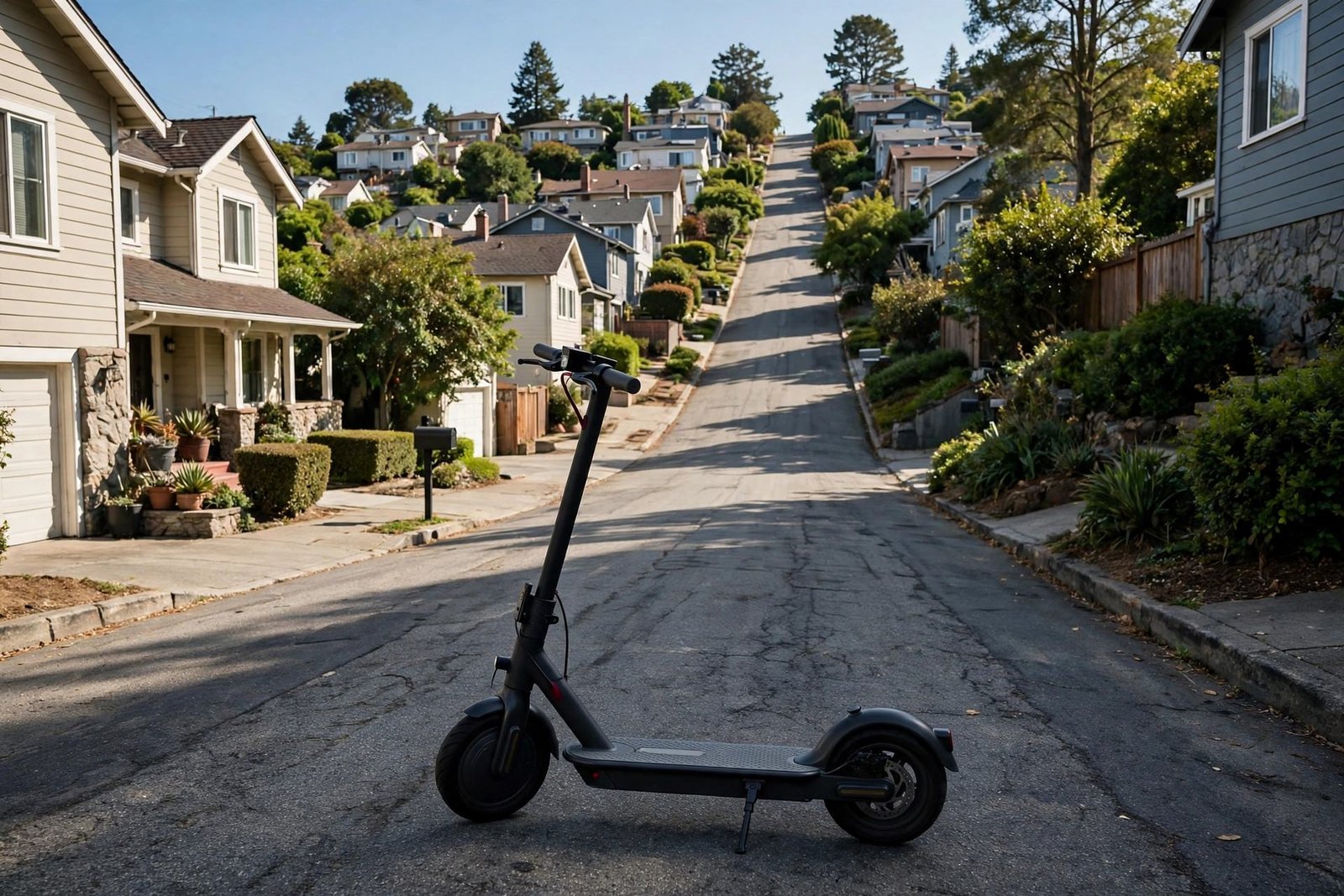
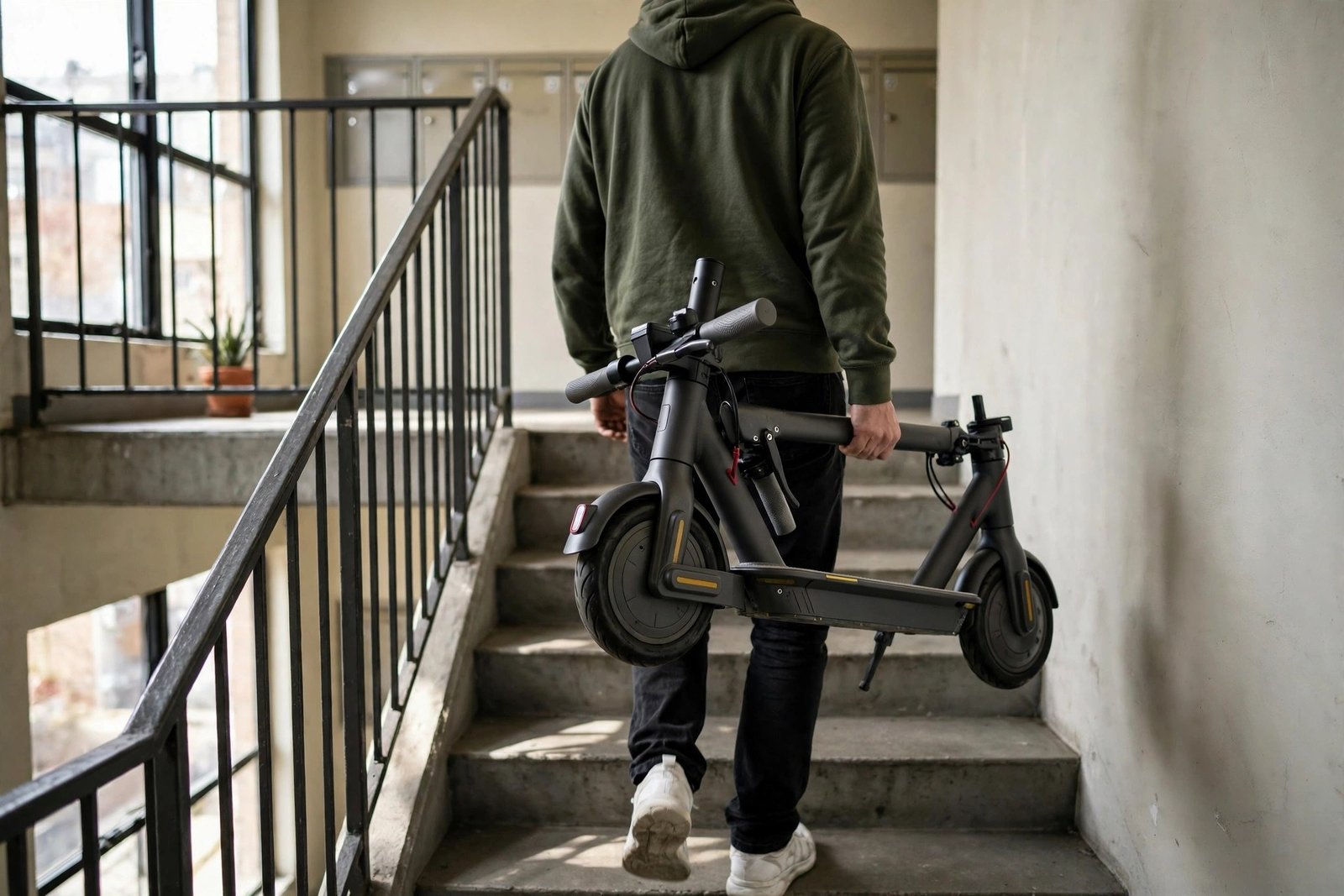
A hill scooter has one more test to pass. It has to fold, and it has to carry up the stairs. The heavy dual-motor climbers in the tested guides fail this test — they climb well and then they sit in the hallway, because nobody carries a 60 lb scooter up two flights of stairs. Every scooter in this guide folds and is light enough to carry — the heaviest is the MAX G3, the lightest the HopCycle at 31.5 lb.
The test is simple, and it is the same carry test from our apartment guide: pick the scooter up folded, with one hand, and carry it ten steps. If you can, it lives in the flat. If you cannot, it lives in the hallway — and a scooter in the hallway is a scooter that gets stolen. A hill scooter that fails the carry test is a scooter for a house, not a flat — and this guide is written for flats.
Hills eat range — plan for it
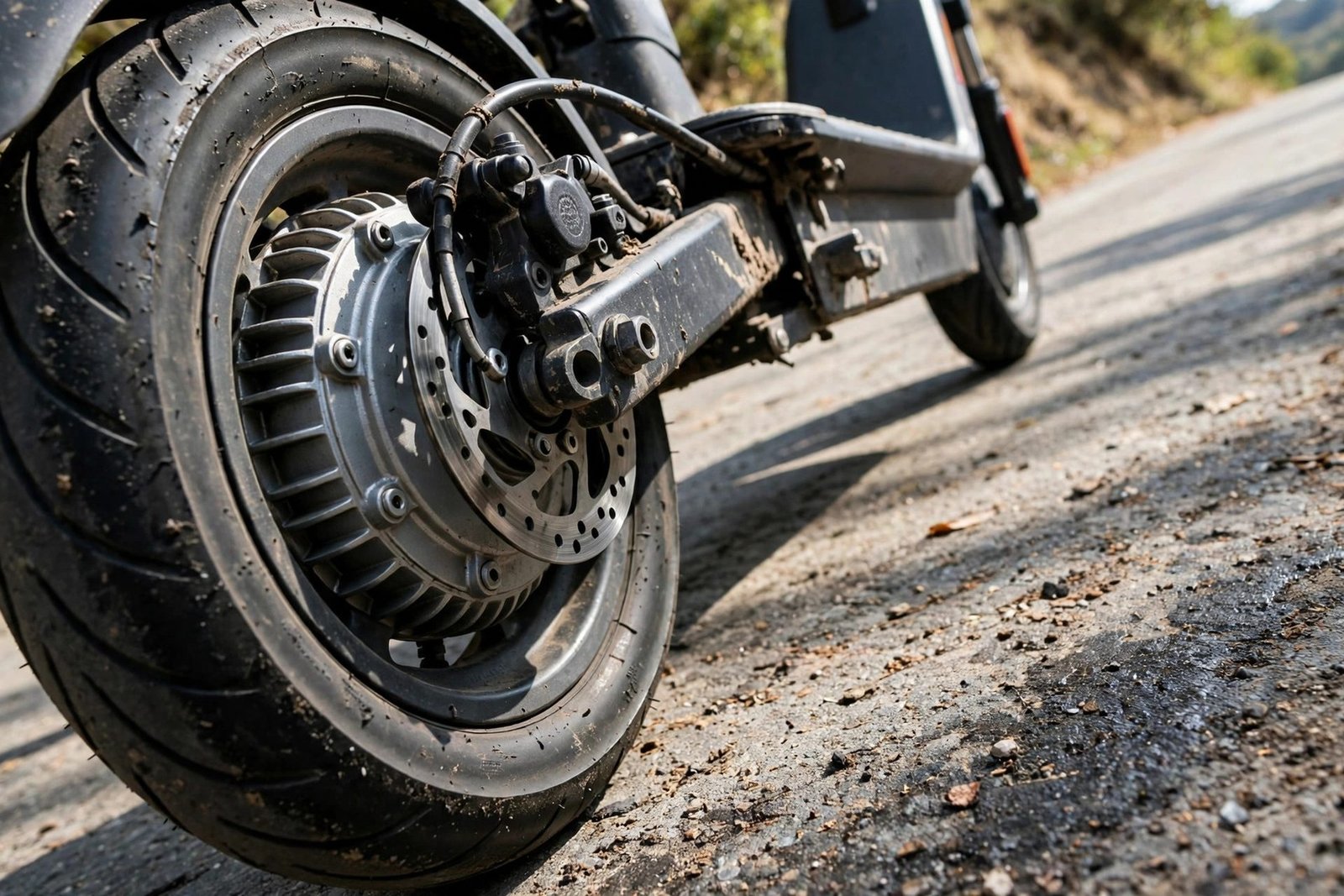
A hill costs range. A climb draws the most current the battery will ever deliver, and a route with three steep hills will return far less range than the same distance on the flat. The box range is a flat-road number. Your commute is not flat. Plan on roughly half the claimed range on a hilly route — a scooter that claims 40 miles will do about 20 miles of hills, and one that claims 15 will do about 7 or 8. That is physics, not a defect, and it applies to every scooter here.
The MAX G3’s 50 claimed miles are not about going far — they are about arriving. A long claimed range is a buffer against the hills. If your commute is five hilly miles each way, buy the range buffer, not the cheapest pick.
Before you buy
If your commute has a hill, ride the hill before you buy the scooter — or at least walk it and look at it. A hill you can walk up without stopping is a gentle slope, and the E2 Plus will do it. A hill that makes you stop halfway is a steep one, and the E2 Pro is the minimum. The hill you actually ride is the only hill that matters, and no listing can tell you how steep it is.
If you are near a scooter’s payload limit, buy the bigger motor — the margin is the climb, and a scooter at its limit on a hill slows to a walk. Check the payload on the listing before you buy, the same way you check the price.
Related reading
- Best E-Bike for Hills (Under $1,000): Torque That Actually Climbs
- Solid vs Pneumatic Scooter Tires: Which One for Commuting? (Flats vs Comfort)
- How Far Can an E-Bike or Scooter Go on One Charge? Real-World Range vs the Box Claim
- Article #61 “Best Electric Scooter for Long Commutes (10+ Miles): Real Range, Not the Box Claim”.
The bottom line
A hill is a motor question first, and a weight question second. The E2 Pro is the tested answer under $500 — 19 seconds on a 10% grade, and a time beats a wattage figure every time. The MAX G3 is the answer when the commute is long as well as steep. The grade number on the listing is the least reliable part — read it as a percent, ignore the degrees, and buy the scooter that was tested on a real hill. Then fold it, carry it up the stairs, and ride it to work.
Previous: E-Bike Battery Replacement: When It’s Worth It (and When to Buy New Instead)
Next: Best E-Bike for Trails & Off-Road (Under $1,000): What a Budget Trail Bike Actually Is