

Some links in this article are affiliate links. If you buy through them, we may earn a commission at no extra cost to you.
You need a scooter for the daily commute and you have $500. The question is not whether $500 is enough — it is. The question is which $500 scooter is a real commuter and which one is a toy.
Five hundred dollars is not a toy budget. It is the real entry point. Below $200 you get a scooter that struggles on hills and dies on range. At $500 you get a proper commuter — if you pick for the three things that decide a commute, and not for the number on the box. Range, tyres, and weight. Top speed barely matters: every scooter here does 15 mph or more, already faster than city traffic at rush hour.
This guide judges eight scooters against the daily commute and the flat they live in — because a scooter that cannot be carried up the stairs or charged from a wall socket is not a commuter scooter, however good its spec sheet looks.
The three trade-offs that decide it
Every scooter under $500 makes the same three compromises. Learn them once and you can read any listing in a minute.
First, range — and the battery is the first thing to check. The box claims 15 to 40 miles at this price — measured at low speed, on flat ground, with a light rider, in warm weather. Plan on 60 to 70% of the claimed range. A scooter that claims 25 miles does about 15 to 17 in real commuting; one that claims 15 does about 9 to 11. That is the number your commute has to fit inside — not the claim, the real one. A five-mile-each-way commute is ten miles a day, so a scooter with 15 real miles gets you there and back with a margin, and one with 9 does not. The battery is the first thing to check because it is the thing you cannot upgrade later.
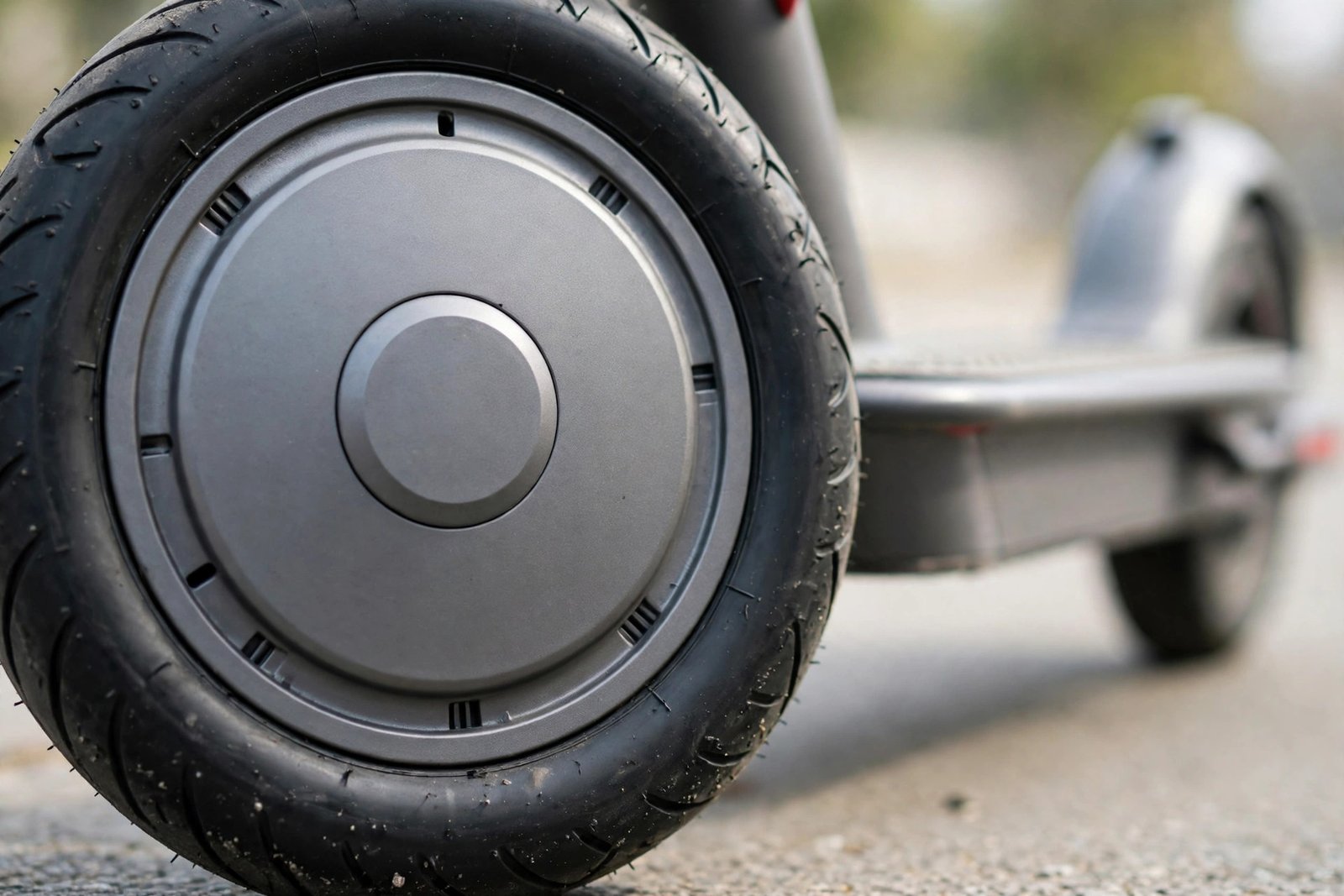
Second, tyres — solid means no flats but a hard ride, pneumatic means comfort but punctures. A solid tyre cannot puncture — no flat on the way to work, no pump, no repair. But it cannot deform around the road either, so it has less grip and transmits every crack straight to your wrists. A pneumatic tyre deforms, grips, and cushions — and it can puncture, which is why the weekly pressure check matters. There is no right answer, only a trade-off you choose knowingly. On smooth pavement, pneumatic is the comfortable pick. On glass and debris, solid is the pick that gets you to work every day. Our comparison of Solid vs Pneumatic Scooter Tires explains the trade-off in full.
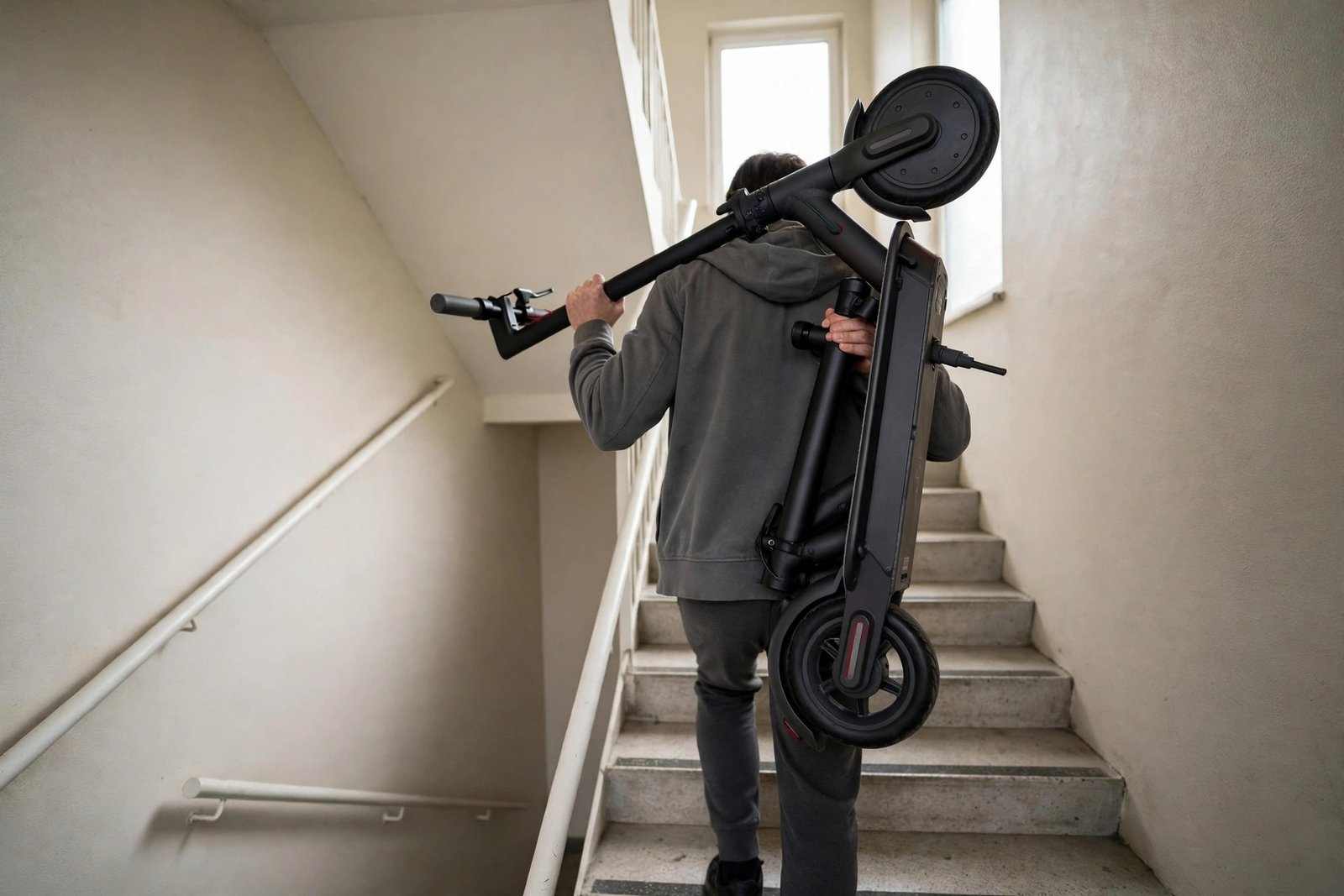
Third, weight — you carry it up the stairs, so 31 lb vs 48 lb matters more than top speed. A scooter that lives in a flat gets carried: up the stairs, through the door, into the hallway. Ten pounds is the difference between carrying it in one hand and dragging it. The lightest scooter here is 31.5 lb; the heaviest is over 40 lb. That gap is the difference between a scooter you carry without thinking and one you dread at the bottom of the stairs. Top speed barely matters — every scooter here does 15 mph or more, and the difference between 15 and 19 mph on a five-mile commute is about four minutes. Buy the light one, not the fast one.
The apartment test
A commuter scooter has to pass four tests a garage scooter never faces. Can you carry it up the stairs in one hand? Does it fold small enough for the hallway? Can you charge it from a wall socket? Does it fold in one motion, with a latch that locks?
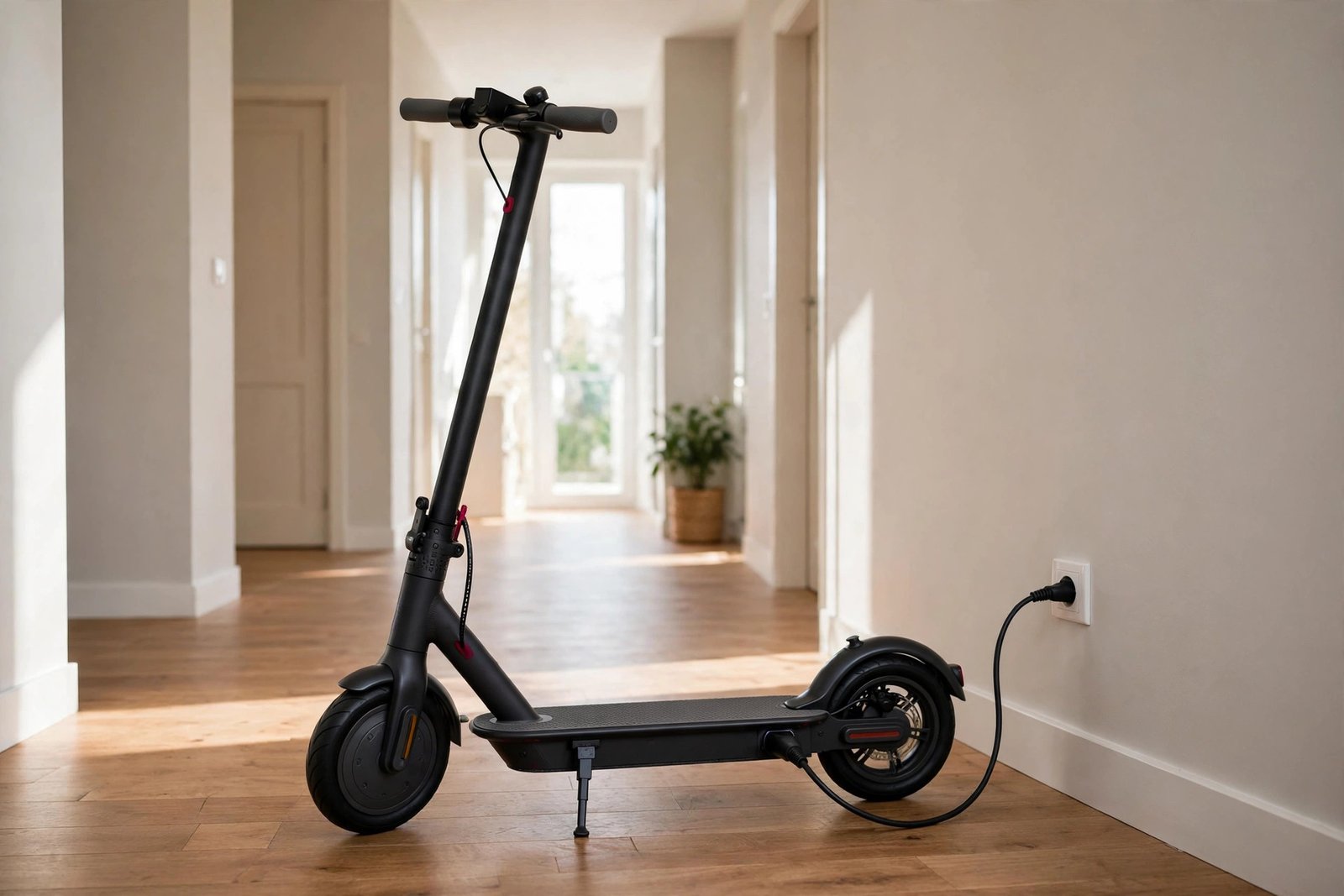
The carry test is the one people skip and regret. Stand at the bottom of your stairs with the scooter folded and lift it with one hand. If you cannot lift it comfortably, you will not carry it — you will leave it outside, and a scooter left outside gets stolen or rained on. The fold matters too: a one-motion fold with a latch that snaps shut is a scooter you fold every day; a fiddly fold is one you stop folding, and an unfolded scooter does not fit the hallway. And charging is the simplest question of all: a scooter that lives in the flat charges from a wall socket, not a garage. Every scooter here does that — the charger plugs into the same socket as your phone.
The eight scooters, side by side
Here they are, with the numbers that decide a commute. Claimed range is the maker’s figure; real range is our planning figure — 60 to 70% of the claim. Prices are Approx — check the listing for the live price.
| Scooter | Claimed range | Real range (plan on) | Tyres | Price |
|---|---|---|---|---|
| Segway Ninebot E2 Pro | 21.7 mi | ~15 mi | 10-inch pneumatic | Check latest price |
| Hiboy S2 Pro | 25 mi | ~15–17 mi | 10-inch solid honeycomb | Check latest price |
| Hiboy S2 MAX | 40 mi | ~24–28 mi | 10-inch self-healing pneumatic | Check latest price |
| Segway Ninebot E2 Plus | 15.5 mi | ~9–11 mi | 8.1-inch solid hollow | Check latest price |
| HopCycle | 21 mi | ~13–15 mi | 8.5-inch pneumatic | Check latest price |
| Phantomgogo | 12–15 mi | ~7–10 mi | 8.5-inch rubber | Check latest price |
| WERHY 500W Adult Scooter | ~21 mi | ~13–15 mi | 10-inch solid | Check latest price |
| Gotrax SD1 | 12 mi | ~7–9 mi | 8.5-inch (see note) | Check latest price |
Read the real-range column before the claimed one. A scooter with 15 real miles covers a five-mile-each-way commute with a margin; one with 9 does not. The S2 MAX is the only scooter here that covers a ten-mile-each-way commute without charging every night.
The picks
Segway Ninebot E2 Pro — Check latest price — The lead pick. Ten-inch pneumatic tyres at 45 PSI, sold as UL 2272-certified, and the most complete commuter package under $500. It does 15.5 mph out of the box and 18.6 mph after an app update. Segway’s own range figures run from 24.9 miles at a slow 9.3 mph to 15.5 miles at full speed, and an independent test got 16.0 miles in Sport mode on a hilly course — so plan on about 15 real miles. At 41.4 lb it is not light, and it has no suspension, so the tyres do all the cushioning. But it is the scooter with the fewest compromises.
Hiboy S2 Pro — Check latest price — The no-flat pick. Ten-inch honeycomb solid tyres that cannot puncture, a 500W motor, 19 mph, and 25 miles claimed. The competitors name it their best no-flat pick: a commuter who never gets a flat never walks to work. The trade-off is the ride — solid tyres are hard, with no suspension to soften them. At 37.4 lb it carries easier than the E2 Pro. Buy it if your route eats tyres and you would rather feel the bumps than fix a flat.
Hiboy S2 MAX — Check latest price — The long-range pick. Forty miles claimed on ten-inch self-healing pneumatic tyres, a 500W motor, and 19 mph. Plan on 24 to 28 real miles — the only scooter here that covers a ten-mile-each-way commute and still has charge left the next morning. At about 40 lb it is heavy to carry upstairs, and at its current price it is the dearest pick here. But if your commute is long, range decides it, and nothing else here has it.
Segway Ninebot E2 Plus — Check latest price — The budget pick. Three hundred watts, 15.5 mph, 15.5 miles claimed, and 8.1-inch hollow tyres with no air in them at all. The hollow tyres mean no pressure check and no punctures — but check the rubber for cracks and chunks, because hollow rubber ages. Plan on 9 to 11 real miles, which covers a short commute and nothing more. It is the cheapest way into a proper brand, and the honest pick if your commute is under four miles each way.
HopCycle — Check latest price — The lightest pick. About 31.5 lb, 500W peak, 21 miles claimed, 18 mph, and 8.5-inch pneumatic tyres. It is the lightest scooter here by ten pounds: the one you carry up the stairs in one hand without thinking about it. Plan on 13 to 15 real miles. The trade-off is the small wheels and the shorter range next to the S2 MAX — but for a flat-dweller with stairs, weight matters most.
Phantomgogo — Check latest price — The cheapest pick. The cheapest scooter on this page, with 8.5-inch wheels, a 350W motor, 15.5 mph, and about 30 lb. The claimed range is short — 12 to 15 miles depending on the variant on the listing — so plan on 7 to 10 real miles. That makes it a short-hop scooter, not a ten-mile commuter. Buy it if your commute is two or three miles each way and price decides it. Do not buy it for a long commute and hope the range works out.
WERHY 500W Adult Scooter — Check latest price — The second cheapest pick. A 500W motor, 10-inch solid tyres, about 20 to 22 mph, and about 21 miles claimed. The solid tyres mean no flats, and the 500W motor is the strongest at this price. One honest note: WERHY sells several near-identical 500W models, so check the listing for the exact variant. Do not confuse this scooter with the WERHY H5, a different product with a safety flag — this is not that scooter.
Gotrax SD1 — Check latest price — The second budget pick, with a warning attached. A 250W motor, 15.5 mph, 12 miles claimed, 33.3 lb, and 8.5-inch tyres — but the listing contradicts itself on the tyres. The title says the front tyre is pneumatic and the rear solid; the product details call the wheel type solid. That is a warning, not a pick: check the tyre with your own eyes when it arrives — a valve stem means air, no valve stem means solid. Plan on 7 to 9 real miles — a short-hop scooter like the Phantomgogo, with a lighter frame and a cleaner fold. Buy it knowing what you are checking, not on the tyre claim alone.
What it costs to run
A scooter is cheap to run. A full charge costs about five cents. The E2 Pro’s battery holds 275 watt-hours, and at the average US electricity price of about 18 cents per kilowatt-hour, a full charge is 0.275 × 18 cents — roughly a nickel. Even the biggest battery here costs less than ten cents to fill. The scooter is not the cost; the bus fare it replaces is. Run your own numbers through our free Cost-to-Own Calculator — put in your commute, your bus fare, and the scooter’s price, and it works out what the scooter costs against the bus or the car over a year.
The other running cost is the battery: it lasts roughly 500 to 1,000 full charges before its capacity drops, which at a daily commute is two to three years. A bigger battery lasts longer in years because you charge it less often — the quiet argument for the S2 MAX.
Before you buy: the four checks
Four checks before you spend a dollar.
First, measure your commute in real miles, not claimed ones. Work out the round trip, then find it in the real-range column above. If the round trip is longer than the real range, the scooter does not fit your commute — however good the claimed number looks.
Second, lift it. If you live upstairs, pick the scooter up folded, with one hand, and carry it ten steps. The HopCycle at 31.5 lb and the SD1 at 33.3 lb are the ones that pass this test easily; the E2 Pro at 41.4 lb and the S2 MAX at about 40 lb are the ones you feel. If you cannot lift it comfortably in the shop, you will not lift it at home.
Third, check the tyres with your eyes. Pneumatic tyres need a pressure check every week — our guide to What PSI Should My E-Bike Tires Be? explains why the sidewall number is a maximum. Solid tyres need a visual check for cracks and chunks. And if you buy the SD1, check the valve stem on arrival — a valve stem means air, no valve stem means solid — because the listing says both.
Fourth, buy the lock with the scooter, not after it. A scooter is stolen in seconds, and a commuter scooter spends its working day parked outside. Our guide to how to lock an electric scooter covers the locks that actually work — read it before your first park outside.
Related reading
- Best First Electric Scooter Under $250 (for Beginners): Cheap, Safe, and Not a Toy
- How Far Can an E-Bike or Scooter Go on One Charge? Real-World Range vs the Box Claim
- What PSI Should My E-Bike Tires Be? The Right Pressure for Fat Tires, Commuters and Scooters
- Electric Scooter Maintenance: The Owner’s Checklist (Weekly, Monthly, Seasonal)
- Best Electric Scooters Under $500 in 2026: Budget Picks That Actually Last
The bottom line
Five hundred dollars buys a real commuter scooter — if you pick for range, tyres, and weight, and not for the number on the box. The E2 Pro compromises least. The S2 MAX is the pick if your commute is long. The S2 Pro is the pick if you never want a flat. The HopCycle is the pick if you live upstairs. And the E2 Plus, the Phantomgogo, the WERHY 500W, and the SD1 are the budget picks — each honest about what it is, each wrong if you buy it for a commute it cannot do.
So measure your commute, lift the scooter, check the tyres, and buy the lock. The right $500 scooter is the one that fits your commute and your stairs — and the wrong one is the one you bought for the top speed.
Previous: How to Sell Your Used E-Bike (What It’s Worth, and How to Get It)
Next: Best Bike Wall Mounts for Heavy E-Bikes in Apartments (and the Weight-Rating Trap)
