

Some links in this article are affiliate links. If you buy through them, we may earn a commission at no extra cost to you.
An e-bike is one of the most valuable things you will ever leave outside, and it is also one of the easiest to steal if it is locked badly. Good protection is not about one expensive lock — it is about a system: a strong lock, used properly, in a sensible place, plus a few simple habits that make your bike a harder target than the one next to it.
This guide explains how to choose a lock, how to use it, where to park, and what else protects your bike — from insurance to registration.
Choose the right lock
Locks fall into three main types. A U-lock, or D-lock, is a hardened steel shackle that resists cutting and leverage. It is the best choice for most commuters, and the strongest models are rated Sold Secure Diamond. A chain lock is more flexible — you can lock to a wider range of objects — but a strong chain is heavy to carry. A folding lock is compact and easy to carry, but it is generally less strong than a good U-lock of the same price.
Avoid cable locks as your only lock. A thin cable can be cut in seconds with basic tools, and it offers almost no protection for a valuable e-bike. A cable is useful as a second lock for a front wheel or a saddle, but never as the main lock. When you buy, look for an independent rating — Sold Secure Gold or Diamond in the UK system, or an ART rating — rather than the manufacturer’s own claims. Expect to check the latest price on a lock worth trusting with a bike worth $1,000 or more.

How to lock properly
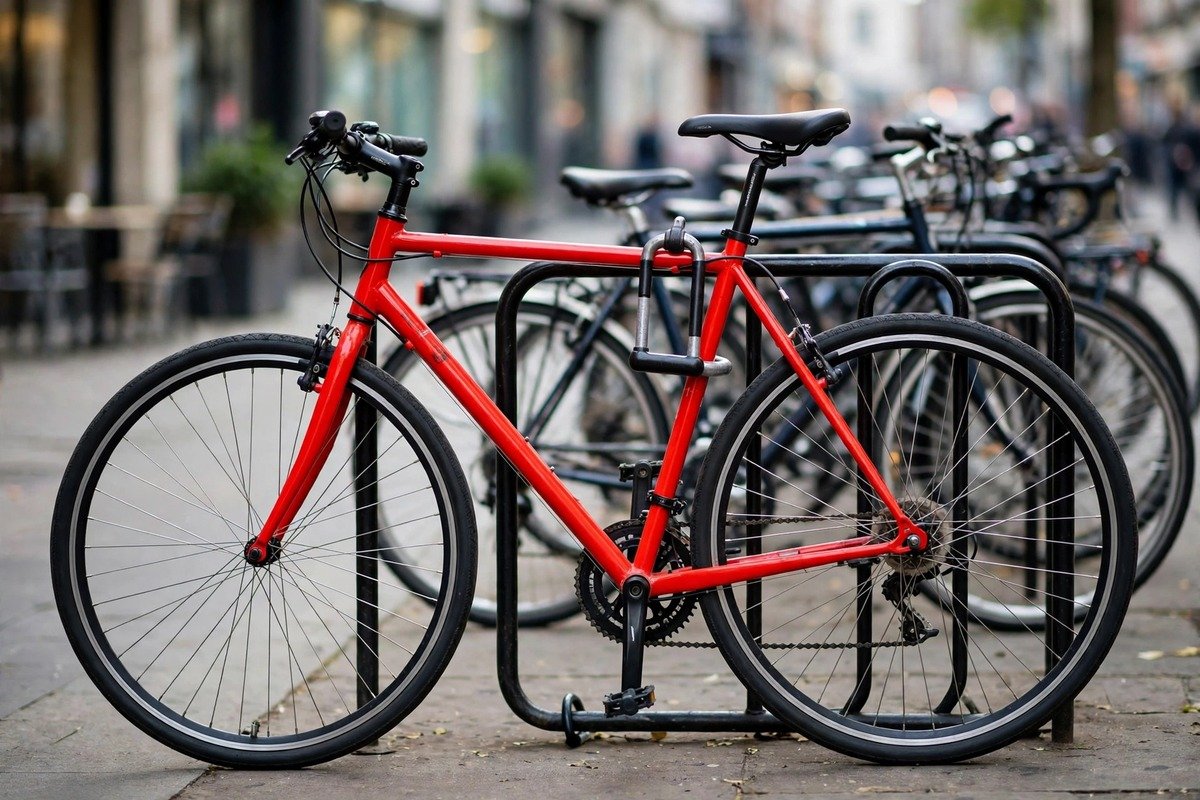
Locking technique matters as much as the lock itself. Always lock the frame, not just a wheel, to a fixed, immovable object — a proper bike stand, a sturdy rail or a ground anchor. A wheel can be removed in seconds, and a signpost can be lifted out of the ground. Fill the space inside the U-lock as much as possible, by locking close to the object, so a thief cannot get a tool or a jack inside it. Keep the lock off the ground, where it is easier to attack with a hammer.
If you can, lock both wheels as well as the frame. A second lock, even a lighter one, makes a thief’s job much harder and takes more time, which is what you want in a public place. Remove quick-release accessories — lights, a computer, a bag — and take the battery with you if you are leaving the bike for a long time. A bike without a battery is far less attractive to a thief, and a battery left on the bike is itself valuable.

Where to park
Choose a busy, well-lit place with plenty of people passing, and ideally with CCTV. Thieves prefer quiet, dark corners where they can work undisturbed. A proper bike rack in a busy area is far safer than a quiet side street. Avoid leaving your bike in the same place at the same time every day if you can, because thieves notice patterns. And never leave your bike outside overnight if you can avoid it: take it indoors, even if that means folding it and carrying it upstairs.
If your building has a bike room, use it, but do not assume it is safe on its own. Lock your bike to a fixed rail inside the room, take the battery indoors, and check who else has access to the room. Shared bike rooms are a common target, precisely because riders relax once they are inside.
Beyond the lock: registration, tracking and insurance
Record your bike’s frame number, and keep photographs of the bike, the frame number and any distinctive marks. Register the bike with a free service such as Bike Index, which police and bike shops can check if a bike is recovered. A GPS tracker, hidden on the bike, can help you find it if it is stolen, although it is not a substitute for a lock — and it needs charging and a subscription, so weigh the cost.
Insurance is worth considering, especially for a bike worth over $1,000. Check whether your home or renters insurance covers an e-bike, and what it requires: many policies require a Sold Secure-rated lock, and some require the bike to be locked to a fixed object or stored indoors overnight. Specialist e-bike insurance may cover theft, damage and accessories, and it may also cover the battery. Read the terms carefully, and keep receipts and photographs as proof of ownership.
Protecting the bike at home
Most thefts happen away from home, but a bike in a flat is not automatically safe. Lock it to a wall anchor or a heavy piece of furniture if you can, especially if you share the flat or if the bike is near the front door. Keep the battery indoors and out of sight, and do not leave the bike visible through a ground-floor window. If you store the bike on a balcony, lock it and cover it, and bring the battery inside.
You may also like: monTEK Swivel Bike Wall Mount (4-Pack) — bring it inside: the best lock is a wall between the bike and the street.
If your bike is stolen
Act quickly. Report it to the police with the frame number, photographs and any tracker information, and mark it as stolen on Bike Index and any other register you use. Tell local bike shops, and check online marketplaces in your area. The sooner a stolen bike is reported, the better the chance of recovering it. It is also worth telling your insurer the same day, as many policies have a time limit for claims.
No lock can guarantee your bike will never be stolen, but a good lock, used properly, in a busy place, with the battery removed and the bike registered and insured, makes a real difference. The best protection is a system, not a single purchase — and the cheapest part of that system is the habit of locking properly every single time.
Best product for locking up outside
Kryptonite Evolution Mini-7 — Sold Secure Gold rated, 13mm hardened steel shackle, 3.55 lb, with a 4-foot flex cable in the box. Pair it with a second lock and take the battery off. Check latest price on Amazon
Frequently asked questions
What is the best way to prevent e-bike theft?
Layered defence — a good U-lock plus a second lock, battery removed, parked where people can see it.
Is a U-lock or a chain lock better?
Both work against hand tools; grinder-resistant U-locks beat standard steel against angle grinders, while a loose heavy chain is harder to cut than a fixed bar.
What lock rating should I buy?
Sold Secure Gold or Diamond (or ART 3+ stars) for an e-bike.
Should I take the battery off when I lock up?
Yes if it is removable — batteries are expensive and easy to resell.
Is it safe to leave my e-bike locked outside overnight?
No — bring it inside whenever you can; no lock survives an undisturbed night with power tools.
Browse by category: Folding E-Bikes · Commuter E-Bikes · Electric Scooters · E-Bike Accessories
As an Amazon Associate, BoltWander earns from qualifying purchases.
Keep reading
Related articles:
- Best E-Bike Accessories for Commuters — the lock comes first
- How to Store an E-Bike in a Small Apartment — bring it inside
- Small Space E-Bike Storage Ideas — eight more ways to fit a bike in a flat
