

Some links in this article are affiliate links. If you buy through them, we may earn a commission at no extra cost to you.
You have read enough e-bike guides to know the sentence by heart: “mid-drive is better.” It is in every comparison, every review, every forum answer. And if you are shopping with $500 to $1,000 — which is where most people shop — it leaves one question hanging: am I buying the wrong bike?
Here is the short version, before the detail: probably not. A mid-drive is the better motor in the abstract, the way a sports car is the better car in the abstract. The question is not which motor is better. The question is which motor is better for your ride, at your budget — and for a flat-to-rolling commute with a short steep pitch on the way home, the honest answer is the hub motor. It costs less, it breaks less, and the money you save buys a bigger battery and a better lock, which matter more than where the motor sits.
One thing first: we have not tested these bikes ourselves. What follows is what the makers publish, what independent guides have verified, and what the listings say — with the gaps flagged where they are. Prices change constantly, so every price here is an Approx figure from when we checked, and the link takes you to the live price.
One more honest thing, up front, because this article would be dishonest without it: we do not sell a mid-drive bike. Every bike in our range has a hub motor. This article says when a mid-drive is genuinely the better buy anyway — because a guide that only ever recommends what the shop sells is an advert, not a guide.
The short answer: three questions decide it
Forget the engineering lecture. Three questions, answered honestly, pick your motor:
Are your hills long and steep, or short and rolling? A short steep pitch — the road home, a bridge, a car-park ramp — is hub-motor country. A ten-minute climb with no flat in the middle is where a mid-drive earns its money.
Do you ride off-road? Mud, roots, single track, a trail that changes gradient every fifty metres — a mid-drive’s gears are built for that. Tarmac and bike paths are not.
Do you want to pay roughly $600–$1,000 more, and change chains more often? That is the mid-drive’s price, in money and in maintenance — and it is the part the “mid-drive is better” guides usually leave until the last paragraph. If the answer is no, you have your motor.
If your hills are short, your riding is on roads, and your budget is under $1,000, the hub motor is not the compromise. It is the right choice. The rest of this guide is why.
What a hub motor is
A hub motor lives inside the wheel — almost always the rear wheel. It is a big, sealed drum built into the hub, and when it is powered, the wheel itself turns. That is the whole mechanism: the motor pushes the wheel directly, with no chain, no gears and no connection to your pedalling at all.
That simplicity is the hub motor’s whole case. There is nothing to wear out except the motor’s own bearings, nothing to adjust, and nothing for the motor to break — the chain and the gears only ever carry your legs, never the motor’s power. It is why hub motors are cheap to build, cheap to repair, and why every budget e-bike has one. The trade-off is that the motor cannot change gear. It pushes with the same force whether you are in first gear or seventh, and on a long slow climb it works hard the whole way up, gets hot, and the controller pulls the power back to protect it. That is the moment a hub motor bogs down — and it is the one honest weakness in this whole article.
A hub motor pushes the wheel directly. No chain, no gears, nothing to wear out — and nothing to help it on a long climb.

The ride feel is the other thing to know. A hub motor feels like a push from behind — the wheel is doing the work while your legs do something else. Most budget hub bikes use a cadence sensor, which is an on-or-off switch: you pedal, the motor gives you its set level of help. The better hub bikes, like the Mars 3.0 below, use a torque sensor, which measures how hard you are pedalling and matches the assist to it — a more natural feel, closer to what a mid-drive gives you. And a hub motor has one trick a mid-drive does not: a throttle. Twist it and the bike goes, pedalling or not — which is the feature that matters most on a flat commute when you are tired, loaded, or late.
What a mid-drive is
A mid-drive sits at the bottom bracket, between the pedals, where the crank arms meet the frame. It does not drive the wheel directly. It drives the chain — and the chain drives the wheel through the gears, exactly the way your pedalling does.
That is the whole advantage, and it is a real one. Because the motor’s power passes through the gears, the motor can use a low gear on a hill and a high gear on the flat — like an engine with a gearbox. On a long steep climb, the rider drops to first gear, the motor spins fast and cool, and the gears multiply its torque at the wheel. A mid-drive with 85 Nm at the cranks is doing far more work at the wheel than a hub motor with 85 Nm at the axle, because the gears are doing the multiplying. The two numbers are not directly comparable, and any guide that compares them head to head without saying so is misleading you.
The ride feel is the other half of the mid-drive’s reputation. Because the motor works through the drivetrain, it feels like a stronger version of you rather than a push from behind — smooth, natural, and quiet. It is the motor every reviewer loves riding. It is also the motor that puts its full torque through your chain and cassette, which is where the cost of that lovely feel shows up: chains and cassettes wear out noticeably faster on a mid-drive than on a hub bike, and the servicing often needs brand-specific tools.
A mid-drive drives the chain, and the chain drives the wheel — through the gears. That is the whole advantage, and the whole cost.
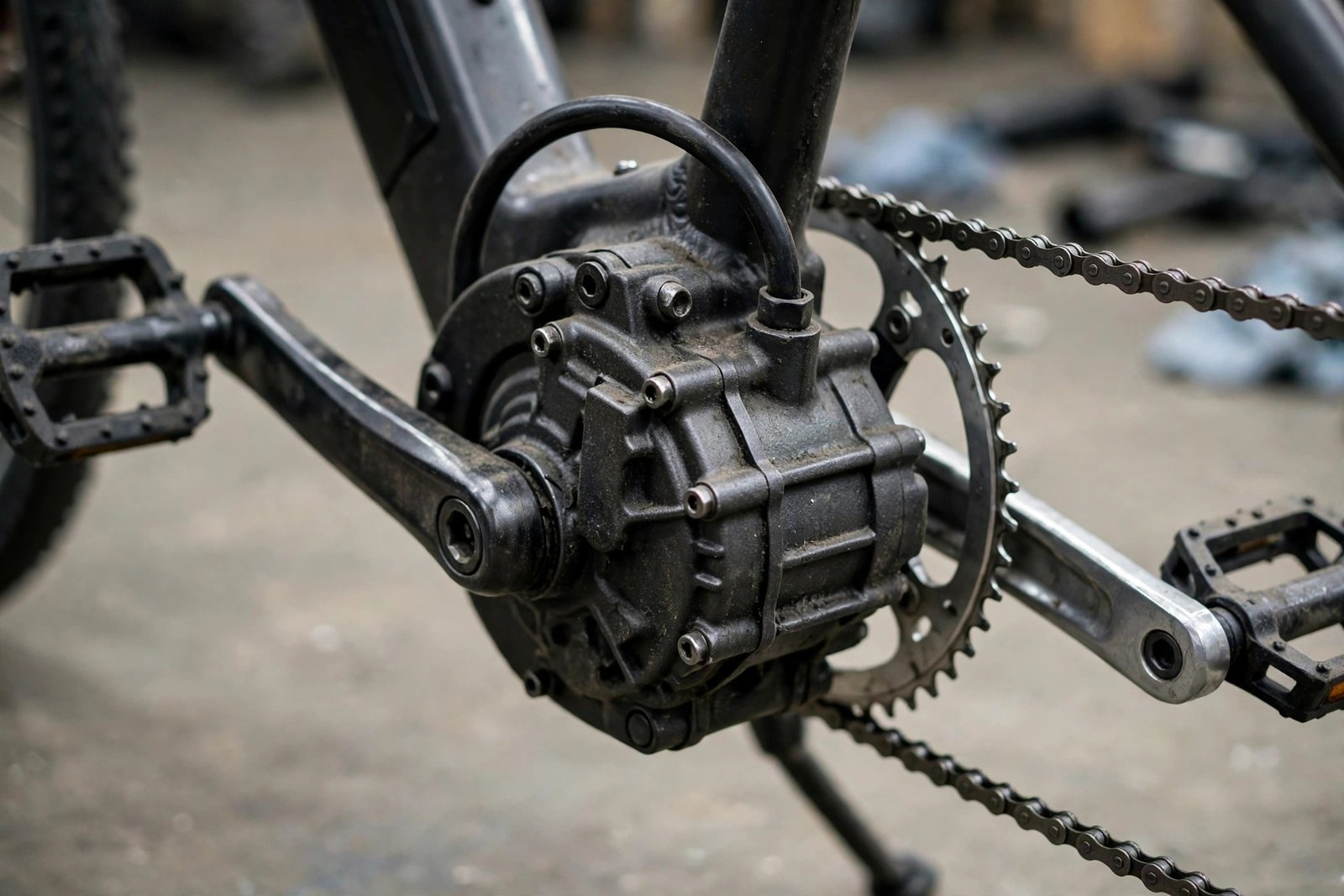
Hub vs mid-drive, side by side
| Hub motor | Mid-drive | |
|---|---|---|
| Where the motor sits | In the wheel, usually the rear | At the pedals, between the cranks |
| Uses the bike’s gears? | No — pushes the wheel directly | Yes — power goes through the chain and gears |
| Hill climbing | Good on short steep pitches; can overheat on long slow climbs | Excellent — downshifts and stays cool |
| Range | Good on flat roads | About 20–30% more in mixed terrain, from the same battery |
| Ride feel | A push from the wheel | A stronger version of you |
| Chain and gear wear | Low — the motor never touches the chain | Higher — the motor’s torque runs through the chain |
| Maintenance | Very low; simple to repair | More — chains, cassettes, brand-specific servicing |
| Weight balance | Weight at one wheel | Weight low and central |
| Typical starting price | About $800–$1,200 | Around $2,000 and up |
| Best for | Flat-to-rolling commutes, budget buyers | Long steep climbs, off-road, heavy cargo |
The table is the article in miniature. Read it as a set of trade-offs, not a scoreboard: the mid-drive wins hills, range and feel; the hub wins price, simplicity and maintenance. Which column matters more depends entirely on the three questions at the top.
Question 1 — Are your hills long and steep, or short and rolling?
This is the question that decides most purchases, because it is the one place the two motors genuinely differ.
A short steep pitch — the hill outside your flat, a bridge, a ramp — is over in a minute or two. The hub motor’s peak torque carries you up and over before heat becomes a problem, and our hills guide puts the number on it: a hub motor over 85 Nm clears a 15 percent residential street with real margin. Every hub bike in this guide clears that bar or comes close to it. For the hill home, the hub motor is not the weaker choice. It is the finished job.
A long sustained climb is a different ride. Ten minutes of gradient, no flat in the middle, the motor working hard the whole time — that is where a hub motor heats up and the controller pulls the power back. A mid-drive does not have that problem, because it drops to a low gear and lets the gears do the work while the motor spins fast and cool. If your daily ride includes a climb like that — a mountain road, a valley road out of town, a hill that takes ten minutes to walk — the mid-drive is worth its money, and no honest guide would tell you otherwise.
So measure your hill before you buy the motor. If it is the road home, buy the hub. If it is a mountain, save for the mid-drive.
A short hill is a hub motor’s job. A long hill is a mid-drive’s. Measure your hill before you buy the motor.

Question 2 — Do you ride off-road?
Off-road is the mid-drive’s second home, for the same reason as the long climb: the terrain changes every fifty metres, and the gears are the tool for that. Mud, roots, loose gravel, a trail that goes up and down all day — a mid-drive shifts with the ground, keeps the motor in its efficient range, and balances the bike’s weight low and central, which matters when the bike is leaning and bouncing.
On tarmac, none of that applies. A flat road, a bike path, a commute with traffic lights — the gears are doing almost nothing, because the gradient barely changes. GoEBikeLife, the most honest of the comparison guides, puts it plainly: “if your riding is mostly flat-to-rolling, a hub motor is usually the smarter, cheaper win.” That is not a budget excuse. It is the right tool for the job.
There is one off-road caveat in the other direction: a hub motor’s weight sits in the rear wheel, which makes the back of the bike heavy and the handling clumsier on rough ground. If you ride trails every weekend, you will feel it. If you ride roads every day, you will not.
Question 3 — Do you want to pay more, and change chains more often?
This is the question the “mid-drive is better” guides bury, and it is the one that matters most at your budget.
The money. Entry-level hub-motor bikes start at about $800–$1,200; decent mid-drive bikes start at around $2,000 and go up from there — those are the independent guides’ bands, not ours. For a comparable bike — same battery, same brakes, same build — the mid-drive costs roughly $600–$1,000 more. That is not a small premium on a $500–$1,000 budget. It is the whole budget again.
The maintenance. A mid-drive puts its full torque through your chain and cassette, and those parts wear out noticeably faster. A chain that lasts 2,000–3,000 miles on a regular bike lasts about 1,000–1,500 miles on a mid-drive; cassettes wear proportionally faster, and replacement chains run $30–$60 with cassettes at $50–$150. Over five years and 10,000 miles of regular commuting, one independent guide puts the mid-drive rider’s drivetrain bill at $400–$600, against $100–$200 for the hub rider — because the hub motor never touches the chain, so the chain only ever carries your legs. Servicing a mid-drive is also pricier and often needs brand-specific tools, where a hub motor is simple enough for most bike shops.
The range. The mid-drive’s one genuine saving is efficiency: because it uses the gears, it gets about 20–30% more range from the same battery in mixed terrain, according to the independent guides. That is real — but do the maths before it impresses you. On a 624Wh battery, that is the difference between roughly 40 miles and roughly 50 miles on a hilly route. A bigger battery buys you the same miles for less money than a mid-drive does, and it does not wear out your chain to do it. (EVELO, which sells mid-drives, claims 30–50% more range — take that from a seller the way you would take a range claim from any maker: with the discount it deserves.)
The range numbers, worked honestly
The efficiency gap deserves a proper look, because it is the mid-drive’s best argument — and it is smaller than it sounds.
Take the Mars 3.0’s 624Wh battery. The maker claims up to 65 miles; our range guide’s rule is that real range runs about 60–70 percent of the maker’s claim, so on a hilly route think 40–45 miles. A mid-drive with the same battery, at the 20–30 percent efficiency the independent guides cite, would stretch that to roughly 48–55 miles on the same route. That is a real gain — about ten extra miles — and on a long ride it is the difference between making it home and not.
But it is also the size of the gap a bigger battery closes for less money. The Aipas M1 Pro below carries 840Wh — a third more battery than the Mars — and on the same hilly route that buys more range than the mid-drive’s efficiency ever could, on a hub motor, for hundreds of dollars less than the cheapest mid-drive. Range is a battery question before it is a motor question, and the battery is the cheaper thing to upgrade.
The hub bikes we sell
Every bike below has a hub motor — because that is what we sell, and this article says so instead of hiding it. Each one is the hub answer to a different rider.
Heybike Mars 3.0 — the do-everything hub, 95 Nm
The most torque you can fold up and put in a hallway. A 750W rear-hub motor (1,400W peak) delivering 95 Nm — a figure Heybike states on its own site and every independent review repeats — a 624Wh removable battery, 20×4-inch fat tyres, full suspension front and rear, a torque sensor that matches the assist to how hard you pedal, and hydraulic disc brakes. The maker claims up to 65 miles of range and a 440 lb payload. It folds, so it fits a flat in a way the others do not — and the battery comes out with a key, so the whole bike never has to go near a socket.
No price quoted here — we have no verified price for the Mars 3.0 in our sheets, so the price is on the listing, not in this article. Check latest price →
We have not tested this bike ourselves. The 65-mile range is the maker’s claim — your hilly route will be shorter.
Aipas M1 Pro — the high-torque hub, 110 Nm
The most torque in our range, and the only bike here that BoltBikers names its “Best High-Torque Option” for hills. An 1,800W peak rear-hub motor delivering 110 Nm, a 48V 17.5Ah removable battery (840Wh) — the biggest battery in this guide — 26×4-inch fat tyres, dual suspension, a Shimano 7-speed drivetrain and 180mm mechanical disc brakes. The maker claims climbs of up to about 23 degrees and a range of up to 85 miles on pedal assist. It weighs 88 lb.
Check latest price · 110 Nm · 1,800W peak · 48V 17.5Ah · 26×4″ fat tyres · dual suspension · Shimano 7-speed · Check latest price →
We have not tested this bike ourselves. The 85-mile range is the maker’s claim, for pedal assist on flat ground — your hilly route will be shorter.
Lectric XP Lite 2.0 — the flat-commute hub
The lightest way into the range, and the simplest bike here. 49 lb with the battery, 41 lb without it — the battery comes off with one hand, so the carry is two light trips. A 22-inch standover, a half-twist throttle, five assist levels, hydraulic disc brakes, a single-speed drivetrain with nothing to shift, and UL 2849 certification on the bike and UL 2271 on the battery, stated on Lectric’s own site. It folds to 36 by 16 by 27 inches and fits riders from 4 feet 8 inches to 6 feet 2 inches. The standard battery is 375Wh — the smallest in this guide, and the honest reason this is the flat-commute pick rather than the hills pick.
Check latest price · 20-inch wheels · folding · throttle · removable battery · UL 2849-certified · Check latest price →
We have not tested this bike ourselves. The standard battery is 375Wh — the long-range battery costs more and is a separate option.
Jasion EB5 — the budget hub
The cheapest way into the range, and the lightest bike here. A 350W motor (1,000W peak), a 360Wh removable battery, 26-inch puncture-resistant road tyres, a 7-speed drivetrain, front suspension and mechanical disc brakes. The maker claims up to 40 miles of range and a 20 mph top speed, at 49.6 lb. The small battery is the trade-off: guides that have ridden it put the real range at 25–35 miles, which covers a flat daily commute and not much more — and no torque figure is published for it, so it cannot be ranked against the others on climbing. It is the budget pick, and the budget shows in the battery.
Check latest price · 1,000W peak · 360Wh · 26″ tyres · 7-speed · 20 mph · 49.6 lb · Check latest price →
We have not tested this bike ourselves.
The honest close: buy the hub, spend the difference
Here is the whole article in one paragraph. A mid-drive is the better motor — on long climbs, off-road, and in ride feel. It is also roughly $600–$1,000 more for a comparable bike, it wears chains and cassettes out noticeably faster, and it only earns that money on the rides most people do not do. For a flat-to-rolling commute with a short steep pitch on the way home, the hub motor climbs the hill, costs less, breaks less, and leaves you hundreds of dollars to spend on the things that matter more: a bigger battery, which buys more range than the mid-drive’s efficiency ever could, and a better lock, which protects the bike you already own.
That is the budget truth. If your hills are long, your trails are rough, and your budget stretches past $2,000 — buy the mid-drive, and buy it gladly. It is a lovely motor. But if your budget is $500–$1,000 and your ride is the road home, you are not buying the wrong bike. You are buying the right one, and the people telling you otherwise are usually selling the other one.
Frequently asked questions
Is a mid-drive really better than a hub motor?
On long steep climbs and off-road, yes — the gears multiply its torque and keep it cool. On flat-to-rolling roads, the difference is small, and the hub motor’s price and simplicity win. “Better” depends on the ride, not the motor.
How much more does a mid-drive cost?
For a comparable bike, roughly $600–$1,000 more, according to the independent guides — entry-level hub bikes start around $800–$1,200, while decent mid-drives start around $2,000. That premium is the whole budget again for most buyers.
Do mid-drives wear out chains faster?
Yes. The motor’s torque runs through the chain, so a chain that lasts 2,000–3,000 miles on a regular bike lasts about 1,000–1,500 miles on a mid-drive, and cassettes wear faster too. Over five years of commuting, that is roughly $400–$600 of drivetrain parts against $100–$200 for a hub bike.
Can a hub motor climb a steep hill?
A short steep one, yes — a hub motor over 85 Nm clears a 15 percent residential street with margin. A long sustained climb is the problem: the motor heats up and the controller pulls the power back. Short hills are a hub motor’s job; long ones are a mid-drive’s.
Does a mid-drive really give more range?
About 20–30 percent more from the same battery in mixed terrain, according to the independent guides — because it uses the gears. That is real, but a bigger battery buys the same miles for less money, and it does not wear out your chain.
Should I buy a mid-drive if I can afford one?
If your rides are long, steep, or off-road — yes, and gladly. If your ride is a flat commute with one steep road home, spend the difference on a bigger battery and a better lock instead. The motor is not the most important thing you buy; the battery and the lock are.
Browse by category: Folding E-Bikes · Commuter E-Bikes · Electric Scooters · E-Bike Accessories
As an Amazon Associate, BoltWander earns from qualifying purchases.
Keep reading
Related articles:
- Best E-Bike for Hills (Under $1,000): Torque That Actually Climbs — the torque number, and the three hub bikes that clear it
- How Far Can an E-Bike or Scooter Go on One Charge? Real-World Range vs the Box Claim — the 60–70 percent rule, and how to work out your real range
- 7 Mistakes to Avoid When Buying Your First E-Bike (What New Riders Wish They Knew) — the buying mistakes that cost more than the wrong motor
Previous: My E-Bike Won’t Turn On (or Won’t Charge)? The 10-Minute Checklist Before You Call the Shop
Next: How to Fix a Flat Tire on Your E-Bike or Scooter (the Commuter’s Roadside Guide)