

Some links in this article are affiliate links. If you buy through them, we may earn a commission at no extra cost to you.
Start with your commute, not the price tag. How far do you ride each way, and how hilly is it? How often do you stop in traffic, and how hard do you need to stop in the rain? Those four answers decide the two numbers that matter most: battery size, in watt-hours, for your range — and brakes, hydraulic if you ride in traffic or down hills, for stopping. Get those two right and almost any bike under $1,500 will serve you well; get them wrong and no bargain will save the commute.
This guide works the other way round from most roundups. First, what your commute actually needs — range, braking, and the carrying capacity for your daily load. Then the picks under $1,500, by the kind of commuter you are. Prices change often, so treat the figures here as a guide and check the current price before you buy. Some links in this guide are affiliate links — if you buy through them, we may earn a commission at no extra cost to you.
What $1,500 should buy you
At this budget, look for a hub motor of around 500 watts, a battery of at least 400 watt-hours, and a range of roughly 40 to 65 kilometres on a charge in normal use. Hydraulic disc brakes are a real plus, especially if you ride in rain or carry a load, because they stop more reliably than mechanical brakes and need less hand strength. Seven or eight gears are enough for most city riding, and a rack, mudguards and lights save you buying them separately.
Just as important is safety certification. Look for UL 2849 certification for the whole e-bike electrical system, not just the battery, and buy from a brand with a clear warranty and a US parts and service network. A cheap bike with no certification and no support is a false economy, however good the specification sheet looks.
Best value folding commuter
A good folding commuter in this price range folds, so it suits apartment living; it has a 500-watt motor, a throttle, seven gears, a rack and mudguards; and it is usually priced well under $1,500. It is heavy — over 28 kilograms — and its 20-inch wheels feel busy on rough roads, but for a flat city commute it is a lot of bike for the money. It suits riders who need to fold and store their bike, and who are happy to assemble it themselves and do basic maintenance.

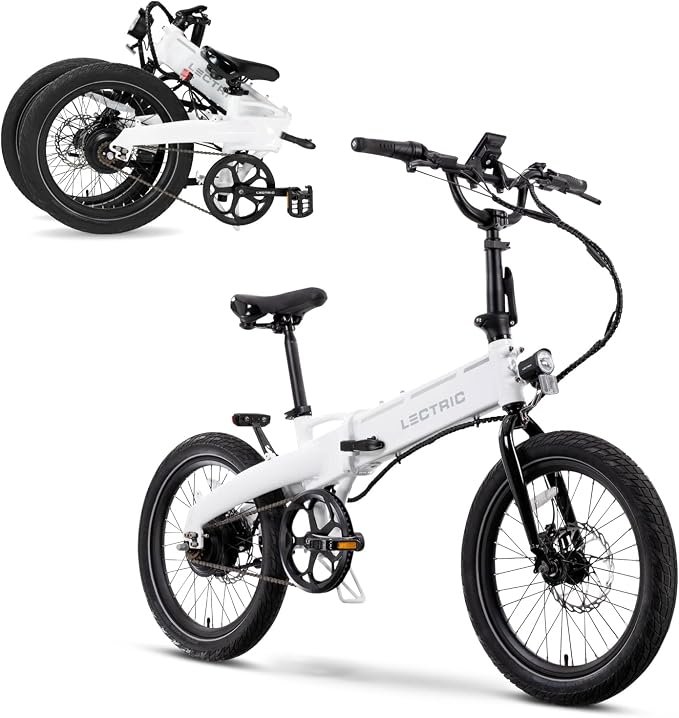
Best lightweight folder: Lectric XP Lite 2.0
If stairs are your main problem, the lighter XP Lite 2.0 is worth a look. Check price on Amazon. It is a simpler bike — a single gear, a smaller battery and fewer extras — but it is noticeably lighter and easier to carry than a heavier folding commuter, and it is usually the cheapest option in this guide. The trade-off is range and hill-climbing: the smaller battery and single gear make it best for flat, shorter commutes of under 10 kilometres. For a rider in a walk-up flat with a short, flat ride to work, that is a fair exchange.
Best full-size commuter
A full-size commuter under $1,500, with larger wheels, a cleaner frame, an integrated battery and a torque sensor on some versions, rides more like an ordinary bicycle than a folding e-bike, and it feels smoother and more stable on a longer commute. It does not fold, so it needs a hallway, a wall mount or a bike room, and a dealer network is a real advantage if you want local servicing. It suits riders with space to store a full-size bike and a commute of 10 kilometres or more.

You may also like: Jasion EB5 — the commuter pick in this guide · Lectric XP Lite 2.0 — the lightest folder here · Heybike Mars 3.0 — a foldable fat-tire commuter for small flats.
Best for comfort: a step-through commuter
A step-through frame, where the top tube is low or absent, makes getting on and off much easier, especially in work clothes or with a bag on the rack. Several brands offer step-through commuters under $1,500. They are worth considering if you have limited mobility, if you ride in a skirt or smart clothes, or if you simply prefer an upright, relaxed position. The only cost is a small amount of frame stiffness, which most commuters will never notice.
What to check before you buy
- Class and speed: most commuters in this price range are Class 2 (throttle and pedal assist to 20 mph) or Class 3 (pedal assist to 28 mph). Check which class is allowed on the paths you use.
- Battery size: a larger battery gives more range and lasts longer, because you charge it less often. Under 400 watt-hours is small for a daily commute.
- Brakes: hydraulic disc brakes are worth paying for if you ride in wet weather or on hills.
- Weight and storage: measure your storage space and test the carry, especially if you have stairs.
- Warranty and parts: check the warranty length, what it covers, and whether you can buy a replacement battery, tyres and brake pads in the United States.
Best product for commuting under $1,500
Jasion EB5 — 1000W peak motor, up to 40 miles claimed, 26-inch wheels with 7-speed gears and a front fork — the commuter pick in this guide. Check latest price on Amazon
Frequently asked questions
What is the best commuter e-bike under $1,500?
One with a big enough battery for your round trip, hydraulic brakes, and a payload rating above your weight — the article ranks on those, not on price alone.
How much range do I need for commuting?
Take your round-trip miles, add 30–40% buffer for hills, cold and battery ageing, then buy above that.
Is a $1,000 e-bike good enough for daily commuting?
Yes for flat, short commutes — spend more for hills, long distances or heavy loads.
What matters more — motor watts or battery size?
Battery size (Wh) decides range; motor torque decides hills — check both, not just watts.
Browse by category: Folding E-Bikes · Commuter E-Bikes · Electric Scooters · E-Bike Accessories
As an Amazon Associate, BoltWander earns from qualifying purchases.
Keep reading
Related articles:
- Lectric vs Aventon — Commuter E-Bike Comparison — two commuter favourites compared
- E-Bike vs Electric Scooter — Which Is Better — the other either/or decision
- How Far Can an E-Bike or Scooter Go on One Charge? Real-World Range vs the Box Claim — range is the number that decides a commute
