

Some links in this article are affiliate links. If you buy through them, we may earn a commission at no extra cost to you.
You bought the e-bike in spring. All summer it did exactly what the box promised — the commute, the errands, the weekend ride, all on one charge with miles to spare. Then December arrived. Same route, same assist level, same rider — and the battery meter is dropping like a stone. By February you are doing mental maths on every trip, wondering whether you will make it home.
Nothing is broken. Your battery has not died, and you did not buy a dud. Cold weather steals range from every lithium battery on the road — e-bikes, phones, cars, all of them — and it steals a lot of it. The good news is that most of that lost range is not gone for good: it comes back when the battery warms up, and a few small habits get most of it back while it is still cold. The bad news is that one winter mistake — charging a freezing-cold battery — can damage it permanently. This article explains how much range winter takes, why it takes it, the one rule you must not break, and how to get through winter with your battery intact.
The short answer: expect 20–30% less range, and never charge a frozen battery
If your e-bike does 40 miles on a charge in summer, plan on roughly 28–32 miles on the same route when it is near freezing. At around −10°C, plan on 24–28 miles. That is the headline, and it is the number to use when you decide whether to top up before you leave.
Two things to hold on to before the detail:
- The range loss is mostly temporary. A cold battery gives you less because it is sluggish, not because it is damaged. Warm it up and most of the range comes back.
- Charging a freezing battery is the one thing that can cause permanent damage. The rule is simple and it is not negotiable: never charge a lithium battery below 0°C (32°F). Warm it to room temperature first.
Why cold steals range
Your e-bike battery is a lithium-ion battery, and it makes its power with chemistry. Inside the battery, lithium ions move between electrodes through a liquid, and that liquid gets thicker and slower as it cools. The ions move more slowly, the battery’s internal resistance rises, and less of the stored energy can get out to the motor. It is the same reason a car battery turns over slowly on a frosty morning.
Think of it like trying to run in cold weather yourself: your muscles are stiff, your reactions are slow, and everything takes more effort. The battery is doing the same thing — it is not weaker, it is slower, and a slow battery delivers less of what it holds.
Two more winter effects pile on top of the chemistry:
- Cold air drops your tire pressure. Air contracts as it cools, so tires that were right in October are soft by January. Soft tires roll with more resistance, and more resistance means more battery for the same miles.
- Winter riding is harder riding. Headwinds, slush, snow on the path, heavier clothing, a loaded pannier — every one of them asks the motor for more.
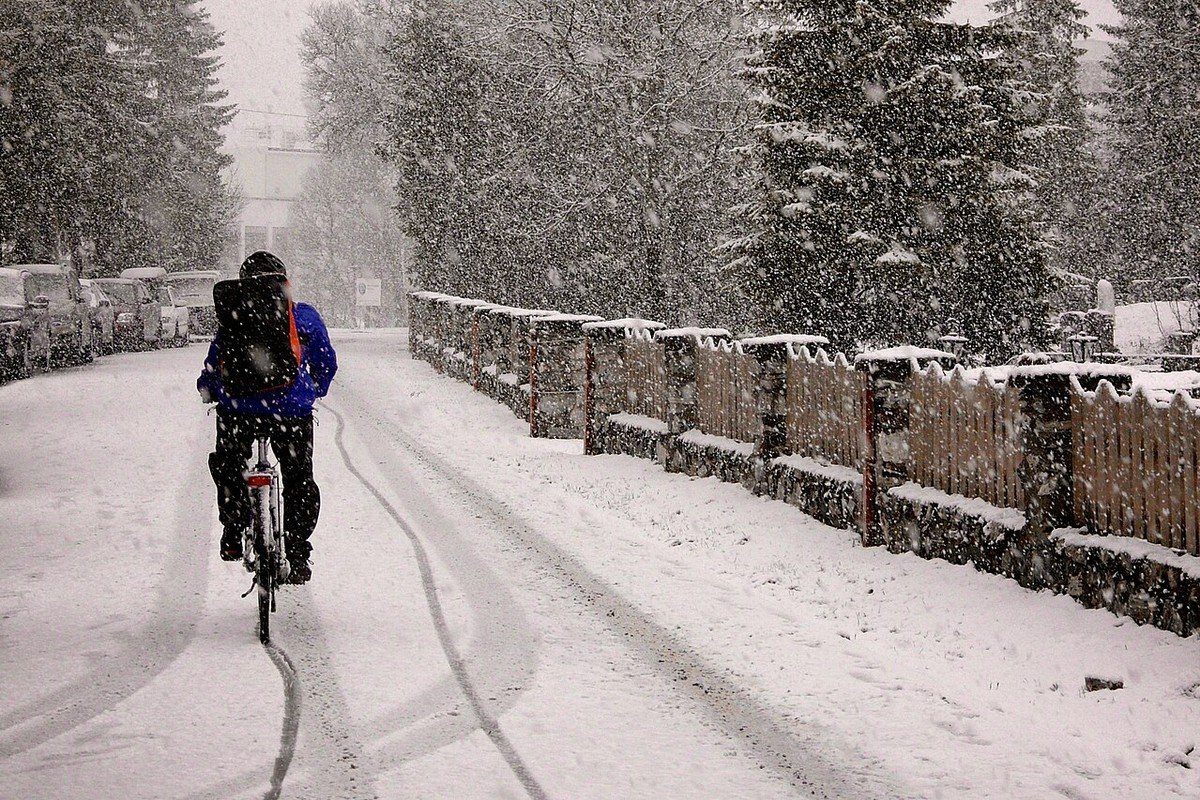
The numbers: how much range winter actually takes
The honest answer is that it depends — on the battery’s age, on how cold it is, on how much assist you use and on how hilly your route is. But the range of what riders actually see is fairly consistent:
- Near 0°C (32°F): expect roughly 20–30% less range than the same ride in mild weather.
- Around −10°C (14°F): expect roughly 30–40% less range.
Those are not precise predictions for your bike. A new battery on low assist on flat ground loses less; an old battery on turbo up hills loses more. Use the ranges as planning numbers, not promises.
One more thing the numbers do not show: the loss is not linear. The first few degrees below freezing cost more than the next few, because the battery is going from warm to cold. That is why a bike kept in a heated hallway behaves so differently from the same bike kept in an unheated garage.
The 32°F rule: never charge a lithium battery below freezing
This is the most important section in this article, and it is a hard rule, not a tip. Do not charge a lithium-ion battery when it is below 0°C (32°F).
When a lithium battery charges, lithium ions are supposed to slide neatly into the graphite of the negative electrode. Below freezing, they cannot do that properly. Instead of sliding in, some of them plate out as metallic lithium on the surface of the electrode. That plating is permanent — it is capacity you never get back — and in the worst cases it can grow into structures that make the battery unsafe. A single cold charge will not usually destroy a battery, but repeated cold charging wears it down in a way that warm charging does not.
Here is what that means in practice:
- A battery left in a freezing garage overnight is a battery you must not plug in. Bring it indoors and let it warm to room temperature — a few hours is enough — before it goes on the charger.
- Riding in the cold is fine; charging in the cold is not. Discharging a cold battery is safe, and it even warms the battery slightly as you ride. It is the charger, not the ride, that is the problem.
- Some batteries and chargers refuse to charge below freezing. If yours does, that is a safety feature, not a fault. Let the battery warm up and try again.
- Do not try to warm a battery quickly. No radiators, no hair dryers, no hot water. Room temperature, over a few hours, is the way.
If you remember one sentence from this article, make it this one: never charge a frozen battery.
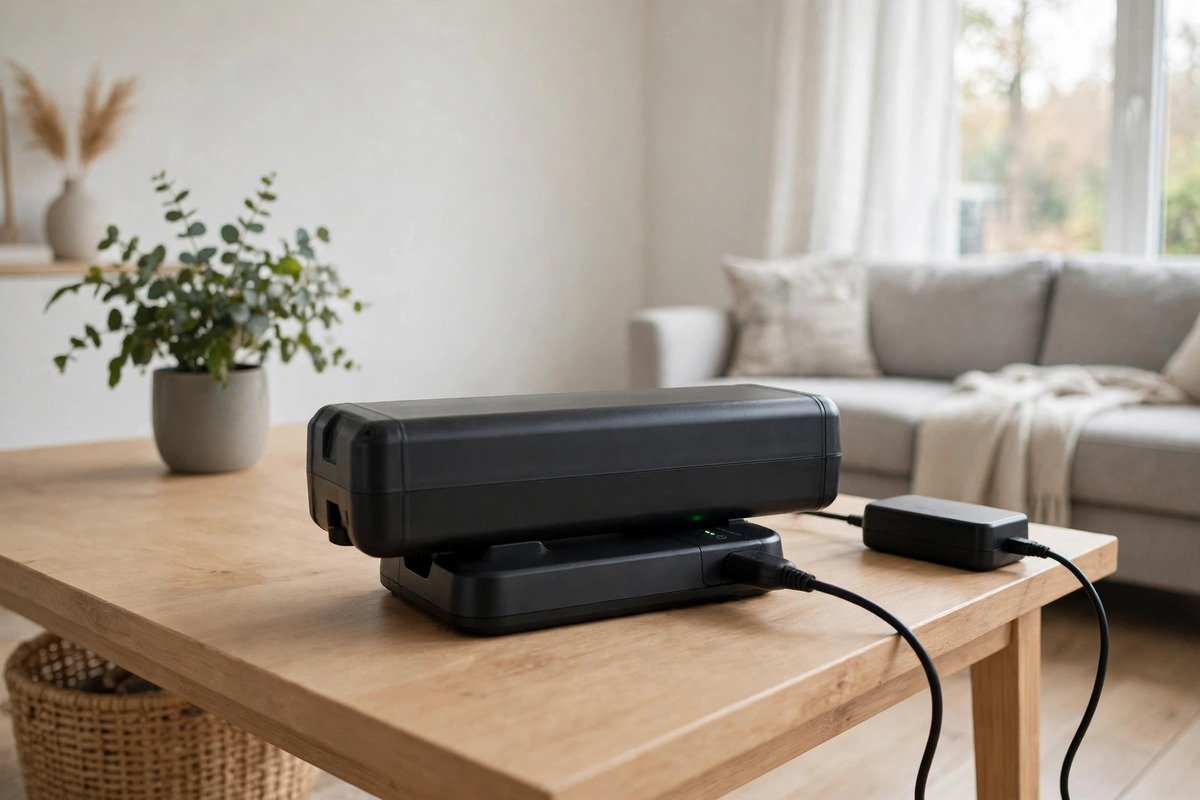
Storing the battery indoors in winter
If your battery comes off the bike, take it off and bring it inside for winter. It is the single most effective thing you can do, and it costs nothing:
- Store it at room temperature, somewhere dry. A hallway cupboard, a shelf in a heated room, anywhere that stays above freezing.
- Store it partly charged. Roughly half charge is the usual guidance for storing a lithium battery: not full, not empty.
- Check your manual. Battery makers differ on the details — some want a slightly higher storage charge, some a slightly lower one — and the manual wins.
- If the battery does not come off the bike, bring the whole bike inside if you can. If you cannot, at least bring it into a garage or shed that is out of the wind, and cover it.
Getting winter range back
You cannot change the weather, but you can win back most of what it takes:
- Warm the battery before you ride. Keep it indoors overnight and fit it to the bike just before you leave, so it starts the ride at room temperature.
- Charge indoors at room temperature. This is the 32°F rule again, but it is also the easy way to start every ride with a full, warm battery.
- Use a lower assist level. The difference between eco and turbo is the difference between arriving and walking the last mile.
- Keep your tires at the right pressure. Check them weekly in winter, not monthly, and pump them up to the pressure on the sidewall.
- Store at partial charge. A battery stored at about half charge over winter holds up better than one stored full or empty.
- Cut the drag where you can. A clean, dry chain and properly adjusted brakes are free range.
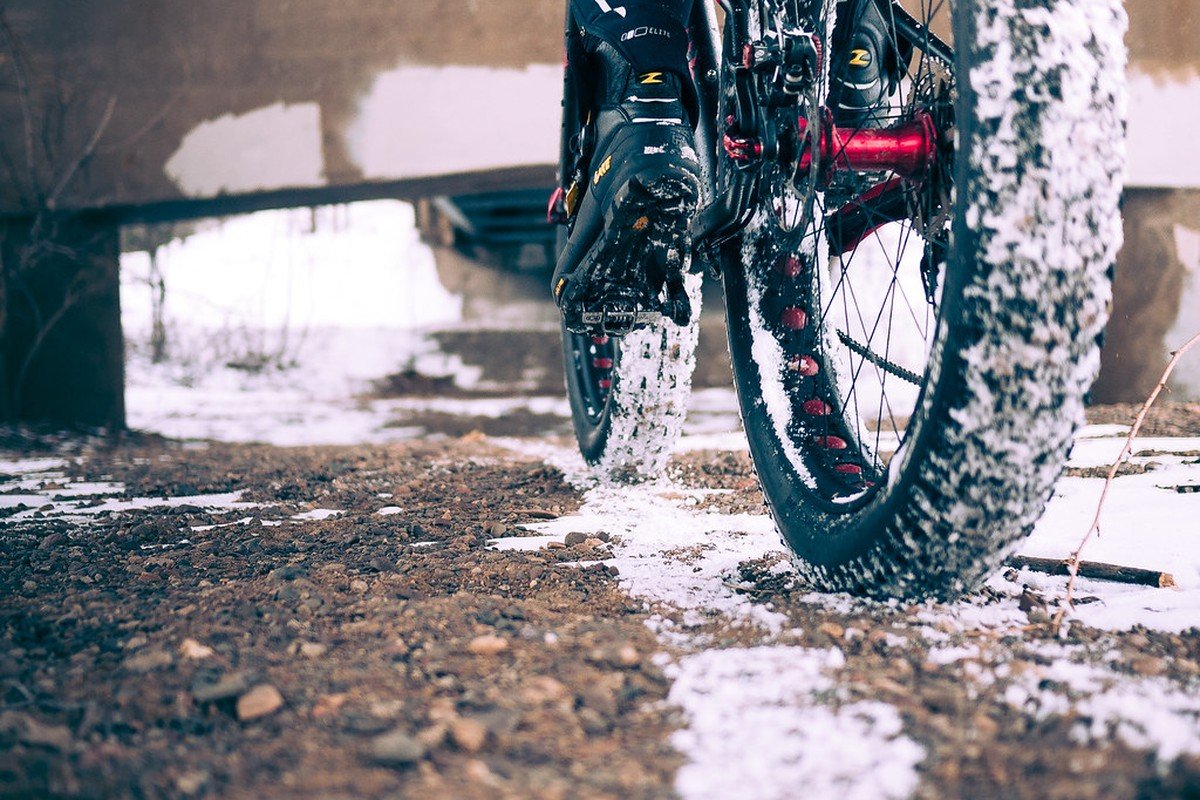
Riding in snow and ice safely
Range is only half the winter question. The other half is staying upright:
- Fat tires help, and they are the honest reason to want them. Wide tires spread your weight over more snow, and they grip better on the soft stuff.
- Brake early and gently. On snow and ice, brake well before you need to stop, use both brakes, and squeeze, don’t grab.
- Slow down and stay smooth. No sudden turns, no sharp leaning, no hard acceleration. Every input should be gentle.
- Be seen. Winter means short days, grey light, and drivers who are not expecting a cyclist. Lights on, bright clothing, reflective strips.
- Dress for the cold, not for the effort. You will warm up as you ride, but your hands and feet will not. Warm gloves, warm socks, and a windproof layer are not optional.
And know when not to ride. Some days are not riding days: freezing rain, black ice, a blizzard. On those days the bus wins, and that is a good decision, not a defeat.
You may also like: If a removable battery is what makes winter riding workable for you, our folders with removable packs are the Heybike Mars 3.0 — the biggest removable pack in our range — and the Jasion EB6.
Best product for winter commuting
Heybike Mars 3.0 — the bike in our range that makes winter riding workable, because its battery comes off. You bring the battery indoors, charge it at room temperature, and put it back on for the ride. We picked it because the 1,000W motor and the 180 mm fat tires handle snow-covered tracks and winter wind, and because a big, removable battery is exactly what this article says matters most. Check latest price on Amazon
What we will not pretend otherwise: the Mars 3.0 does not make winter easy. It is heavy, it still needs care on ice, and no bike will make a blizzard ride fun. What it does is put the battery — the thing winter punishes most — in your hands, where you can keep it warm.
Frequently asked questions
How much range does an e-bike lose in cold weather?
About 20–30% near freezing, and 30–40% at around −10°C. Most of it comes back when the battery warms up.
Can I charge my e-bike battery when it’s freezing?
No. Never charge a lithium battery below 0°C (32°F). Warm it to room temperature first.
Should I store my battery indoors in winter?
Yes. Room temperature and about half charge is the usual guidance.
Does cold weather permanently damage an e-bike battery?
Cold riding and cold storage do not. Charging a frozen battery can, because lithium plates onto the electrode instead of sliding into it.
How do I get winter range back?
Warm the battery indoors before you ride, charge at room temperature, use a lower assist level and keep your tires at the right pressure.
Is it safe to ride an e-bike in snow?
Yes, with care: slow down, brake early, use fat tires, and skip the ride on freezing-rain or black-ice days.
Browse by category: Folding E-Bikes · Commuter E-Bikes · Electric Scooters · E-Bike Accessories
As an Amazon Associate, BoltWander earns from qualifying purchases made through links on this page.
Keep reading
Related articles:
- E-Bike and Scooter Range: What You’ll Actually Get vs What the Box Claims
- Can You Charge an E-Bike Battery Inside Your Apartment? Rules, Risks and a Safer Setup
- Can You Ride an E-Bike in the Rain? IP Ratings Explained
Previous: E-Bike vs E-Scooter for Commuting: Which Saves You More Money?
Next: E-Bike vs E-Scooter for Commuting: Which Saves You More Money?
Image credits: Wikimedia Commons — Unsplash, Pexels.
