

Some links in this article are affiliate links. If you buy through them, we may earn a commission at no extra cost to you.
You already own a bike helmet. It has sat in the closet for years, it still fits, and it did its job fine on your old bicycle. Now you ride an e-bike — and somewhere in the back of your mind is the question you keep not asking: is that old helmet still enough?
Here is the honest answer: for most slow, short rides, probably. For a Class 3 e-bike at 28 mph in traffic, probably not — and the law may agree with us. The difference is not the helmet being “bad”. It is that your e-bike changed the speeds, and the speeds changed what a helmet has to do. This article explains the two labels you will keep seeing — MIPS and NTA-8776 — what the law actually requires, and how to pick a helmet that fits the way you really ride. No scare tactics, no sales pitch — just the facts, and the places where the facts run out.
The short answer: yes, wear one — and match it to your speed
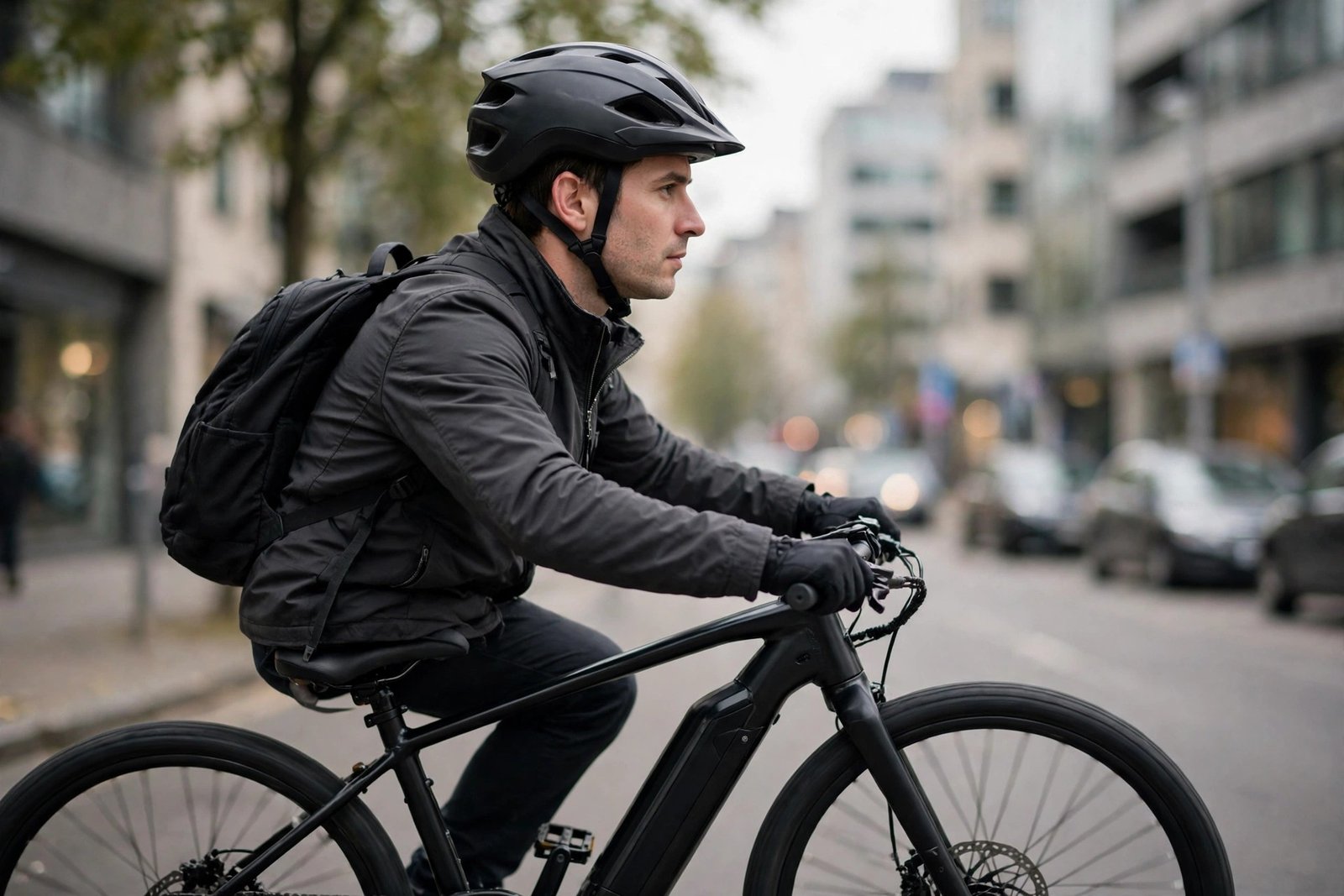
If you ride an e-bike, wear a helmet on every ride. That is the whole answer for most people. The longer answer is about which helmet:
- Class 1 or Class 2 (up to 20 mph), short flat trips: a regular bicycle helmet that meets the CPSC standard is a reasonable choice — it is the legal baseline in the United States, and it is built for the speeds you are riding at.
- Class 3 (up to 28 mph), or any regular riding above 20 mph: look for a helmet built for those speeds — ideally one certified to NTA-8776, the Dutch standard written specifically for faster e-bikes, and ideally with MIPS inside it.
- Whatever you buy: it has to fit properly. A helmet that rocks, slides, or sits on the back of your head protects less than a cheaper helmet that fits right.
The law is a separate question from safety, and we cover it below — but do not let the law decide for you. In many states the law does not require an adult to wear a helmet on a Class 1 or 2 e-bike at all. That does not make riding bareheaded a good idea. It just means the decision is yours.
Why speed changes the question
A fall at 28 mph is not a slightly worse version of a fall at 20 mph. The energy in a crash grows with the square of the speed — so a fall at 28 mph carries roughly twice the kinetic energy of a fall at 20 mph. Your head hits the ground harder, and it hits it with more twisting force, because you are usually moving forward as well as down.
That is the whole reason e-bike helmets exist as a separate idea. A standard bicycle helmet is impact-tested for the speeds of ordinary cycling. An e-bike routinely cruises at 20 mph and a Class 3 reaches 28 mph — speeds a normal bicycle only reaches downhill. The helmet standards written for ordinary cycling were never designed around those speeds, and that gap is exactly what the two labels in this article are trying to close.
Is a regular bike helmet enough on an e-bike?
For slow riding, yes. If your trips are short, flat, and under 20 mph, a standard CPSC-certified bicycle helmet is doing the job it was designed for. There is no rule that says a regular helmet stops working the moment a motor is involved — the motor does not change the helmet, it changes the speed, and the speed is what matters.
The honest limit is this: standard bicycle helmets are tested at the impact speeds of ordinary cycling (roughly 12–15 mph in the test conditions manufacturers describe, per Himiway). Once you are regularly riding at 25–28 mph, you are outside the speeds those tests were built around. You are not unprotected — a certified helmet is still far better than no helmet — but you are asking it to do a job it was not specifically tested for. That is when an e-bike-specific helmet earns its price.
What MIPS actually is — and what it is not

MIPS stands for Multi-directional Impact Protection System. It is a thin, low-friction layer — often a yellow liner you can see inside the helmet — fitted between the outer shell and the inner padding. On a straight, head-on impact it does very little. On an angled impact, which is how most real falls happen, the layer lets the shell slide a small amount — about 10 to 15 millimetres — against your head, instead of passing the full twisting force straight through to your skull.
That twisting force is the part that matters. A straight impact compresses the brain in one direction. An angled impact adds rotation, which shears and strains brain tissue — and rotational force is a significant contributor to concussion and other brain injuries. MIPS was developed to address exactly that gap: in 1995, neurosurgeon Hans von Holst at Sweden’s Karolinska Institute began asking why people were still suffering serious brain injuries while wearing helmets that met the existing standards, and worked with engineer Peter Halldin at the KTH Royal Institute of Technology on how rotational force behaves inside the skull. Their work led to the MIPS system, which first appeared on equestrian helmets in 2007 and on cycling helmets in 2009.
Three things to know before you pay for it:
- MIPS is not a certification. It is a technology inside the helmet, not a pass/fail safety standard. A helmet still needs its CPSC (or EN 1078) certification — MIPS sits on top of that, it does not replace it.
- It adds very little weight and a modest premium. Roughly 20–30 grams and a small price increase (per Helmets Advisor) — for most riders, that is a fair trade for rotational protection.
- Independent testing backs the mechanism. The Bicycle Helmet Safety Institute’s testing has shown MIPS reduces rotational acceleration, and Virginia Tech’s STAR ratings — which test helmets on both linear and rotational measures — are one of the most useful ways to compare helmets if you want a number rather than a label.
Is it worth it? For a commuter riding daily in traffic, yes — it is a small premium for protection against the kind of fall you are most likely to have. For a slow, occasional rider on flat paths, a well-fitting standard helmet is still a reasonable choice.
What NTA-8776 actually is
NTA-8776 is a Dutch helmet standard, developed under NEN (the Dutch Standardization Institute) and published in late 2016. It was the world’s first safety standard written specifically for e-bikes and speed pedelecs — bikes that assist up to 45 km/h, about 28 mph, which is the top assisted speed of a US Class 3 e-bike.
It differs from a standard bicycle helmet in two ways:
- It is tested at higher impact speeds — the speeds a fast e-bike actually reaches, not the speeds of ordinary cycling. Helmets certified to it absorb roughly 40–43% more impact energy than standard bicycle helmets (per Himiway and Ride Lumos).
- It covers more of your head. The test line on the sides and rear sits much lower than on a standard bicycle helmet, so the helmet protects a larger part of the head — especially the temples and the back of the head, the areas most exposed in a fall at speed.
A few honest limits. NTA-8776 is not a legal requirement in the United States — helmets sold here must still comply with the CPSC standard, and NTA-8776 is an added signal on top of that, not a replacement for it. In the Netherlands, an NTA-8776 (or motorcycle-certified) helmet is legally mandatory for speed pedelec riders on public roads. And an NTA-8776 helmet still protects substantially less than a motorcycle helmet meeting the US DOT standard — it is the middle ground between a bicycle helmet and a motorcycle helmet, built for the speeds in between.
Who needs it? If you ride a Class 3 e-bike, or you regularly ride above 20 mph, it belongs high on your checklist. If you ride a Class 1 or 2 at neighbourhood speeds, a CPSC-certified helmet with MIPS is a reasonable choice and NTA-8776 is a bonus, not a necessity.
The law: what you must wear
There is no federal helmet law for e-bikes in the United States. The rules are set state by state, and sometimes city by city — and they change, so check your own state’s current rules before you ride. Here is the shape of it:
- Class 3 is where the law bites. The model legislation promoted to states by PeopleForBikes and the Bicycle Product Suppliers Association includes mandatory helmet use for all riders of Class 3 e-bikes. Many states have adopted that rule. In California, for example, a helmet is required for every Class 3 rider regardless of age (California Vehicle Code §21213(a)), while Class 1 and 2 riders need one only if they are under 18. Per the Bicycle Helmet Safety Institute’s state-by-state list, 31 states plus Washington DC have a statewide helmet rule covering at least some e-bike riders or classes (as compiled in August 2026 by eBike Local).
- Class 1 and 2 are usually age-based. In most states, adults are not legally required to wear a helmet on a Class 1 or 2 e-bike — only riders under 18 (or under 16 in some states) are. A few states require helmets for all riders on all classes.
- The CPSC standard is the manufacturing baseline, not a riding law. Helmets sold in the US must comply with the CPSC bicycle helmet standard. That is a rule about what can be sold, not about what you must wear — the wearing rules are the state laws above.
One more thing the law will not tell you: a helmet that meets the legal minimum is not necessarily the helmet that protects you best. The legal minimum is a floor. Your riding speed is what should set the ceiling.
You may also like: A helmet is only half of being seen and being safe in traffic. Our OutdoorMaster Cycling Helmet is the commuter helmet in our range, and the Ascher Ultra Bright Bike Light Set (Check latest price) is the cheapest way to make sure drivers see you after dark — lights and a helmet solve different halves of the same problem.
How a commuter helmet should fit
A helmet that does not fit is a helmet that does not protect you — and this is the part most riders get wrong, because nobody ever showed them. The check takes thirty seconds:
- Level, not tilted. The helmet should sit level on your head, covering your forehead, with the front edge about two fingers’ width above your eyebrows. If it sits on the back of your head like a cap, it is not protecting your forehead.
- Snug, not tight. It should feel snug all round with no pressure points. Shake your head gently — the helmet should move with your head, not rock back and forth on its own.
- Straps in a V. The side straps should meet in a V just below each ear.
- One finger under the chin strap. The chin strap should be tight enough that only one finger fits between the strap and your chin. If you can fit two, it is too loose — and a loose helmet can come off in exactly the crash you bought it for.
- Try it with your riding gear on. If you wear glasses, a cap, or headphones under your helmet, try the fit with them on. A helmet that fits in the shop and pinches on the road will end up hanging on a hook at home.
And one rule that is not negotiable: replace a helmet after any crash in which your head hit something — even if the helmet looks fine. The foam inside is designed to crush once, and damage you cannot see is still damage. Manufacturers generally recommend replacing a helmet after around five years of regular use even without a crash, because the materials age. If you are not sure whether yours is still good, assume it is not.
What to look for when you buy
In order, and only in this order:
- The CPSC label. No CPSC (or EN 1078) certification, no purchase — whatever else the listing promises. This is the baseline that every helmet sold in the US must meet.
- NTA-8776, if you ride fast. Class 3, or regular riding above 20 mph — this is the label that says the helmet was tested for your speeds.
- MIPS, if you ride in traffic. A small premium for rotational protection against the angled falls that traffic riding produces.
- Fit, before brand. Try it on. A helmet from a brand you have never heard of that fits perfectly protects you better than a famous helmet that rocks on your head.
- Vents and weight, for comfort. A helmet you leave at home because it is hot and heavy protects nobody. Vents matter on a summer commute; weight matters on a long one.
- Visibility. Bright colours, reflective details, or a light mount — being seen is part of not crashing in the first place.
One thing not to do: do not buy a helmet from a no-name seller with no certification mark and no brand behind it. The certification label is the only objective quality signal you have, and a helmet without one is a guess, not protection.
Best product for e-bike commuting
OutdoorMaster Cycling Helmet — the commuter helmet in our range, in the skate-style shape that suits city riding and looks at home off the bike as well as on it. It is the helmet we link to because it is the one we have verified — a real product, a working affiliate link, and a price you can check before you buy. Check latest price on Amazon
What we do not know, and will not pretend otherwise: we have not confirmed whether this particular OutdoorMaster model carries MIPS — the MIPS-carrying model in our catalogue is the OutdoorMaster Gem MIPS. If MIPS matters to you, that is the one to check — and check the listing for the MIPS mark before you buy, do not take our word for it. What we can say is that this helmet is a real, verified commuter helmet at a price that leaves room for lights and a lock — and that a helmet that fits and gets worn beats a better helmet that stays on a shelf.
A second MIPS option: the Giro Isode MIPS II.
Frequently asked questions
Do I need a helmet for an e-bike?
Yes — wear one on every ride. The law may not require it for an adult on a Class 1 or 2 e-bike in your state, but the speeds an e-bike reaches make a helmet the single most effective piece of protection you own. The legal minimum is a floor, not a recommendation.
Is a regular bike helmet enough on an e-bike?
For slow, short, flat rides under 20 mph, a CPSC-certified regular bicycle helmet is a reasonable choice — it is doing the job it was designed for. Once you regularly ride above 20 mph, or you ride a Class 3 e-bike, you are outside the speeds standard bicycle helmets are tested for, and an e-bike-specific helmet (ideally NTA-8776) is the honest upgrade.
What is MIPS and is it worth it?
MIPS is a thin, low-friction layer inside the helmet that lets the shell slide about 10–15 mm against your head in an angled impact, reducing the rotational force that contributes to concussion. It is a technology, not a certification — the helmet still needs its CPSC label. It adds roughly 20–30 grams and a modest premium. For a daily commuter in traffic, yes, it is worth it.
What is NTA-8776 and who needs it?
NTA-8776 is a Dutch standard (NEN, published 2016) written specifically for e-bikes and speed pedelecs up to 45 km/h (28 mph). It tests at higher impact speeds and covers more of the head — temples and rear — than a standard bicycle helmet. It is not a US legal requirement. It belongs on your checklist if you ride a Class 3 e-bike or regularly ride above 20 mph.
Do I legally have to wear a helmet on a Class 3 e-bike?
In many states, yes — for all riders, regardless of age. The PeopleForBikes model law includes mandatory helmets for Class 3, and states like California require a helmet for every Class 3 rider (CVC §21213(a)). But the rules are state by state and they change: check your own state’s current law before you ride, and do not assume the law where you live matches the law where you read about it.
How should a commuter helmet fit?
Level on your head, front edge two fingers above your eyebrows, straps in a V under each ear, chin strap tight enough for one finger only, snug with no rocking. Replace it after any crash in which your head hit something, and after around five years of regular use even without a crash.
Browse by category: Folding E-Bikes · Commuter E-Bikes · Electric Scooters · E-Bike Accessories
As an Amazon Associate, BoltWander earns from qualifying purchases.
Keep reading
Related articles:
- E-Bike Battery Safety — What UL 2849 Means — the labels behind the safety rules in this article
- Best E-Bike Accessories for Commuters — the lock, lights and pump every commuter needs on day one
- Can You Charge an E-Bike Battery Inside Your Apartment? The Honest Safety Answer — the other half of riding safely from a flat
Previous: Can You Charge an E-Bike Battery Inside Your Apartment? The Honest Safety Answer
Next: E-Bike Classes Explained: Class 1 vs 2 vs 3, and Where You Can Legally Ride Each One