

Some links in this article are affiliate links. If you buy through them, we may earn a commission at no extra cost to you.
Your shift starts in your hallway. Not at a depot, not in a garage — in the metre of floor between your front door and your shoes, where the bike slept last night next to the delivery bag. By midnight it will have carried thirty kilos of food across town, been locked and unlocked forty times, and come home to the same metre of floor. That is the whole job, and it is why a delivery bike is a different purchase from a commuter bike: it is a work tool that lives in your living room.
This guide is written for the part-time rider, not the full-time courier with a cargo bike and a van. You do two or three evening blocks a week, you live in a flat, and you want the bike to pay for itself without taking over your home. Four bikes below do that, for four different riders. The rest of this guide is how to pick between them — and the honest maths on what the work actually pays.
One thing first: we have not tested these bikes ourselves. What follows is what the makers publish, what independent guides have verified, and what the listings say — with the gaps flagged where they are. Prices change constantly — check the listing for the live price.
The short answer: range, rack, fold, lock
Forget the top speed. A delivery bike is decided by four things, in this order:
Range that survives a shift. Not the number on the box — the real miles, loaded, in stop-start traffic, with the throttle doing half the work. Our range guide’s rule is that real range runs about 60–70 percent of the maker’s claim, and eBikePeak, which tests delivery bikes for a living, puts it blunter: real delivery range is about half the claimed figure. A bike that claims 85 miles gives you roughly 40–50 real delivery miles. That covers a part-time shift. It does not cover a full day.
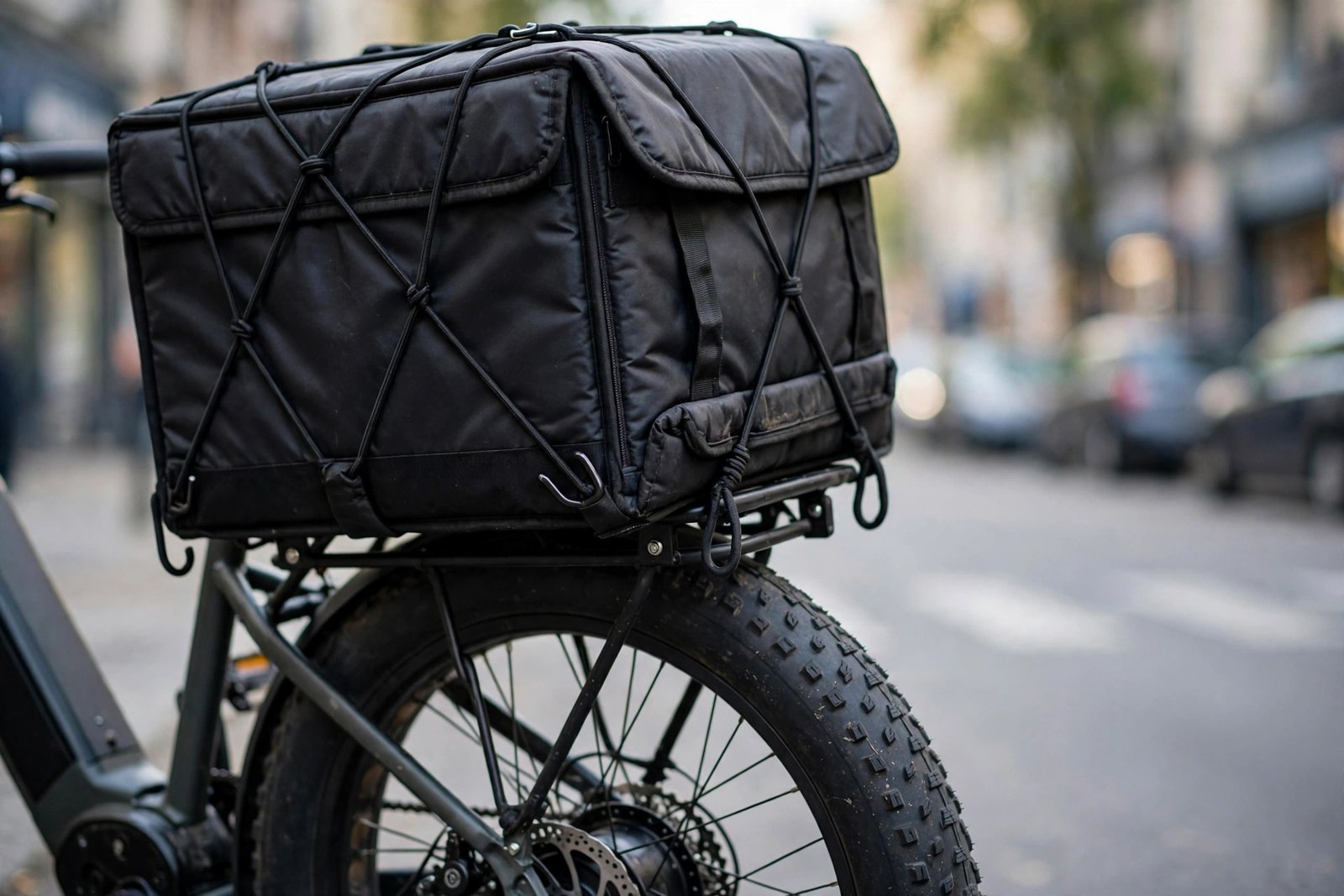
A rack that actually holds food. The bag is the job. If the bike has no rear rack, you are carrying dinner on your back for four hours — and the food arrives shaken, cold, and sideways. A rack is not an accessory for this job. It is the job.
A fold that fits your flat. A full-size fat-tire bike in a hallway owns the hallway. A folder tucks against the wall, and the battery comes out with a key so the whole bike never has to go near a socket.
A lock routine you will actually do forty times. eBikePeak calls it “the forty lock-ups a shift” — and the lock you will use forty times is the one that takes ten seconds, not forty-five.
The four bikes below are the four answers to those four demands: the Aipas M1 Pro for the long shift, the Heybike Mars 3.0 for the small flat, the TST for the long zone, and the isinwheel M10 Plus for the tight budget. The rest of this guide is why.
What a delivery shift actually demands
A delivery shift is harder on a bike than any commute, and the difference is not the distance — it is the stops.
A commuter rides twenty miles and stops twice. A delivery rider rides the same twenty miles and stops twenty times — a restaurant, a flat, a restaurant, a flat — with the motor working hardest exactly where it is least efficient: accelerating away from every kerb with a loaded bag. That is why the range number on the box is the least useful number in this guide. eBikePeak’s delivery testing puts a 624Wh battery at 30 to 40 loaded miles on a full charge — enough for one normal city shift, and not a mile more. BoltBikers, whose delivery guide is the freshest in the field, says the same thing from the other side: riders using higher speeds or frequent throttle bursts should expect less range than the claim, and a casual e-bike rated for 40 miles might only get you 20 to 25 real miles once you factor in throttle use, cargo, hills, stop-and-go traffic and weather. That last line is from GoEBikeLife’s delivery guide, and it is the truest sentence in this whole article.
The bag matters as much as the battery. A loaded delivery bag weighs 10 to 15 kilos, and it sits high and behind you — which is why the rack, the tyres and the brakes all matter more here than on a commuter. Fat tyres smooth out the potholes that would shake a pizza box apart. Disc brakes stop a loaded bike in traffic, again and again, without fading. And a step-through frame — getting on and off without swinging a leg over a loaded rack — saves seconds at every stop. BoltBikers makes the point directly about the Aipas: the low-step frame is an advantage because “getting on and off repeatedly becomes much easier than swinging your leg over a high frame.” Over forty stops, those seconds are the shift.
And then there is the part nobody photographs: the bike comes home. It goes up the stairs, or into the lift, or folds into the hallway. It charges overnight from the same socket as your phone. The battery comes out so the bike itself never has to move. A delivery bike that does not fit your flat is a delivery bike you will stop using — and the cheapest bike in this guide is the one that fits through your front door.
The five things that decide it
1. Real range, not box range. Take the maker’s claim and halve it. That is your delivery range — eBikePeak’s rule, and it holds up across every bike in this guide. If your shift is 25 miles of loaded city riding, you need a bike that claims 50. If your shift is 40 miles, you need a bike that claims 80 — or a second battery, or a charging break between blocks. The battery size in watt-hours is the number to compare, not the miles: 624Wh is a part-time shift, 840Wh is a long shift, and anything under 500Wh is a short block, not a shift.
2. The rack and the bag. Check the rack before you check the motor. Does the bike come with a rear rack in the box, or is it an optional extra you have to buy? Is the rack rated for the weight of a loaded bag? Can the bag sit flat and level, so the food does not slide? One bike in this guide fails this test outright — the isinwheel M10 Plus ships with no rear rack at all, and the honest section below says so plainly. The other three all come with one.
The bag is the job. If it does not sit flat on a rack, you are carrying dinner on your back all shift.
3. The fold and the stairs. A folder that weighs 70 lb is still 70 lb — BoltBikers says it plainly about the Mars 3.0: at around 70 lbs, it is still heavy to lift, even when folded. The fold saves space, not weight. What it does save is the hallway: a folded bike stands against the wall instead of lying across the room. And the battery comes out, so the carry is two trips — bike, then battery — instead of one impossible one. If your flat is on the third floor with no lift, the lightest bike in this guide is the one to look at, and the heaviest is the one to avoid.
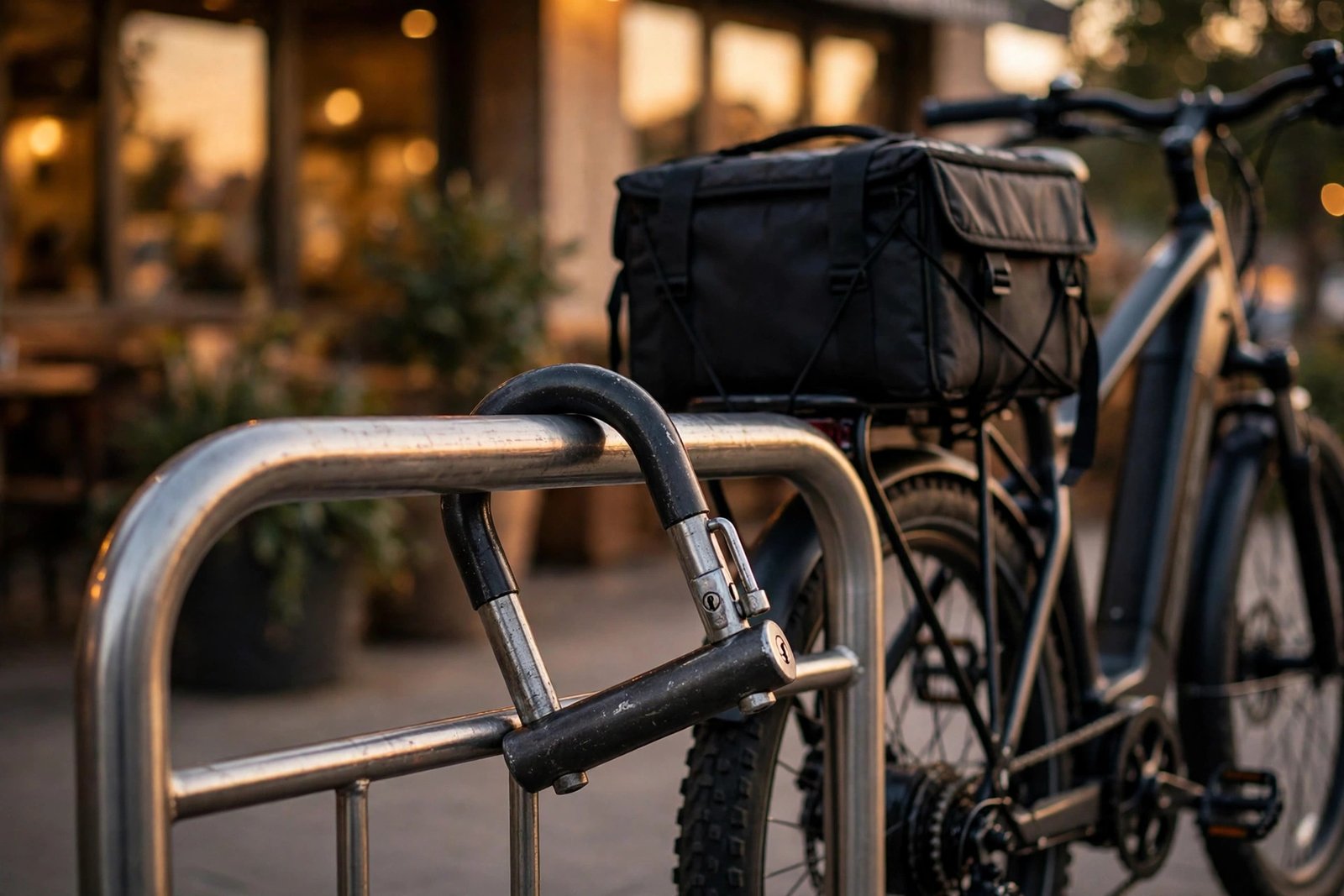
4. The lock routine. You will lock this bike more times in one shift than most people lock theirs in a month. eBikePeak’s phrase is “the forty lock-ups a shift”, and eBicycles.ai puts the same number at 20 to 40 times per shift. A proper U-lock takes 30 to 45 seconds to thread through the frame and a fixed object; a frame lock — the kind you press with your foot — takes about 10 seconds. That difference, times forty, is the difference between a shift that pays and a shift that leaks minutes. The routine that works is two locks: a U-lock through the frame for the longer stops, and a quick cable or frame lock for the thirty-second drop-offs. And the rule that sits above both: never leave the bike unlocked, even for a thirty-second drop-off. That is when it goes.
Forty lock-ups a shift. The lock you will actually use is the one that takes ten seconds, not forty-five.
5. Brakes and tyres that survive the shift. Disc brakes, not rim brakes — a loaded bike in traffic needs them, and every bike in this guide has them. Fat tyres — 26×4-inch or 20×4-inch — smooth out the potholes that would shake a pizza box apart and keep the bike stable with a high, heavy bag. Hydraulic brakes are nicer than mechanical ones for repeated stops, and BoltBikers flags it as the Aipas’s one real weakness: mechanical discs require more hand effort than hydraulic systems, especially during repeated stops with extra cargo. It is a trade-off, not a deal-breaker — but it is the trade-off you feel in your hands by the end of the shift.
The honest earnings maths
Delivery pay is per order, not per hour — and that single fact is why every earnings number you see online disagrees with every other one. The platforms pay a base fee per delivery, plus tips, plus the occasional promotion. Your hourly rate is something you work out afterwards, not something you are promised.
Here is what the tracked data actually says. Gridwise, which tracked more than 100,000 drivers through 2025 and published the results in early 2026, found medians — half of drivers earned more, half earned less, gross before expenses and tax — of $14.07 an hour in trip pay for Uber Eats, $15.03 with tips and promos, at 1.87 deliveries an hour; and $11.26 an hour for DoorDash, $11.63 with tips, at 1.51 deliveries an hour. A separate tracked-driver dataset from Solo, covering the first half of 2026, found the reverse — DoorDash at $15.95 an hour against Uber Eats at $14.16. BoltBikers, citing ZipRecruiter, puts the national average for bike delivery workers at about $18 an hour in August 2026. The honest conclusion is that the two platforms pay broadly similar, modest hourly rates — and that your city, your timing and your strategy move the number more than the platform does. The top end exists too: an October 2026 New York City government report found app-based delivery workers averaging $27.03 an hour including tips, after minimum-pay protections came in. That is New York, not everywhere.
Now the maths that matters — yours. Take the Gridwise Uber Eats median with tips, $15.03 an hour, and a part-time rider doing 15 hours a week. That is about $225 a week gross. The e-bike’s running cost is the thing that makes the maths work: electricity is about 15 cents a charge, and a week’s riding costs a few dollars in power plus a little wear on tyres and brake pads — call it $10 to $15 a week all in. That leaves roughly $210 a week net before tax. At that pace, the Aipas (<aCheck latest price) pays for itself in about four to five weeks; the TST (Check latest price) in about two to three. A car driver doing the same hours spends most of that money on petrol — one earnings tracker puts a car driver’s net at about $11 an hour against an e-bike rider’s $19, on the same gross, because the vehicle’s running cost is the whole difference.
That is the example, with its assumptions stated: 15 hours a week, the Gridwise median, a dense city, dinner and weekend shifts. Your city will differ. Run your own numbers before you buy — our free Cost-to-Own / Savings Calculator works out what a bike costs you per week against a car, and the same logic applies to a delivery shift: the bike is cheap to run, and the running cost is where the profit lives.
One more honest line, because it matters: a second battery is the cheapest range upgrade there is. A spare battery costs less than the jump from a 624Wh bike to an 840Wh one, and it turns a part-time bike into a full-shift bike. Every bike in this guide has a removable battery — charge one at home while you ride on the other, and the shift never ends early.
The four bikes
Every bike below is in our range, and each one is the answer to a different rider. Prices change — the link takes you to the live price.
Aipas M1 Pro — the long shift, 110 Nm
The best overall delivery bike in BoltBikers’ fresh guide — their words, not ours — and the most torque in our range. An 1,800W peak rear-hub motor delivering 110 Nm, a 48V 17.5Ah removable battery (840Wh) — the biggest battery in this guide — 26×4-inch fat tyres, full suspension, a step-through frame, a Shimano 7-speed drivetrain, 180mm mechanical disc brakes and a rear rack in the box. The maker claims up to 85 miles on pedal assist, and BoltBikers repeats the figure — but apply the rule: half of that is your real delivery range, roughly 40–50 loaded miles, which is a long shift. It weighs 88 lb, and the payload rating is about 450–500 lb (sources disagree on the exact figure). The step-through frame is the feature that matters most at forty stops a day — getting on and off without swinging a leg over a loaded rack.
Check latest price · 110 Nm · 1,800W peak · 48V 17.5Ah · 26×4″ fat tyres · full suspension · step-through · rear rack
We have not tested this bike ourselves. The 85-mile range is the maker’s claim, for pedal assist on flat ground — your loaded delivery shift will be roughly half that. The mechanical brakes need more hand effort than hydraulic ones on repeated stops.
Heybike Mars 3.0 — the small flat, 95 Nm
BoltBikers’ best folding e-bike for delivery, and the only bike here that folds into a hallway. A 750W rear-hub motor (1,400W peak) delivering 95 Nm, a 624Wh removable battery, 20×4-inch fat tyres, full suspension, a torque sensor that matches the assist to how hard you pedal, dual disc brakes, and a rear rack and fenders included. The maker claims up to 65 miles of range — real delivery range is roughly 30–40 loaded miles, which is a part-time shift, not a full day. It folds, so it fits a flat in a way the others do not — and the battery comes out with a key, so the whole bike never has to go near a socket. It weighs 70 lb, and the payload is 440 lb.
No price quoted here — we have no verified price for the Mars 3.0 in our sheets, so the price is on the listing, not in this article.
We have not tested this bike ourselves. The 65-mile range is the maker’s claim — your loaded delivery shift will be roughly half that. BoltBikers’ own warning: at 70 lb it is still heavy to lift even when folded, and full-time riders may need to plan charging breaks.
TST — the long zone
The range pick, and the cheapest way into a big battery. A 48V battery (720Wh on the 15Ah version), 26×4-inch fat tyres, dual suspension, a Shimano 7-speed drivetrain and a rear rack. The maker claims up to 60 miles — real delivery range is roughly 30 loaded miles on the 15Ah battery, and more on the 25Ah one, if that is the version you buy. Which brings us to the honest flag: the listing sells two battery versions, 15Ah and 25Ah, at different prices, and the motor figures vary across the listing too — 750W rated, 1,500W peak in one place, 2,000W peak in another. The price below is the one in our sheets, and it may be the 15Ah version only. Check which battery you are buying before you pay — the 25Ah version is a different bike for delivery purposes, and a better one.
Check latest price · 48V 15/25Ah · 720Wh (15Ah) · up to 60 mi claimed · rear rack
We have not tested this bike ourselves. The 60-mile range is the maker’s claim — your loaded delivery shift will be roughly half that, on the 15Ah battery.
isinwheel M10 Plus — the tight budget
The cheapest way into the range, and the lightest bike here — but read the whole box before you buy it, because this one has a catch. A 500W motor (1,000W peak per the listing — the maker’s own manual says 900W peak, and we flag the difference), a 48V 13Ah removable battery (624Wh), 26×4-inch fat tyres, dual suspension, a 7-speed drivetrain and mechanical disc brakes. The maker claims up to 75 miles; the manual’s own range is 45–65 miles, and the delivery rule halves that again — think 25–35 loaded miles, which is a short block, not a shift. It weighs 72.8 lb and carries 330 lb. The catch: there is no rear rack in the box. The rack is an optional add-on, which means the bag goes on your back until you buy one — and for a delivery bike, that is the difference between a work tool and a compromise. Buy the rack with the bike, or buy a different bike.
Check latest price · 1,000W peak · 624Wh · 26×4″ fat tyres · 7-speed · 28 mph · 72.8 lb
We have not tested this bike ourselves. No rear rack is included — budget for one, or the bag rides on your back.
Where it lives: the hallway test
Buy the bike, then live with it for a week — in your flat, not in a review. The test is simple, and it takes five minutes on the first night.
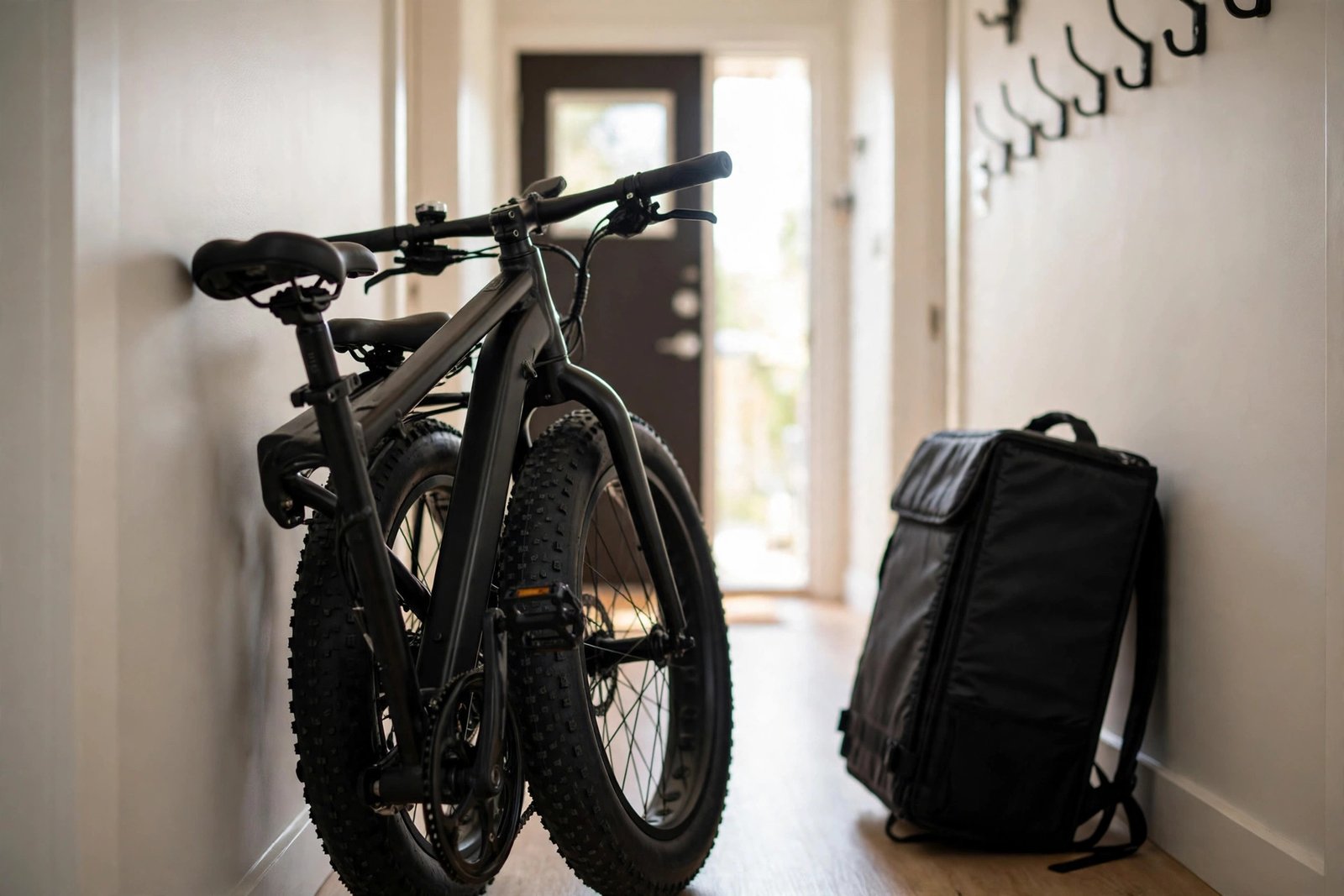
Fold it, or stand it against the wall. The Mars 3.0 folds; the others stand. Either way, it has to fit without blocking the door, the kitchen, or your flatmate. If it does not fit, it will live on the street — and a bike that lives on the street gets stolen, not ridden.
Take the battery out and charge it where you sleep. Every bike in this guide has a removable battery, and that is the feature that makes apartment delivery work at all: the battery charges from a normal socket, indoors, at room temperature, while the bike stays by the door. Never charge a freezing-cold battery — bring it inside and let it warm up first. Our charging-safety article covers the rules in full.
Keep the bag by the door, not on the bike. The delivery bag lives next to the bike, ready to strap on. The lock lives on the bike, not in a drawer — a lock in a drawer is a lock you will not use forty times a day.
A delivery bike lives in your hallway, not a garage. If it does not fold, it owns the room.
The honest close: which bike for which rider
Here is the whole article in one paragraph. If you ride two or three evening blocks a week and you live upstairs, buy the Mars 3.0 — it folds into your hallway, its battery comes out to charge, and its 30–40 loaded miles cover a part-time shift. If you ride long shifts, five days a week, buy the Aipas M1 Pro — the biggest battery, the most torque, the step-through frame, and the only bike here that does not need a charging break. If your zone is wide and your orders are far apart, buy the TST — but check which battery version you are buying, because the 25Ah one is a different bike from the 15Ah one. And if your budget is under $700, buy the isinwheel M10 Plus — and buy the rear rack with it, on the same order, because a delivery bike without a rack is a backpack with wheels.
That is the budget truth. The fastest bike does not win this job. The bike that survives the shift, folds into the flat, locks in ten seconds and pays for itself in a month does — and that bike is not the most expensive one here. It is the one that fits your hallway.
Frequently asked questions
Can I do DoorDash or Uber Eats on an e-bike?
Yes. DoorDash allows bikes and e-bikes in many markets, and Uber Eats allows bicycle couriers in most cities. Both pay per delivery, not per hour, and you keep 100% of your tips on both.
How many miles is a delivery shift, really?
A part-time block is 20–30 loaded miles; a full shift is 40–80 km (25–50 miles), per eBicycles.ai. The box claim is not the shift: real delivery range is about half the claimed figure, so a bike that claims 85 miles gives you roughly 40–50 loaded miles.
How much can I earn on an e-bike?
Tracked data puts the median at roughly $14–$16 an hour with tips — Gridwise found Uber Eats at $15.03 and DoorDash at $11.63 an hour with tips and promos in 2025, and Solo found DoorDash at $15.95 against Uber Eats at $14.16 in the first half of 2026. The e-bike’s advantage is not the gross — it is the running cost: about 15 cents a charge, against a car driver’s petrol.
What if the battery dies mid-shift?
It should not, if you matched the battery to the shift — 624Wh is a part-time shift, 840Wh is a long one. If it does, a spare battery is the cheapest fix: every bike in this guide has a removable battery, so charge one at home while you ride on the other.
Do I need a rear rack, or can I carry the bag on my back?
You need the rack. A loaded bag on your back for four hours shakes the food, soaks your jacket, and wears you out — and the food arrives sideways. Three bikes in this guide come with a rack in the box; the isinwheel M10 Plus does not, and you must buy one with it.
Can I really do delivery on a folding e-bike?
Yes — BoltBikers names the Heybike Mars 3.0 its best folding e-bike for delivery, precisely because it folds into a flat. The fold saves space, not weight: at 70 lb it is still heavy to lift, so the battery comes out and the carry is two trips.
Browse by category: Folding E-Bikes · Commuter E-Bikes · Electric Scooters · E-Bike Accessories
As an Amazon Associate, BoltWander earns from qualifying purchases.
Keep reading
Related articles:
- What Does an E-Bike Really Cost to Own? The First-Year Costs Nobody Mentions — the full cost maths this article’s earnings section sits inside
- How Far Can an E-Bike or Scooter Go on One Charge? Real-World Range vs the Box Claim — the 60–70 percent rule, and how to work out your real range
- Best E-Bikes Under $1,000 in 2026: Commuters, Folders and Fat-Tire Picks That Are Worth It — the wider budget roundup these four bikes come from
Previous: How to Fix a Flat Tire on Your E-Bike or Scooter (the Commuter’s Roadside Guide)
Next: My E-Bike Was Stolen — What to Do in the First 30 Minutes (and How to Get It Back)
